Best Radio-Linked Smoke Alarms for Home Safety
Radio-linked, or wireless interconnect, smoke alarms provide synchronized alerts across multiple units. This article highlights top options that are easy to install and maintain, helping buyers choose the right setup for apartments, single-family homes, or larger residences. The selections emphasize reliable interconnection, long-lasting power, and clear alert signals. The top picks are best for homeowners who want simple wireless networks that cover every room and minimize nuisance alarms.
Summary of chosen products:
- Heiman Smoke Detector — Wireless interconnection, UL 217 10th Ed certified, compact design.
- SITERWELL GS525A — 10-year sealed battery, photoelectric, easy maintenance.
- X-Sense SC06-W — 6-pack, wireless interconnection, 10-year battery, combines smoke and CO detection.
- First Alert Interconnect Hardwire — Hardwired interconnect with battery backup and voice alerts.
- SITERWELL GS562A — Hardwired interconnected with 9V backup, strong coverage, multiple units.
Heiman Wireless Interconnected Smoke Alarm

Best for: Homes wanting flexible, full-home wireless coverage with a modern design. This unit uses a dual-photoelectric sensor and interconnects up to 656 feet, enabling rapid alerts to every room when one unit triggers. It carries UL 217 10th Ed. certification and has a Red Dot award for its design, signaling trusted safety plus a contemporary look.
Why chosen: The combination of wide-range wireless interconnection, high-safety certification, and dual-beam detection provides precise fire detection while reducing false alarms from cooking or steam. The compact form is suitable for hallways or bedrooms where space matters.
Limitations: Battery-powered operation means ongoing battery maintenance is required, and performance depends on line-of-sight between units.
SITERWELL GS525A 10-Year Smoke Detector
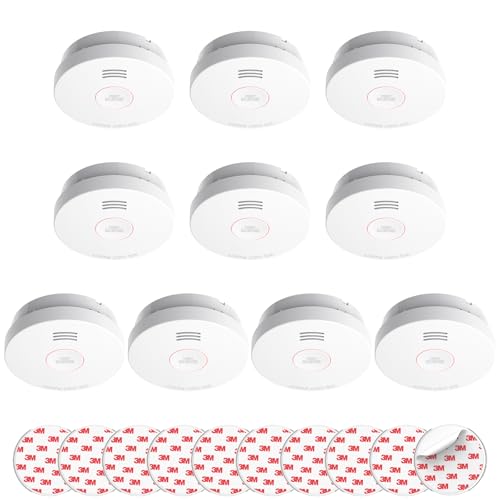
Best for: Homeowners who want long-term reliability with minimal maintenance. The 10-year sealed lithium battery eliminates regular battery changes while providing dependable protection for a decade.
Why chosen: The included test-silence feature and LED indicators aid quick verification of status, and the device uses a photoelectric sensor for better performance against smoldering fires. It pairs well in a cluster of similarly powered detectors for a cohesive system.
Limitations: It is primarily a standalone unit; ensure your overall network supports interconnection if you want full-house syncing.
X-Sense SC06-W Wireless Interconnected Alarm

Best for: Larger homes or rooms that require flexible wireless interconnection without Wi-Fi dependency. The SC06-W offers a 10-year sealed battery and UL 217 and UL 2034 certifications for smoke and CO protection in one device.
Why chosen: Its wireless interconnection behavior ensures all alarms sound when one is triggered, and the 10-year battery reduces ongoing maintenance. It’s a practical option for homeowners seeking combined fire and CO detection in a single unit.
Limitations: It does not rely on Wi-Fi, which can limit smart-home integration; verify compatibility if you want mobile app features.
First Alert Interconnect Hardwire Smoke Alarm

Best for: Homes with existing wiring or those planning a hardwired network for high reliability. The 3-pack provides a scalable option for multi-story residences.
Why chosen: First Alert BRK Precision Detection technology aims to minimize nuisance alarms while delivering early warning. Voice and location alerts help identify the specific area of danger, and the latching indicator assists quick status checks.
Limitations: Being a hardwired system, it requires electrical wiring and may involve professional installation in some layouts.
First Alert SMI100 Battery-Operated Smoke Alarm

Best for: Renters or DIY installers seeking a straightforward, battery-powered alarm with simple maintenance. The unit fits easily in various rooms without hardwiring.
Why chosen: Precision Detection helps reduce false alarms, while the front-access battery compartment makes replacements quick and easy. It provides reliable protection without requiring wiring or a service call.
Limitations: Limited by battery life and non-interconnected operation unless paired with other compatible wireless units.
First Alert SMI100-AC Hardwire Alarm

Best for: Homes seeking dependable interconnectivity with battery backup during power outages. Useful in multi-story layouts where a hardwired backbone is desired.
Why chosen: This model combines hardwire interconnect with a battery backup, ensuring continued protection during outages. Early-warning interconnects help ensure all alarms respond together.
Limitations: Requires electrical wiring; installation may be more involved than battery-only models.
Buying Guide
What kind of interconnection do you need?
Choose wireless interconnection for easy, tool-free installation across rooms. If your home already has hardwired detectors, a compatible hardwired interconnect can offer robust, continuous protection with battery backup.
Battery life and maintenance concerns
Look for 10-year sealed batteries when possible to minimize replacements. Battery-powered units are easier to install but require periodic checks to ensure they remain functional.
What sensors matter most?
Photoelectric sensors excel with smoldering fires and cooking nuisances, while ionization sensors respond quickly to flaming fires. Many alarms combine both or specialize in one method. Dual-sensor models often offer the best balance.
Alarm features to prioritize
- Test and Silence controls for quick status checks
- Voice or location alerts to identify the triggering unit
- LED indicators to show power and fault status
- Interconnection range and the ability to connect multiple devices
Installation considerations
Plan detector placement to cover bedrooms, living spaces, and kitchens, avoiding alignment near vents or fans that can affect performance. For hardwired setups, consider professional installation if necessary.
Compliance and safety standards
Verify UL 217 certification for smoke alarms and UL 2034 for CO detectors when applicable. Interconnection should be compatible with existing devices to ensure synchronized alerts.
FAQ
- What does wireless interconnection mean? It allows multiple alarms to sound together when one detects smoke, without running wires between units.
- How long do the batteries last? 10-year sealed batteries provide long-term protection; other model batteries vary by usage and manufacturer.
- Can these work with existing hardwired systems? Some models are designed for hardwired interconnection; others are standalone wireless units. Check compatibility before mixing technologies.
- Is a CO detector included in these options? Some models combine smoke and CO detection; others focus solely on smoke. Review features to confirm.
- Do I need professional installation? For hardwired systems or complex interconnect layouts, professional installation is recommended. Wireless installs are typically DIY-friendly.
- What is a good coverage strategy for a two-story home? Place detectors on every level, near bedrooms, and in common areas to ensure rapid alerts across the house.