Best Low Voltage Solar Panels for Small Projects and DIY
Low voltage solar panels are ideal for hobbyists, educators, and DIY enthusiasts seeking affordable, easy-to-use power sources for small devices, models, lights, and off-grid experiments. This guide features five practical options that suit beginners and tinkerers. Each product is assessed for who it’s best for, why it stands out, and a straightforward limitation to consider.
Summary of Selected Products:
| Product | Best For | Key Benefit | Potential Limitation |
|---|---|---|---|
| KEJNYT 5 Pcs Small Solar Panels | DIY hobbyists needing multiple compact panels | High efficiency for small area (up to 21% under ideal conditions) | Low wattage per panel |
| KEJNYT 10 Pcs Small Solar Panels | Portable projects and multiple-series/parallel builds | More total current and flexibility with many panels | Low individual wattage |
| Sunnytech 0.5w Mini Solar Panel | Educational kits and model projects | Built-in blocking diode for simple protection | Very small output |
| SOLPERK 20W Solar Panel Kit | 12V battery charging for vehicles and boats | Higher voltage and integrated charge controller options | More complex setup |
| gulisot 6W Solar Panel | Outdoor security or camera setups | 6W capacity with 360° adjustability | Basic panel without full controller included |
KEJNYT 5 Pcs Small Solar Panels, 1W Each

Product overview: Five small panels rated at 1W each, delivering 5V and about 200mA per unit. It uses polysilicon epoxy cells with a claimed efficiency of 18–21%. Panels are designed for easy clamping with wire clips, enabling parallel or series configurations without soldering.
- Best for: Hobby projects and small line-powered DIY devices where compact size and ease of wiring matter.
- Why selected: High conversion efficiency within a small footprint; flexible wiring options support simple experimentation.
- Limitation: Total output is limited to about 5W when all panels are used together, so larger loads require more panels.
KEJNYT 10 Pcs Small Solar Panels, 0.45W Each

Product overview: Ten compact panels offering 0.45W each at ~3V and 150mA, with epoxy polysilicon cells and a -40°C to +85°C operating range. Includes wire clips for quick, solder-free connections either in parallel or series.
- Best for: Projects that need more modular panels and flexible configuration than a single panel can provide.
- Why selected: Higher panel count increases total potential current for small devices; convenient for classroom or workshop demos.
- Limitation: Each panel has modest voltage, so achieving higher voltages requires multiple units in series.
Sunnytech 0.5W Mini Solar Panel Module

Product overview: A 0.5W panel designed for educational and model-building use. It features an integrated blocking diode for protection against reverse current and comes with color-coded wires and alligator clips for easy assembly.
- Best for: Teaching kits, model builders, and experiments where simple, safe operation is key.
- Why selected: Built-in protection and easy wiring enhance reliability in beginner projects.
- Limitation: Lower power output limits its use to small devices or demonstration projects.
SOLPERK Solar Panel Kit 20W (12V)
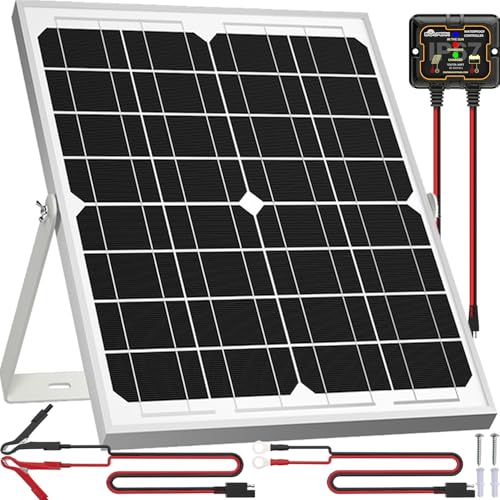
Product overview: A 20W panel designed for 12V charging with a smart MPPT controller option. It uses monocrystalline cells with a robust frame and is rated for outdoor, all-weather operation. The controller offers three-stage charging to prevent overcharging and improve efficiency.
- Best for: Off-grid charging of 12V batteries for boats, caravans, or small RV setups.
- Why selected: Higher wattage and a stage-based controller can optimize battery health and power delivery in outdoor conditions.
- Limitation: More complex setup and larger footprint than tiny 5W–6W panels; best used with a dedicated battery system.
gulisot 6W Solar Panel with 360° Mount

Product overview: A 6W solar panel designed for outdoor use with IP66 waterproofing and a 360° adjustable mount. It is suitable for security devices or compact off-grid applications requiring flexible positioning.
- Best for: Outdoor camera setups and small, weather-exposed installations needing adjustable sun exposure.
- Why selected: The adjustable mount helps maximize sun intake, improving daily energy capture in variable conditions.
- Limitation: May require a separate controller or battery setup for certain devices; not all cameras are compatible with direct USB charging.
Buying Guide
What is “low voltage” in solar panels?
Low voltage typically means panels that deliver 5V to 12V outputs or are composed of small cells ideal for USB-powered devices or handheld projects. These panels are safer to handle and simpler to wire for beginners.
How do I choose the right panel for a project?
- Power needs: Estimate the device’s wattage and runtime. Choose a panel with higher total wattage if you need longer operation between charges.
- Voltage requirements: Ensure the panel’s voltage matches or can be configured to your device or battery bank (e.g., 5V USB devices vs. 12V battery charging).
- Wiring and configuration: Panels that allow parallel or series connections offer flexibility for adjusting voltage and current.
- Durability and weather resistance: For outdoor use, look for IP ratings, tempered glass, and robust frames.
- Ease of use: Panels with built-in diodes or simple clip connections reduce setup complexity for beginners.
What accessories should I consider?
- Blocking diodes or protection diodes to prevent backflow at night
- Charge controllers for 12V or higher systems to regulate charging
- Battery compatibility (Li-ion, AGM, SLA) and necessary adapters
- Mounting hardware and weatherproof enclosures for outdoor deployments
Installation tips for best results
- Position panels toward direct sunlight during peak hours for maximum output.
- Avoid shading from trees or structures that can dramatically reduce performance.
- Apply proper cable management to prevent wear and accidental disconnections.
FAQs
- Can I run a small device directly from a solar panel?
- Do I need a battery with these panels?
- Is harder-to-find voltage a problem with dual-panel setups?
- Are these panels waterproof?
- What is the typical lifespan of a small solar panel?
Yes, for small devices with compatible voltage and current, but consider a regulator or diode for protection and stability.
Not always, but a battery stabilizes output for intermittent loads and helps store energy for cloudy periods.
Dual-panel setups can increase either voltage or current when configured in series or parallel, respectively. Plan wiring to meet device needs.
Many panels are designed for outdoor use with weather resistance; always verify IP ratings and mounting suitability for your climate.
Most panels are designed for many years of service, with performance measured by ongoing efficiency and environmental exposure.