Best Solar Panel Battery Regulator: Top PWM Controllers for 12v/24v Systems
Choosing a reliable solar panel battery regulator is essential for protecting batteries and maximizing energy harvest. This guide highlights five well-regarded PWM solar charge controllers designed for 12V and 24V systems, with features ranging from IP-rated waterproofing to intelligent LCD displays. Each product below is evaluated for compatibility with common battery chemistries and for practical use in RVs, boats, and off-grid setups.
Summary of selected products
- SOLPERK 8A 12V Solar Charge Controller with LED Display
- [Upgraded] 30A Solar Charge Controller by Depvko
- Renogy Wanderer Li 30A 12V PWM Charge Controller
- Sunapex Solar Charger Controller 12V 10A
- Anern 30A PWM Solar Charge Controller with LCD Display
Product comparisons at a glance
- Regulator types: All PWM controllers, with multiple protection features and LCD/LED status indicators.
- Voltage compatibility: Primarily 12V and 24V systems; suitable for lead-acid variants and some lithium-compatible models depending on design.
- Key protections: Overcurrent, short circuit, reverse polarity, overcharge, and reverse current protection are common across models.
- Display: Several models include clear LCD displays or LED indicators for charging state and parameter adjustments.
SOLPERK 8A 12V PWM Controller

The SOLPERK model is a compact, waterproof PWM solar charge controller designed for outdoor use in RVs, boats, and cars. It showcases a durable IP67-rated housing and a simple LED display that communicates charging status. Safety features protect against reverse current, overheating, short circuits, overcharging, and voltage spikes. This controller emphasizes reliability in harsh weather while supporting a range of battery chemistries common in portable energy setups. A practical option for users seeking straightforward operation with robust weather sealing.
[Upgraded] 30A Solar Charge Controller (Depvko)
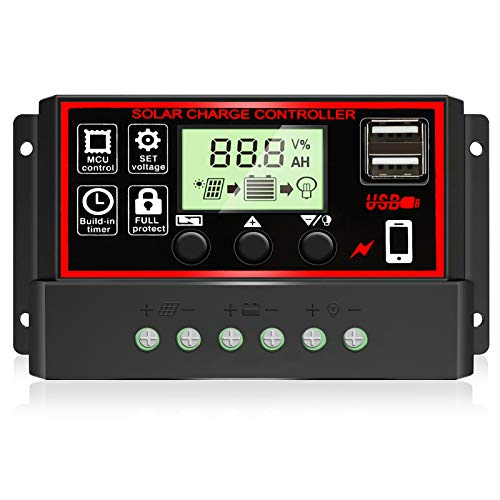
This upgraded 30A controller is tailored for 12V and 24V systems with automatic parameter memory and dual USB outputs for charging mobile devices. It includes multiple protections (overcurrent, short circuit, inverse connection, low voltage, and overcharge) and offers a three-stage PWM charging profile to optimize efficiency. Note that it is designed for lead-acid chemistries (Open, AGM, GEL) and is not compatible with lithium batteries. Its design aims to maximize safety and system longevity in general-purpose installations.
Renogy Wanderer Li 30A PWM Controller

Renogy’s Wanderer Li is a 30A PWM controller designed to optimize charging for lithium, AGM, GEL, and flooded batteries. It features a four-stage charging scheme (Bulk, Boost, Float, Equalization) and a three-stage protection suite that guards against reverse polarity, overcharging, overload, and short circuits. The device includes an IP32-rated waterproof casing and a compact form factor suited for tight RV or marine spaces. This model is especially suitable for users prioritizing compatibility with modern lithium and sealed lead-acid options.
30A PWM Solar Charge Controller (Rolokit)

The Rolokit 30A controller provides a robust PWM solution with automatic parameter adaptation for 12V/24V systems. It offers a clear LCD display for monitoring and configuration, along with protections that help prevent battery damage due to over-discharge, short circuits, and reverse connections. It’s designed for versatile use in home, industrial, and commercial contexts and supports dual USB charging for devices alongside solar regulation. The device is positioned as a reliable mid-range option for multi-utility installations.
JahyShow 100A PWM Controller

The JahyShow model offers a higher-capacity PWM solution with a 100A rating, suitable for larger 12V or 24V systems and multi-battery configurations. It includes a large LCD screen to display status and programmable parameters, along with comprehensive protective features aimed at preventing over-discharge, overcurrent, and short circuits. This controller is intended for users who manage more substantial solar arrays or those who require more robust load management along with USB outputs. It complements systems that demand higher current handling without switching to MPPT technology.
Buying Guide: key considerations for choosing a solar panel regulator
- System voltage and battery type compatibility: Confirm whether the regulator supports 12V or 24V systems and whether it is suitable for lead-acid variants, AGM, GEL, flooded, or LiFePO4 batteries. Some models offer broader compatibility, while others target specific chemistries.
- Current rating and expansion needs: Choose a regulator with a current rating that matches or exceeds your solar array’s current output. If you anticipate expansion, plan for a higher-capacity unit to avoid replacing the controller later.
- Protection features: Look for overload protection, short-circuit protection, reverse polarity protection, reverse current prevention, and low-voltage cut-off. These protections help extend battery life and prevent equipment damage.
- Display and configurability: An LCD or LED status display makes it easier to monitor charging stages, battery voltage, and regulator settings. Consider whether you need auto-recognition of battery type and adjustable parameters like float and low-voltage thresholds.
- Waterproofing and durability: For outdoor installations, IP-rated housings (IP67 or IP32) and rugged construction matter. Waterproof controllers perform better in rain, snow, and dusty environments.
- USB and auxiliary outputs: Some regulators include USB ports for charging devices directly from the solar system. Evaluate the wattage and port count based on your device needs.
- Size and installation constraints: If space is limited, compact controllers with a slim profile and simple mounting options can be decisive in RVs, boats, or compact sheds.
- Warranty and support: Check the manufacturer’s warranty length and the availability of customer support or replacement programs in case of hardware issues.
When selecting a solar panel regulator, balance your current needs with potential future upgrades. PWM controllers are generally cost-effective and reliable for lead-acid and some lithium systems, but MPPT models may offer higher efficiency in hot, sunny conditions or with higher voltage arrays. Consider your battery chemistry, required protections, and how the regulator’s features align with your off-grid or mobile energy goals.