Best Sealed Battery Smoke Detectors for Reliable Fire Safety
Answering the need for maintenance-free home safety, sealed-battery smoke detectors provide long-lasting protection without regular battery changes. This guide highlights five top models suited for different home setups—from compact apartments to multi-room houses—so buyers can choose based on detection technology, size, and additional features. The top picks emphasize early warning, low maintenance, and clear alerts for bedrooms, kitchens, and living areas. Read on to compare options and find the best fit for your space and risk profile.
| Product | Key Benefit | Best For |
|---|---|---|
| First Alert SMI110 | 10-year sealed battery, precision detection | Homes needing minimal maintenance |
| First Alert SM210 | Slim profile, 10-year sealed battery | Compact spaces |
| First Alert SMCO210 | Smoke + CO, sealed battery | Homes needing dual protection |
| SITERWELL GS525A (10 Pack) | 10-year battery, photoelectric sensor | Multiple-room coverage |
| Kidde 20SD10 (3 Pack) | Fast smoke detection, 85 dB alarm | New installs or replacements in bulk |
First Alert SMI110: 10-Year Sealed Battery Detector

Best for: small to medium homes needing low maintenance and early warning efficiency. The SMI110 uses First Alert’s Precision Detection to reduce nuisance alarms from cooking while ensuring early warnings for home fires. Its 10-year sealed battery eliminates replacements and low-battery chirps for the life of the alarm. An end-of-life warning signals when replacement is due.
Why selected: It combines reliable detection with maintenance-free operation, suitable for bedrooms, living rooms, and kitchens where false alarms can be disruptive. Caution: performance depends on proper placement and regular testing per manufacturer guidelines.
First Alert SM210: Slim, Sealed Battery Smoke Alarm

Best for: spaces with limited depth or tight ceilings. The SM210 keeps a slim profile—half the depth of a standard alarm—while still delivering a 10-year sealed battery and precision detection to minimize cooking nuisance alarms. This model is ideal for hallways, kitchens, and bedrooms where space is at a premium.
Why selected: Its compact design reduces bulk on ceilings without sacrificing reliability. Limitation: as a single-use unit, it does not combine CO detection.
First Alert SMCO210: Smoke + CO 10-Year Alarm

Best for: homes seeking dual protection in one device. The SMCO210 provides 2-in-1 fire and carbon monoxide detection with a sealed 10-year battery. It uses precision sensing to reduce false alarms and delivers reliable, continuous protection for bedrooms and living areas where CO risk is a concern.
Why selected: Combines two critical safety functions in a compact unit, simplifying installation. Caution: some homes may require additional CO alarms in other zones for comprehensive coverage.
SITERWELL GS525A 10-Year Battery (10 Pack)
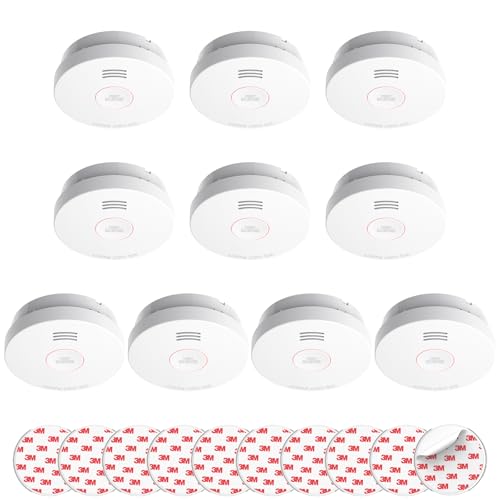
Best for: large homes or buildings with multiple rooms requiring uniform coverage. The GS525A 10-year battery model uses a photoelectric sensor to respond quickly to slow, smoldering fires, reducing nuisance alarms in kitchens and bathrooms. It includes LED indicators and a low-maintenance design for long-term use.
Why selected: Economical choice for multi-room installations in larger residences or rental properties. Limitation: 10-pack units may require coordinated placement to optimize coverage across floors.
Kidde 20SD10: 10-Year Battery Powered

Best for: bulk replacements or new installations in homes requiring a robust, fast-smoke warning system. The 20SD10 detects smoke over 25% faster and emits an 85 dB alarm with a red LED for clear visual alerts. It uses a 10-year sealed battery to minimize maintenance and reduce total ownership costs.
Why selected: Strong balance of fast detection and long-lasting power. Caution: this model emphasizes smoke detection; if CO monitoring is a priority, consider a combination detector.
Buying Guide: Key Purchase Considerations
- Battery life: Sealed 10-year batteries reduce maintenance but ensure the model matches your home size and ceiling placement.
- Detection technology: Photoelectric sensors excel at slow smoldering fires; ionization sensors respond faster to flaming fires. Some models combine both or include CO detection.
- Placement and coverage: Plan for detectors in bedrooms, hallways, kitchens, and living areas. Large homes may need multiple units to ensure full coverage.
- Safety certifications: Look for UL217 or UL2034 listings and compliance with local fire safety codes.
- Maintenance: Even sealed-battery alarms require periodic testing and prompt replacement at end of life.
Frequently Asked Questions
- Do sealed-battery smoke detectors require replacement after 10 years? Yes, typically they are designed to last 10 years and should be replaced at the end of life warning or upon expiration.
- What is the difference between photoelectric and ionization sensors? Photoelectric sensors detect slow, smoldering fires with less false alarms from cooking. Ionization sensors react quickly to fast, flaming fires but can be more prone to nuisance alarms from cooking.
- Can I mix different brands of sealed-battery detectors in the same home? Yes, but ensure consistent coverage and follow installation guidelines for optimal performance.
- Is dual (smoke and CO) detection worth it? For homes with sleeping areas near potential CO sources, a 2-in-1 detector provides convenient coverage and alerts for both hazards.
- How many detectors should I install in a multi-story home? A good rule is one detector per sleeping area plus additional units in common areas and near kitchens, ensuring complete coverage.
- What maintenance steps are required after installation? Regularly test alarms monthly, replace batteries if applicable, and follow manufacturer end-of-life recommendations.