Best ESD Safe Storage Cabinets for Electronics and MSD Components
Answer: For protecting moisture-sensitive and electrostatically sensitive components, choose heavy-duty, ESD-safe storage cabinets with low-humidity control and solid grounding. This guide highlights five top options ideal for electronics manufacturing, PCB assemblies, and SMT/MSD inventory. Best for high-value components, best for compact spaces, and best for flexible expansion. Each product includes who it’s best for, why it’s selected, and a practical caution to consider before buying.
| Product | Best For | Key Benefit |
|---|---|---|
| TUFFSAFE 870L / 30.72 Cu.Ft. Dry Cabinet | Mid-to-large inventory, electronics manufacturing | Ultra-low humidity and full ESD protection |
| TUFFSAFE 1436L / 50.71 Cu.Ft. Dry Cabinet | Large-scale storage, extensive MSDs | JEDEC-compliant, scalable humidity control |
| MechMaxx EDC320C | Modular labs, expanding setups | Flexible, replaceable modules and 1-10% RH |
| BLUEIAN 24″ x 19″ x 19″ Flammable Cabinet with ESD Grounding Cable | Hazardous materials with static protection | ESD grounding and robust fire-safe features |
| BLUEIAN 24″ Flammable Cabinet (ESD Grounding Cable) | Compact, safe storage with grounding | Stable, corrosion-resistant construct |
870L / 30.72 Cu.Ft. Dry Cabinet — ESD Safe and Low Humidity

Best for: Medium-to-large SMT/MSD reels and moisture-sensitive components. The cabinet combines ultra-low humidity control (1-10% RH) with comprehensive ESD safeguards, including a dissipative steel body, anti-static casters, and a 1MΩ ground wire. The high-accuracy sensor (+/-3% RH) ensures precise environmental control, supporting reliable floor life reset for moisture-sensitive devices.
Why selected: It targets both moisture control and electrostatic protection in one unit, aligning with IPC/JEDEC J-STD-033C standards. It offers a robust desiccant-based humidity system paired with IEC 61340-5-1 compliant ESD design for process integrity.
Caution: Large footprint means installation space must be measured; ensure power and grounding provisions meet the cabinet’s requirements.
1436L / 50.71 Cu.Ft. Industrial Dry Cabinet
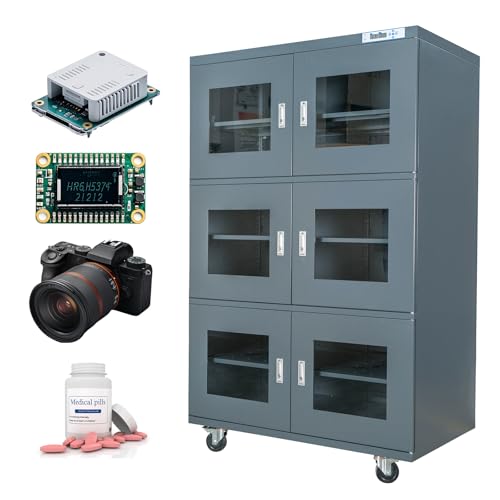
Best for: Large inventories of SMT/MSD components requiring precise humidity control. This unit is JEDEC-compliant with a high-accuracy sensor and intelligent digital controller to maintain exact RH settings, supporting high yields in 24/7 operations.
Why selected: The larger capacity complements continuous production environments needing strict environmental control without frequent human intervention.
Caution: Higher energy use is possible with continuous operation; plan for energy management and maintenance access.
MechMaxx EDC320C — 320L ESD Desiccator Cabinet

Best for: Laboratories and modular workflows needing customizable storage. The cabinet emphasizes modularity with replaceable dehumidifiers, shelves, controller, and power units, plus 1-10% RH control for moisture-sensitive components like semiconductors and optical lenses.
Why selected: It’s designed to scale with growing storage needs, allowing future-proofing as part of a broader ESD and humidity-management strategy.
Caution: Modular upgrades may require planning to ensure sensor calibration remains consistent after changes.
BLUEIAN 24″ Flammable Cabinet With ESD Grounding Cable

Best for: Small- to mid-sized facilities needing fire-safe storage with static grounding. The cabinet features a robust double-walled door design and an integrated ESD grounding conductor to reduce static risks during material handling.
Why selected: Combines fire-resistance with ESD grounding, making it suitable for mixed storage scenarios where both chemicals and electronics are present.
Caution: While compact, verify clearance for any doors or vents during operation to avoid obstruction.
BLUEIAN 24″ x 19″ x 19″ Flammable Cabinet With ESD Grounding Cable

Best for: Compact facilities needing a balance of fire protection and ESD grounding. The cabinet’s adjustable shelves allow flexible arrangement for varied hazard materials while maintaining static safety.
Why selected: The slide-friendly adjustment and corrosion-resistant construction support long-term reliability in hazardous material storage with ESD considerations.
Caution: Ensure the grounding path remains connected and inspect shelves for sag if storing heavy items.
Buying Guide: Key Considerations For Esd Safe Storage Cabinets
- Humidity Control: Look for 1-10% RH capability and reliable sensors. This minimizes moisture-induced damage to moisture-sensitive devices.
- ESD Protection: Confirm IEC 61340-5-1 compliance, dissipative materials, and a grounded conductor or grounding wire to prevent ESD events.
- Capacity vs. Footprint: Match cabinet size to your inventory scale. Large capacities help consolidate stock, while compact units save space.
- Construction Quality: Prefer powder-coated steel or galvanized steel with a robust frame, anti-static casters, and secure doors to prevent moisture ingress and tampering.
- Modularity: Consider cabinets that support interchangeable modules, shelves, or add-ons for future expansion.
- Safety Features: For mixed storage (flammable and electronics), ensure separate compartments or certified fireproof design and proper grounding.
- Power and Monitoring: Ensure compatibility with any required power sources, alarms, and sensor calibration routines for continuous operation.
Frequently Asked Questions
- What does ESD safe storage cabinet mean?
- Why is humidity control important for MSDs?
- What is JEDEC J-STD-033C compliance?
- Can I store flammable materials with electronics in the same cabinet?
- Do these cabinets require special maintenance?
It refers to a cabinet designed with materials and hardware that prevent electrostatic discharge from damaging sensitive electronic components, often featuring grounded conductors and dissipative surfaces.
Most moisture-sensitive devices degrade with moisture exposure; low RH helps maintain device integrity and extends shelf life.
It’s a standard that governs moisture/reflow sensitivity of silicon devices, guiding environmental controls for moisture-sensitive components.
Only if the cabinet is designed for both hazards, with fireproof features and proper grounding; otherwise use separate, compliant storage.
Yes, regular humidity sensor checks, grounding verification, and door seals inspection help maintain performance.