Best Laser Cutting Fume Extractors for Clean Air and Safe Workspaces
For buyers seeking reliable odor and particle control in laser cutting and engraving, a dedicated laser fume extractor is essential. These units capture smoke, dust, and fumes at the source, protecting eyes, lungs, and the surrounding workspace. This guide highlights five strong options, clarifying who each model is best suited for, and why you might choose one over another.
Overview at a glance: the table below compares core specs that matter for laser and soldering tasks, such as airflow (m³/h), filtration stages, and typical use cases. Use this to quickly identify which model aligns with your equipment and space.
| Product | Airflow | Filtration | Best For | Notes |
|---|---|---|---|---|
| FumeClear FC-2004 | Up to 420 m³/h | 3-stage + main carbon | High-power laser engraving | Strongest suction among listed |
| FumeClear FC2002A | 260 m³/h | 3-stage + carbon | Mid-range laser engraving | Good balance of power and cost |
| FumeClear FC-100A | 100 m³/h | 3-stage + carbon | Desktop soldering and small benches | Compact; not for large lasers |
| ATOMSTACK D5 | Up to 1400 Pa suction | 3-stage | Low-noise desktop setup | Very strong suction for small stations |
| Helucidy Fume Extractor | 250 m³/h | 3-stage + 12 pre-filters | Soldering and general fume work | Good filtration capacity |
FumeClear Solder Fume Extractor FC100A — 100W Suction for Small Benches
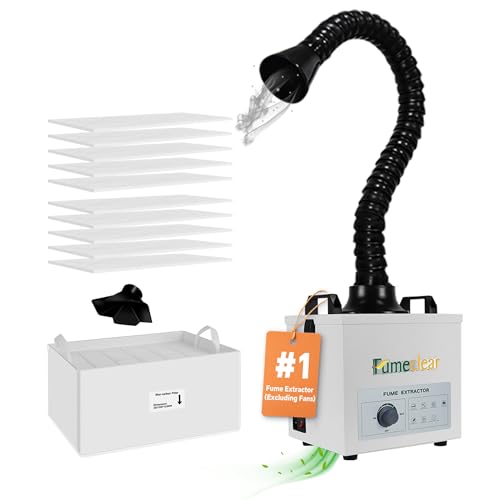
The FC100A model delivers 100W no-load power and a 3-stage filtration system designed for compact soldering setups and small laser-related tasks. It improves purification efficiency beyond entry-level absorbers and helps protect eyes and lungs from fine particulates. Best for: small bench soldering operators who require reliable, quiet operation without taking up significant space.
Why selected: its compact footprint and strong 99.97% purification rate at submicron sizes make it a practical choice for tight work areas. The main carbon filter uses high-iodine coconut carbon for enhanced adsorption and longer service life, expected to last around 3000 hours in typical use.
Limitation: not ideal for large laser engraving systems; for bigger setups, consider FC-2002, FC-2003, or FC-2004 models that offer higher airflow and broader coverage.
FumeClear FC-2002A Laser Fume Extractor — 260 m³/h for Laser Engravers

The FC2002A provides robust suction of up to 260 m³/h, suitable for 10–40W laser engraving machines, cutting devices, desktop soldering, and even some 3D printing environments. Its 3-stage filtration (pre-filter, HEPA, main carbon) achieves 99.97% purification, helping to reduce smoke and odors at the source. Best for: small to mid-size laser setups where consistent capture and clean air are priorities.
Why selected: the model integrates high-iodine carbon filtration for strong adsorption, with an estimated service life up to 4000 hours for the carbon filter, offering long-term value. The inclusion of 10 pre-filters supports efficient maintenance.
Limitation: while powerful for its size, users with very high-output lasers or dense material work may prefer higher airflow options like FC-2004.
FUMEGO XF250 — 4-Stage Filtration for 10–40W Lasers

The XF250 from FUMEGO delivers 280 m³/h airflow with a four-stage filtration system, including an upgraded pre-filter, HEPA, and a dual-layer deodorization setup. It supports positions like S1, M1, Vista, LX2 and more, and includes a 1.2 m gooseneck arm and 1.5 m hose for flexible placement. Best for: users seeking a versatile setup that adapts to various laser engravers and workspace layouts.
Why selected: the four-stage filtration and extended hose/arm options provide versatile odor control and fume capture across multiple tasks beyond laser engraving, such as soldering and 3D printing. The combination of HEPA capture and carbon deodorization yields strong, broad filtration.
Limitation: the model’s higher complexity may be unnecessary for very small, single-task benches where a simpler unit would suffice.
ATOMSTACK D5 Solder Fume Extractor — 3-Stage Filtration with 1400Pa
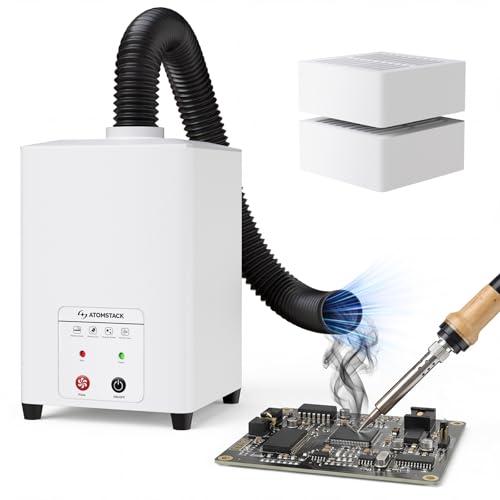
The D5 offers up to 1400 Pa suction with a compact desktop design and sub-65 dB operation. Its 3-stage filtration includes pre-filter cotton, a medium-efficiency layer, and an activated carbon filter, making it suitable for soldering, laser engraving, and other small-scale electronics work. Best for: users who need strong suction with quiet operation in a tight workspace.
Why selected: the high suction power supports rapid fume capture near the work area, helping minimize smoke during detailed soldering or laser tasks. The unit’s compact form factor makes it easy to place on a desktop without sacrificing airflow.
Limitation: the D5’s compact design means airflow coverage is best near the source; for larger or more open setups, consider higher-output options like FC-2004 or FC-2002A.
FumeClear FC-2001S — 128–168 m³/h for Precise Soldering

The FC-2001S serves soldering enthusiasts with an airflow range of 128–168 m³/h and a three-stage filtration system. It captures 99.99% of fine particles and uses a high-iodine carbon filter to enhance adsorption. Best for: precise soldering tasks in compact spaces where consistent, low-noise performance matters.
Why selected: its compact size and strong particulate capture make it ideal for hobbyists or small workshops seeking straightforward, effective fume control. The high-iodine carbon aids in odor reduction, improving air quality over time.
Limitation: airflow is on the lower end for larger laser engraving tasks; for bigger operations, a higher-capacity model is recommended.
Buying Guide: How to Choose the Right Laser Fume Extractor
What workspace size and laser power should guide your choice?
Higher-power lasers produce more smoke, so prioritize models with greater airflow (m³/h) and robust filtration. Small desks with soldering tasks can rely on compact units like FC100A or D5, while larger engravers benefit from FC-2004 or similar high-capacity options.
What filtration stages are essential?
A three-stage filtration (pre-filter, HEPA, and carbon) captures both particulates and gases. For stronger odor control, look for main carbon filters with high iodine content and longer service life.
How important is noise level?
Low-noise operation is important for comfortable long sessions. Models like ATOMSTACK D5 emphasize sub-65 dB operation, making them preferable for quiet workshops.
Is a flexible installation important?
Gooseneck arms and adjustable hoses help target the hood directly at the source of fumes. Flexible setups reduce leakage and ensure consistent capture across tasks such as soldering, engraving, and 3D printing.
Maintenance considerations
Check filter replacement intervals and availability of spare pre-filters. Some models offer long carbon filter life (thousands of hours), while others require more frequent changes. Balance replacement cost and downtime with your typical usage.
Which model should you buy to cover multiple tasks?
If you perform soldering and laser work, choose a unit with strong suction, a versatile 3-stage filtration, and a flexible mounting option. This provides reliable fume capture for different materials and processes without swapping units.
Summary of key buying considerations
- Airflow matched to laser power and room size
- Filtration quality and carbon filter longevity
- Noise level and ergonomic design
- Adaptability with gooseneck and hose options
- Maintenance, filters, and replacement costs
Frequently Asked Questions
- What is a good airflow for a small laser engraver space? — Look for 150–260 m³/h models to capture fumes at the source without excessive footprint.
- Do I need a 4-stage filtration system? — A 3-stage system is common and effective; a 4-stage setup adds enhanced deodorization for odor-heavy tasks.
- Can these units work for soldering and laser tasks simultaneously? — Yes, many models are designed for both, with adaptable hoses and arms for flexible positioning.
- How long do carbon filters last? — Filter life depends on usage; some high-iodine carbon filters can last thousands of hours, others require more frequent changes.
- Is remote control necessary? — Remote control features improve convenience for desktop setups and reduce bending or reaching during use.
- Will a fume extractor improve air quality in a shared workshop? — Yes, keeping fumes localized at the source helps reduce overall airborne contaminants in the room.