Best 3 Phase Solar Inverter Solutions for Modern Homes
Three-phase solar inverters are designed to balance heavy loads and improve efficiency in larger homes, workshops, and small commercial setups. This guide reviews five reliable options from Amazon, highlighting how each model handles 3-phase capability, MPPT charging, and integration with batteries. Whether you need true three-phase output now or scalable parallel configurations for future growth, these inverters provide robust performance, protection features, and smart monitoring to optimize solar energy usage.
| Product | Rated Power | MPPTs | Phase/Output | ||
|---|---|---|---|---|---|
| SUNGOLDPOWER SPH10048P (10kW) | 10 kW | 2 | Split Phase 120/240V (or 120V) | Up to 200A | Parallel-ready via multiple inverters |
| Aninerel 12000W Solar Hybrid | 12 kW | 2 | 120V single phase / 240V split phase | Up to 220A | Parallel up to 6 units |
| POWLAND 12000W Hybrid | 12 kW | Built-in 200A MPPT | Split Phase 120/240V | Battery-free design option | Grid-tied, hybrid operation |
| GROWATT 10000W Hybrid | 10 kW | 3 MPPTs | Split Phase 120/240V | Dual battery ports | IEEE1547 off-grid/on-grid capable |
| Ampinvt 6000W | 6 kW | 1 MPPT | Split Phase 120/240V | Supports 0-35A charging | Off-grid with full protections |
Each model supports solar input, battery charging, and house loads with a focus on stability, efficiency, and expandability. The selection favors three-phase capable configurations and parallel stacking to increase total power, enabling larger systems to run more demanding appliances while maintaining smooth transfers during grid interruptions.
SUNGOLDPOWER SPH10048P 10kW Inverter

The SPH10048P is an all-in-one solar charge inverter that combines a 10 kW DC 48V pure sine wave inverter with built-in MPPT charging for efficient solar harvesting. It supports up to 200A battery charging and features two MPPT controllers with a maximum open-circuit voltage of 500V DC. Output can be configured as split phase 120/240V or single-phase 120V, and a WiFi module enables remote monitoring via a mobile app. This model is designed for reliable AC output with multiple protection layers, including over-voltage, over-current, and overload safeguards to protect both system and appliances.
With four charging/output modes—Hybrid Charging, Utility Priority, Solar Priority, and Solar Only—it can adapt to a range of operating strategies. The device is suitable for homes or small commercial setups that require scalable solar + grid operations, and it supports parallel operation to boost total power where needed.
Aninerel 12000W Hybrid Solar Inverter

The Aninerel 12 kW inverter provides 48V DC to 120V/240V AC single- or split-phase output, with two MPPT controllers and a robust 220A battery charging capacity. It supports parallel connections up to six units, enabling a scalable path toward higher three-phase output (e.g., 208V three-phase when three units are paralleled). It accepts high PV input voltages (up to 500VDC), which improves energy capture in arrays with long wiring or shaded conditions. The unit is designed for off-grid, on-grid, or hybrid configurations, and is compatible with a wide range of battery chemistries including lead-acid and lithium types.
POWLAND 12000W Grid-Tied Hybrid Inverter

POWLAND’s 12 kW grid-tied hybrid inverter blends solar, grid, and potentially battery power to maximize home energy use. Its built-in MPPT controller supports up to 200A of charging capacity and PV input voltage from 90 to 500 V DC, enabling robust solar energy harvesting. The system is designed to feed surplus solar power back to the grid when available and power loads directly when grid conditions are favorable. The battery-free option can reduce upfront costs, while the hybrid design enables seamless switching between power sources for critical loads and overall efficiency improvements.
GROWATT 10000W Hybrid Inverter
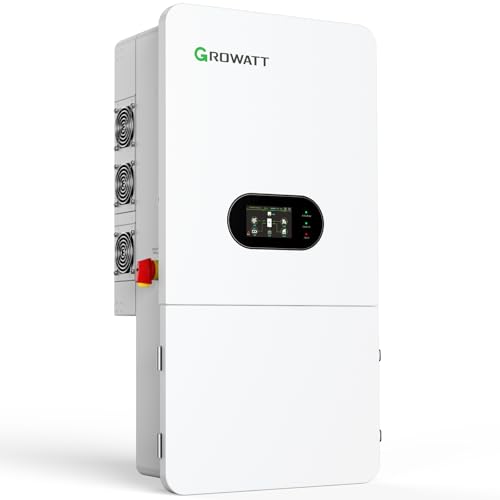
The GROWATT SPH 10000TL-HU-US is a 10 kW three-in-one solution with three built-in MPPTs, designed for versatile solar installations. It supports a wide MPPT input range (150–450V), enabling flexible panel configurations and multiple strings per tracker. The inverter delivers clean, utility-grade power (50/60 Hz, up to 97.5% efficiency) with dual AC inputs for grid and generator support. It also offers dual battery ports to accommodate various battery systems. This model is well-suited for residences aiming for both off-grid and on-grid operation with strong adaptability to different solar layouts and battery strategies.
Ampinvt 6000W Solar Inverter

The Ampinvt 6 kW inverter provides split-phase 120/240V output with a built-in 100A MPPT solar controller. It is designed for off-grid use with protections such as over-temperature, over-load, and short-circuit safeguards. The unit supports flexible charging current (0-35A) and can operate at 110–120% of rated output for a short period before engaging bypass. This model suits users who want a compact yet robust option for mid-range solar installations, including those that rely on a strong pure sine wave output for sensitive electronics.
Buying Guide: Key Considerations For 3-Phase Solar Inverters
- Phase configuration and expansion: For true 3-phase operation, check whether the system supports parallel stacking of multiple inverters to reach three-phase output (208V) or whether it relies on split-phase configurations that can still power large loads effectively. Consider future growth plans and whether the inverter’s parallel capability matches your target system size.
- MPPT count and voltage range: More MPPTs offer better optimization for multi-array layouts and shading conditions. A wide MPPT voltage range (e.g., 150–500 VDC) improves compatibility with various panel configurations and reduces the need for micro-adjustments as the system ages.
- Battery compatibility and charging: Confirm the maximum battery charging current, compatible chemistries (lead-acid, Li-ion, LiFePO4), and whether the unit supports battery-less operation. In systems with batteries, reliable charging control and protection are essential to prolong battery life and system reliability.
- Grid-tied vs off-grid vs hybrid: Decide whether you need grid-tied with backfeeding, off-grid independence, or a hybrid that blends solar, storage, and grid. Hybrid models typically offer more flexible operation and backup options for critical loads.
- Protection features: Look for over-voltage/current protection, anti-backfeed functions, short-circuit protection, and thermal management. These features protect appliances and extend equipment life in variable solar conditions.
- Efficiency and transfer time: Higher efficiency reduces energy loss, while fast transfer times (backup transfer under 10 ms) help maintain power for sensitive electronics during switching events.
- Monitoring and connectivity: WiFi or app-based monitoring allows real-time visibility into voltage, current, and charging status. This helps optimize performance and perform preventive maintenance.
- Physical installation and warranty: Verify mounting requirements, cooling needs, and local support or service options. A longer warranty and readily available spare parts are valuable for long-term reliability.
When selecting a 3-phase solar inverter, prioritize models that can scale via parallel configurations, offer multiple MPPTs for diverse array layouts, and provide robust protection and monitoring. The right choice will balance immediate needs with the potential for future expansion, ensuring efficient solar energy use across a growing home or small business installation.