Best Heavy-Duty 12 Volt Solenoid Relays for Golf Carts, Winches, and Marine Use
Finding a reliable 12-volt solenoid relay hinges on understanding how many amps you’ll need, the environment you’ll operate in, and the mounting options that fit your setup. This guide highlights five top options designed for heavy-duty applications, including golf carts, winches, and marine use. Each choice is best for specific buyers—job-site trackers, off-road enthusiasts, boaters, and fleet operators. Below is a quick summary table to help compare core specs at a glance.
| Product | Best For | Max Current | Environment |
|---|---|---|---|
| Max 300A 12V Duty Solenoid Relay (LDMINDA) | Heavy loads, long-term use | 300A peak, 150A working | General/Marine-friendly |
| Upgrade Max 300A (MaySpare) | Winches and carts needing robust NO contacts | 300A peak, 150A working | Weathered environments |
| Lucky Seven 300A (Rush) | Multiple model compatibility | 300A peak, 150A working | Marine/golf cart use |
| AFEISOL Hot Rod Starter Solenoid (SW3) | Automotive starters and trucks | 12V, 4-terminal | Durable, heat-dissipating |
| MaySpare 80-Amp SPST (White 4 Pin) | Light-to-moderate loads, isolators | 80A continuous | Battery isolator applications |
Max 300A 12V Duty Solenoid Relay by LDMINDA

This four-terminal, nickel-plated 12V solenoid is designed for high transient current and heavy-duty operation. It specifies a maximum transient current of 300A with a recommended continuous current under 150A. The coil uses 180°C copper wire, and the outer nickel-plated shell helps resist environmental corrosion. This model replaces common part numbers such as 70-111224 and 3635820, making it a suitable option for golf carts, winches, and marine gear that demand robust switching capability.
Best for: users who need a rugged, nickel-plated unit capable of handling high inrush and sustained loads in outdoor or marine environments.
Limitations: Not ideal if your system regularly exceeds 150A continuous current or requires higher contact material diversity beyond copper points.
Upgrade Max 300A Peak Instant Current 12V Solenoid (MaySpare)

This solenoid provides a 300A peak current with a 14Ω resistance and 10.2W capacity, featuring a NO contact configuration and 180°C copper wire coil. The mounting bracket is straight, with holes spaced for standard 5/16 x 19/32 dimensions. It also carries nickel-plating for environmental resistance and a wide replacement footprint including 70-111224, 3635820, and others. Best for: heavy-duty winches or golf carts where immediate, high-current response is needed.
Better for: installations requiring compatibility with numerous legacy part numbers and a robust, corrosion-resistant build.
Caution: Continuous operation should remain under 150A to preserve longevity in demanding cycles.
Lucky Seven 300A Continuous Duty Solenoid Relay

The Lucky Seven model is designed for continuous duty in winch, golf cart, and marine applications. It replaces standard parts such as 70-111224 and 1114208, supports NO contact configuration, and uses a 180°C copper wire coil with nickel-plated cover. The mounting bracket uses standard straight SPST mounting with the same hole pattern. This product is best for buyers who need easy cross-compatibility with multiple OEM replacements and a heavy-duty build.
Best for: buyers who want broad compatibility with common replacement numbers and a proven, corrosion-resistant design.
Limitations: Ensure your continuous current stays near 150A to maximize life span and performance in continuous-service scenarios.
AFEISOL Hot Rod Starter Relay Solenoid 12V SW3

The AFEISOL unit is a four-terminal starter solenoid with a 12V rating and a grounded base for stability. The coil uses copper windings, and contacts are designed for corrosion resistance with galvanized external surfaces. It lists broad compatibility with many automotive starter models and features 10-32 post terminals for the switch and relay connections. This option is best for buyers seeking a reliable replacement solenoid compatible with classic truck and automotive starters.
Best for: reliable replacement in classic and older-model equipment where a 4-terminal, copper-wound coil is preferred.
Limitation: It targets older starter configurations, so verify terminal sizes and mounting compatibility with your specific vehicle or equipment first.
MaySpare 80-Amp 12V Continuous Duty Solenoid Isolator
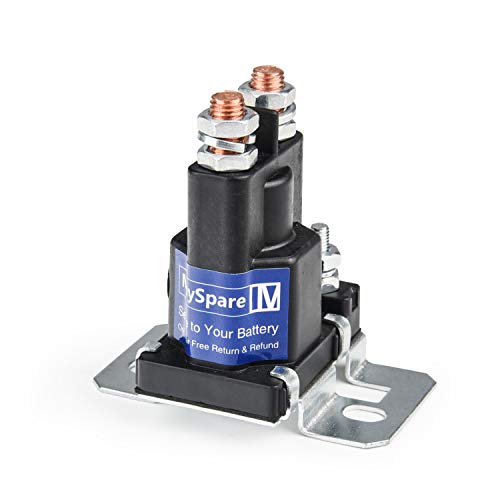
This 80A continuous-duty solenoid is intended for battery isolator and starter relay applications. It offers a max surge of 500A and 100,000 mechanical cycles, with Normally Open contacts and copper contacts with silver pins. It is suitable for dual-battery setups and switching between circuits with a relatively conservative load profile. Best for: isolating and controlling separate battery circuits in vehicles or boats where moderate current needs are present.
Choose this if: you require a long life with high mechanical cycles and a simple SPST configuration at moderate current.
Buying Guide: Key Considerations for Selecting a 12V Solenoid Relay
What current rating do I need?
Match the solenoid’s continuous working current to your typical load. Many models list a 150A safe continuous limit—staying near this value generally yields longer life and fewer overheating issues. If your system experiences occasional high inrush, a higher peak (300A) can be beneficial, but avoid operating at peak levels for extended periods.
How important is environmental resistance?
Nickel plating and robust gaskets help resist corrosion in marine or outdoor environments. If your equipment is regularly exposed to saltwater, rain, or mud, prioritize units with corrosion-resistant housings and sealed connections.
What mounting and terminal configurations should I expect?
Standard straight brackets with 5/16 x 19/32 holes align with common mounting patterns. Ensure you have compatible terminal sizes (NO/NC contacts, 5/16-24 or 10-32 posts) to mate with wiring harnesses or battery cables. A four-terminal design offers flexibility for isolator and starter-relay setups.
Which models are most versatile for replacements?
Units listing multiple compatible replacement part numbers (for example 70-111224, 3635820, and others) tend to be easier to drop into older systems. These models reduce the need for additional adapters or modifications.
What are practical limits for continuous duty?
Many heavy-duty solenoids specify 150A as a safe continuous current. For continuous operations near this limit, ensure adequate cooling and consider units designed specifically for continuous service. For sporadic high-current demands, a model with higher peak current can be advantageous.
Does the solution support marine or vehicle applications?
Look for models with corrosion resistance and compatibility with automotive or marine electrical standards. A nickel-plated housing and copper windings typically indicate better performance in demanding environments.
Frequently Asked Questions
- What does peak current mean on a solenoid? Peak current is the maximum transient current the solenoid can handle for a short time, typically during switch-on. Do not rely on peak current for continuous operation.
- Is 12V the right voltage for all starters and winches? Most automotive and marine solenoids operate at 12V DC, but verify your system’s voltage requirements and the terminal sizes before purchasing.
- Why choose a nickel-plated solenoid? Nickel plating provides enhanced corrosion resistance, which is beneficial for outdoor and marine environments.
- What installation considerations matter? Check mounting hole spacing, bracket type, and the wire gauge needed for 150A or higher to avoid overheating and ensure a secure fit.
- Can I use a 300A solenoid for low-current loads? Yes, but it may be physically larger and could draw more current than necessary, potentially increasing heat and wear if used far below its rating.
- How do I know if a solenoid replaces my old part numbers? Look for the listed replacements in product features to confirm compatibility with common OEM part numbers and vehicles.