Best Solar Inverter Three Phase Systems for Reliable Off-Grid Power
Answering the question: the best three-phase solar inverter setups combine high-quality MPPT charging, robust parallel expansion, and reliable split-phase or three-phase output for homes, workshops, and small commercial use. This guide highlights five top options that fit different needs—from pure sine wave reliability to scalable, multi-unit configurations. Ideal buyers include preppers needing off-grid resilience, homeowners expanding solar capacity, and small business owners seeking scalable power. Each pick is evaluated for who it’s best for, with clear pros, limitations, and practical setup notes.
| Product | Best For | Key Benefit |
|---|---|---|
| Aninerel 12000W Solar Hybrid Inverter | Large homes and workshops | Parallel up to 6 units for up to 72 kW |
| GROWATT SPH 10000TL-HU-US | Reliable whole-home backup | 3 MPPTs, 10 kW split-phase |
| Anjfylque 12000W Hybrid Inverter | High-demand off-grid plus grid | Dual MPPT, versatile modes, 12 kW |
| EcoSolLi 12000W Hybrid Inverter | Smart energy management | Dual MPPT, remote monitoring |
| GoHz 6500W Three-Phase Inverter | Solar-powered water systems | MPPT VFD with 380V backup |
Aninerel 12000W Solar Hybrid Inverter

Best for: Large off-grid or grid-tied systems where future expansion is planned. The unit provides 12,000W continuous output with 24,000W peak and supports parallel operation with up to six units, enabling up to 72 kW. It is designed to convert 48V DC to 120V/240V AC and supports high-voltage PV inputs up to 500VDC. The built-in dual MPPTs enhance energy capture from varied panel orientations.
Why selected: The dual MPPT charging and 220A charging current maximize solar harvest, especially in setups with multiple strings or shaded sections. The ability to operate in no-battery mode for solar-to-load use adds flexibility for direct-dc-to-load scenarios. Best for buyers planning scalable power and heavy loads like large appliances or workshop equipment.
Limitations: Parallel configuration requires careful electrical design to ensure phase balance and safe commissioning. Some users may need external monitoring or professional installation for multi-unit systems.
GROWATT SPH 10000TL-HU-US Hybrid Inverter
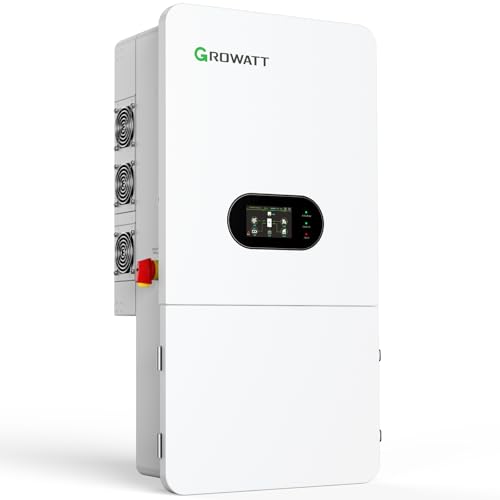
Best for: Whole-home backup with strong reliability and local support. This 10 kW pure sine wave inverter features three MPPT trackers, robust efficiency, and easy integration with 120/240V utility grids. It supports grid and generator inputs with dual battery ports for flexible configurations.
Why selected: A long-standing brand with broad acceptance, 10-year workmanship considerations (as noted in product materials) and a design that accommodates diverse panel arrays. Its wide MPPT range improves performance in varied sun conditions and mounting orientations.
Limitations: While highly capable, it is not a dedicated three-phase output device on a single unit; for three-phase loads at scale, multiple units or additional components may be needed to reach true three-phase balance.
Anjfylque 12000W Hybrid Inverter

Best for: High-demand homes or small commercial spaces needing flexible operation modes. This unit supports dual MPPTs and multiple output modes (grid-tied, off-grid, and hybrid), with capability to operate with or without batteries and a built-in limiter for grid interplay.
Why selected: The two independent MPPT controllers boost solar harvest from two different panel strings, while battery activation features ensure quick reactivation after interruptions. It offers several configurable modes to optimize use of PV, grid, and battery energy.
Limitations: Complex mode configurations may require careful setup to align with local grid policies and backup requirements. Battery-less operation demands sufficient PV voltage to cover loads when batteries are absent.
EcoSolLi 12000W Hybrid Inverter

Best for: Energy-conscious buyers who want smart management and remote monitoring. The EcoSolLi offers dual MPPTs, remote WiFi/GPRS, and a 72 kW parallel-ready capacity, making it suitable for scalable home or small business setups.
Why selected: Real-time MPPT efficiency to 99% and features that help reduce backfeeding to the grid. The broad parallel capability supports building a larger system without sacrificing control or safety protections.
Limitations: Some users may require additional components or sensors to maximize off-grid performance in extreme climates, and remote monitoring features may need stable network access for optimal use.
GoHz 6500W Three-Phase Inverter

Best for: Solar-powered water pumping or small three-phase loads where reliable 380V backup is needed. This model supports DC input up to 750V and optional AC backup, with dual MPPT-driven efficiency.
Why selected: The two MPPT channels help optimize harvest when PV strings are oriented differently or shaded, improving overall system performance. It’s purpose-built for three-phase or high-load single-phase applications with smart protection.
Limitation: This unit emphasizes pump and three-phase adaptation; for fully residential three-phase homes, matching with additional inverters or proper distribution planning is advised to balance phases.
Buying Guide: Key Considerations For Three-Phase Solar Inverters
- Output configuration: Do you need true three-phase output or split-phase with robust three-phase expansion? Choose units that support parallel operation to reach your target power.
- MPPT capability: More MPPT trackers improve energy harvest from multiple panel arrays and shading conditions. Look for 2 or more MPPTs and high PV voltage tolerance.
- Battery compatibility: Check supported battery chemistries (lead-acid, Li-ion, LiFePO4) and whether the unit supports batteryless operation for solar-to-load scenarios.
- Parallel expansion: If you plan to scale, ensure the inverter supports safe, balanced parallel connections and clear guidance from the manufacturer.
- Protection features: Overload, short-circuit, DC undervoltage/overvoltage, and anti-backfeed protections reduce risk for home systems and ensure stable power.
- Monitoring and control: Remote monitoring via WiFi or cellular can simplify maintenance. Verify app compatibility and data accessibility.
- Installation considerations: Some three-phase configurations require professional electrical work, especially when combining multiple inverters or interfacing with the service panel.
Frequently Asked Questions
- What is a three-phase solar inverter? It is an inverter that can deliver power on three alternating current phases, enabling balanced distribution for larger or multi-load systems.
- Can I run three-phase loads with a single inverter? Some inverters offer split-phase or three-phase outputs; for true three-phase loads, multiple units or a dedicated three-phase system may be needed.
- Why choose an inverter with multiple MPPTs? Multiple MPPTs maximize energy harvest when panels are in different orientations or partially shaded.
- Is parallel expansion safe? When done according to the manufacturer’s instructions and by a qualified electrician, parallel operation can scale power while maintaining protection and balance.
- Do these inverters work off-grid and on-grid? Many models support both modes, allowing flexible operation with or without grid access.