Best Din Rail GFCI Breakers for Safe Electrical Panels
Answering the most common buyer question: which DIN rail mounted GFCI breaker best protects your circuits and simplifies panel wiring? This guide compares five well‑matched options, highlighting ideal buyers, key protections, and practical trade‑offs. Suitable for residential and commercial setups, these breakers are designed for DIN rail mounting and 120–240V AC systems. Use this to choose the right unit for leakage protection, surge resistance, and overall circuit safety.
| Product | ||
|---|---|---|
| DIHOOL 32A GFCI Breaker | 2-pole, 32A, 120–240V | Mid‑range protection for residential panels, reliable 30mA leakage protection |
| CHTAIXI 16A GFCI Breaker | Earth‑leakage, 30mA | Smaller circuits and budget‑conscious installations |
| KERWINN 20A GFCI Breaker | 20A, DIN rail mount | Solar or mixed‑load systems needing visible status |
| DIHOOL 20A GFCI Breaker (20A) | 2‑pole, 120–240V, 20A | Balanced protection with surge and load indication |
| HCOVTXR 50A GFCI Breaker | 2‑pole, 50A, 120–240V | Higher‑current circuits needing leakage and surge protection |
DIHOOL 32A GFCI Breaker
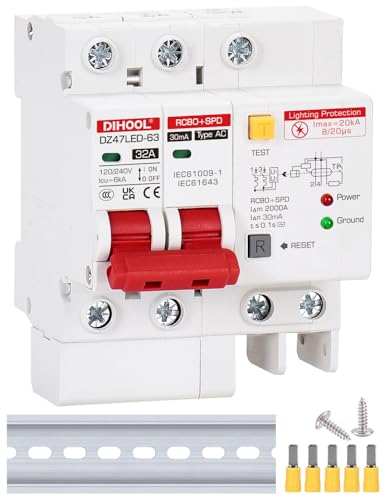
Best for mid‑range residential panels that require strong leakage protection with clear status indicators. This model includes Type 2 20kA surge protection, 30mA class AC ground fault protection, and dedicated visual indicators for power and ground status. The test button is convenient for routine checks, and a visualization window shows whether the breaker is ON or OFF. Suitable for 120V or 240V circuits used in US 110V and 220V voltages.
Who it’s best for: homeowners and small businesses needing robust GFCI protection without exceeding space or budget. Why selected: combines comprehensive protections with easy status monitoring in a single DIN rail unit. Caution: ensure compatibility with existing panel bus bars and verify that the 32A rating matches the circuit being protected.
CHTAIXI 16A GFCI Breaker

Best for smaller circuits within a panel that still require leakage protection and simple control. Functions include earth‑leakage protection for 110V/120V AC circuits, 0.03A residual current with t ≤ 0.1s, and short‑circuit/overload protection. The silver alloy contacts and flame‑retardant shell add durability in compact installs.
Who it’s best for: users with limited circuit loads or installations where space is tight. Why selected: a compact, cost‑effective option that provides reliable leakage protection. Caution: 16A rating may not cover higher‑draw devices; confirm circuit ampacity before installation.
KERWINN Leakage Protection Breaker

Best for solar or mixed‑voltage setups that require visible operation and straightforward DIN rail mounting. This 120V AC 20A unit provides earth leakage protection, ground fault protection, short‑circuit, and overload protection. The large interface and visualization window help quick status checks in busy panels.
Who it’s best for: installers managing solar or off‑grid compatible panels needing reliable leakage protection. Why selected: practical design with a clear status display. Caution: verify that the 20A rating aligns with your circuit loads to avoid nuisance tripping.
DIHOOL 50A GFCI Breaker

Best for higher‑current applications or larger distribution panels needing substantial leakage and surge protection. Features include Type 2 20kA surge protection, 30mA class AC ground fault protection, as well as overcurrent and short‑circuit protections. The status LEDs and test button help with ongoing safety checks.
Who it’s best for: facilities or workshops with higher amperage loads requiring stronger protection. Why selected: expands protection to higher ampacity without compromising detection. Caution: confirm bus bar spacing and panel rating to ensure proper fit and compliance.
Buying Guide: Key Considerations For Choosing DIN Rail GFCI Breakers
- Current rating vs. circuit load: Match the breaker rating (16A, 20A, 32A, 50A) to the protected circuit to avoid nuisance trips or under‑protection.
- Protection scope: Look for devices offering leakage protection (30 mA or similar), overcurrent, short‑circuit protection, and surge protection if your panel faces transient events.
- Voltages and compatibility: Ensure the unit supports 120V and/or 240V AC as required by your installation and is compatible with your DIN rail standards.
- Status indicators and testing: Visual indicators and a dedicated test button simplify reliability checks during maintenance.
- Physical dimensions and mounting: Verify DIN rail compatibility, width, and mounting depth to fit existing panels.
- Environmental considerations: Some units use flame‑retardant shells; choose accordingly for panel environments with higher risk or temperature variation.
- Surge protection: If your system faces voltage surges, prefer models offering Type 2 surge protection up to 20 kA for improved defense against transients.
- Auxiliary features: Visualization windows, easy‑to‑read indicators, and larger interface controls can reduce commissioning time and troubleshooting effort.
Frequently Asked Questions
- What is a DIN rail GFCI breaker? A: A residual current circuit breaker designed to mount on standard DIN rails inside electrical panels, combining leakage protection with circuit safety features.
- When should I use a 50A GFCI breaker? A: For higher‑current circuits or panels where larger loads draw substantial current while needing leakage protection.
- What does 30 mA leakage protection mean? A: It detects small leakage currents to ground and trips the circuit to prevent shock hazards.
- Can I mix different amperages in the same panel? A: Yes, as long as each branch circuit is appropriately protected and the panel labeling reflects the breakers’ ratings.
- Is surge protection essential for GFCI breakers? A: Surge protection is an added safety layer; it helps guard against transient spikes but is not a substitute for proper GFCI leakage protection.
- How do I choose the right GFCI breaker for solar or industrial use? A: Consider higher current ratings, robust leakage protection, and compatibility with DIN rail systems and installation environments.