Best Gas and Propane Generators for Reliable Power on the Go
This buyer’s guide highlights top dual‑fuel generators that run on gas and propane, ideal for home backup, camping, RV trips, and tailgating. The selections below emphasize quiet operation, fuel flexibility, and safe power for electronics. The best choices vary by use case: lightweight portability for camping, more robust outputs for home backup, and RV readiness for mobile needs. A quick summary table follows to compare core capabilities at a glance.
Summary Table of Selected Products
| Product | Fuel Options | Approx. Peak/Running Watts | Best For |
|---|---|---|---|
| PowerSmart 3800 Watt Dual Fuel Inverter | Gas / Propane | Starting 3800 / Running 3300 (gas); Starting 3500 / Running 3100 (propane) | Quiet backup, sensitive electronics |
| Westinghouse 4650 Peak Watt Dual Fuel | Gas / Propane | 4650 Peak / 3600 gas; 4650 Peak / 3240 propane | RV ready, medium home backup |
| Westinghouse 6500 Watt Dual Fuel | Gas / Propane | Gas: 6500 peak / 5300 running; Propane: 5800 peak / 4800 running | Whole‑home backup, transfer switch ready |
| Westinghouse 12500 Watt Dual Fuel | Gas / Propane | Gas: 12500 peak / 9500 running; Propane: 11200 peak / 8500 running | Large home or jobsite power |
| WEN DF475T 4,750-Watt Dual Fuel | Gas / Propane | Gas: 4750 surge / 3800 running; Propane: 4350 surge / 3500 running | Portable with wheels and electrical start |
PowerSmart 3800 Watt Dual Fuel Inverter Generator
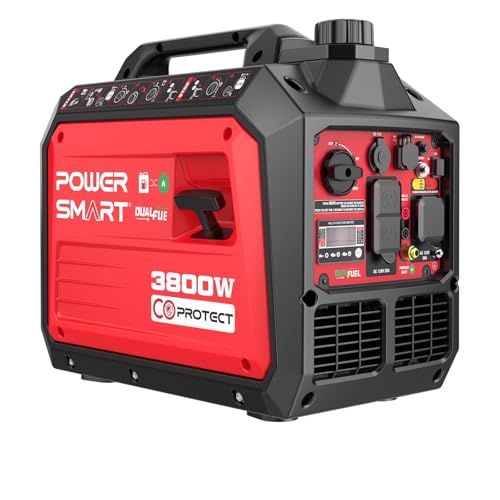
The PowerSmart model offers dual‑fuel flexibility with 3800 starting watts on gas and 3500 starting watts on propane, delivering up to 10 hours on gas and up to 25 hours on propane. This inverter generator provides clean power with less than 3% total harmonic distortion, making it suitable for charging phones, laptops, and CPAP machines. It is designed for quiet operation (65 dBA at 23 feet) and RV compatibility, making it a balanced option for campers and homeowners needing low noise with reliable output.
Best for: small‑to‑mid-size home backup and quiet camping. This unit is a good pick for buyers prioritizing low noise and fuel flexibility. One limitation: its compact output may be insufficient for large power demands or whole‑house needs during outages.
Who should avoid: you need higher wattage for heavy appliances or a large electrical load, such as a central AC unit or multiple high‑draw devices simultaneously.
Westinghouse 4650 Peak Watt Dual Fuel Portable Generator
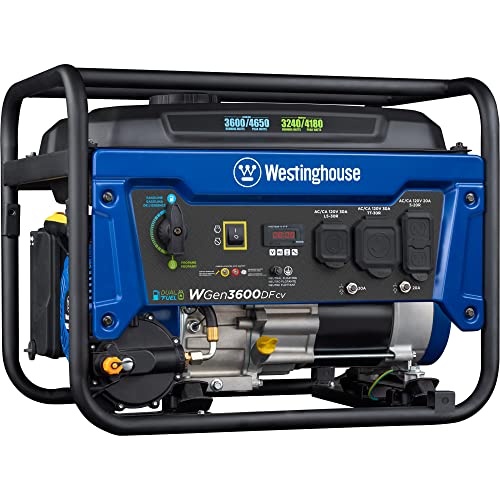
This generator delivers 4650 peak watts with 3600 running watts on gas and 3240 running watts on propane, with a four‑gallon fuel tank and an estimated runtime up to 14 hours per tank. It provides multiple outlets including a 5‑20R 120V duplex, and RV‑ready TT‑30R, plus a warranty‑friendly setup with an included oil funnel and tool kit. The CO sensor adds a safety layer, helping prevent carbon monoxide buildup in enclosed spaces.
Best for: RV owners and people seeking portable backup with multiple outlet options. Better for smaller homes or cabins that don’t require full‑house power. Limitation: runtime may be limited on propane depending on load, and the unit’s overall output is lower than larger models.
Westinghouse 6500 Watt Dual Fuel Home Backup Generator
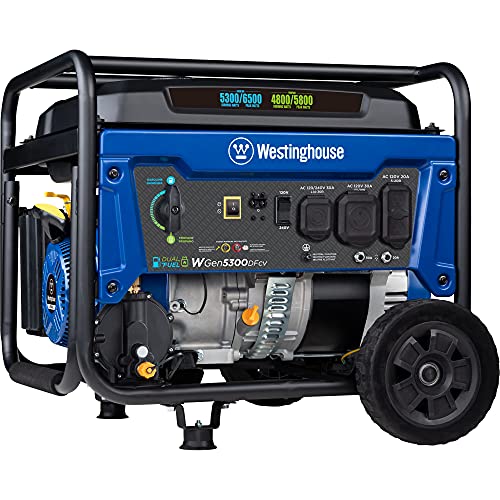
With gasoline power delivering 6500 peak watts and 5300 running watts, or propane delivering 5800 peak and 4800 running watts, this model is designed for home backup and transfer switch readiness. It comes with a 4.7‑gallon tank and a runtime of up to 14.5 hours under typical loads. It offers multiple outlets including GFCI 120V duplex, RV‑ready TT‑30R, and a transfer switch compatible L14‑30R outlet, all protected by rubber outlet covers. It’s a strong choice for homeowners seeking a reliable, semi‑permanent emergency power solution.
Best for: medium to large homes needing backup power with transfer switch capability. Better for: those who want a robust mix of outlets and a longer run time between refuels. Limitation: bulkier and heavier than portable, lighter‑duty units.
Westinghouse 12500 Watt Dual Fuel Home Backup Generator

This heavy‑duty unit offers 12500 peak watts and 9500 running watts on gasoline, with propane offering 11200 peak and 8500 running watts. It features remote electric start for convenience, a 6.6‑gallon fuel tank with a fuel gauge, and multiple outlets including 5–20R duplex, 14–50R for RV use, and a transfer switch ready L14‑30R. It supports a long runtime and high load, making it suitable for whole‑home power during outages and demanding job sites.
Best for: large homes or critical equipment that require substantial power and remote starting. Better for: long outages or frequent high‑demand use. Limitation: large size and weight may require permanent placement and practical handling considerations.
WEN 4,750‑Watt Dual Fuel Portable Generator (DF475T)

The DF475T lets you switch between gasoline (4750 surge / 3800 running) and propane (4350 surge / 3500 running) with a dial, and it supports 120V to 240V output for transfer switches and emergency backup. An electric start feature activates the 224cc OHV engine for quick restoration of power. It’s a practical option for those needing a versatile generator in a portable form factor.
Best for: backyard backup with flexible fuel choice and easy start. Better for: users who value a straightforward transfer switch readiness and portable wheels. Limitation: peak watts may be insufficient for high‑demand loads without careful load management.
WEN 5,600-Watt Dual Fuel Portable Generator

This model provides dual‑fuel capability with 5600 surge / 4500 running watts on gas, and 5000 surge / 4050 running watts on propane. It includes electric start and a CO watchdog sensor to automatically shut down on dangerous CO levels. The combination of higher output and safety features makes it suitable for medium‑to‑large backup needs and more demanding outdoor use.
Best for: power‑hungry setups and safety‑conscious buyers. Better for: users needing automatic CO protection in areas with limited ventilation. Limitation: heavier, less portable than smaller models.
DuroMax XP13000EH 13,000‑Watt Dual Fuel

The XP13000EH delivers up to 13,000 watts on gas and supports propane as an alternate fuel. It is designed for whole‑home backup and features dual fuel compatibility, an electric start, and a robust engine. This model targets users needing substantial power during outages or on job sites where a large, reliable energy source is critical.
Best for: whole‑home backup or heavy load scenarios. Better for: users who want dual‑fuel flexibility and electric starting ease. Limitation: size, weight, and setup complexity require more space and planning.
Buying Guide: Key Considerations for Gas And Propane Generators
- Fuel flexibility: If fuel availability varies, dual‑fuel models minimize outages by letting you switch between gas and propane.
- Power needs: Estimate essential loads (refrigerator, lights, sump pump, heating/cooling) and choose a unit with adequate running watts and surge capacity.
- Portability vs. capacity: Lighter units are easier to move, but larger homes or job sites may demand higher wattage and longer run times.
- Noise and environment: Inverter generators tend to operate quieter and with cleaner power, ideal for neighborhoods and campsites.
- Safety features: Look for CO sensors, automatic shutoffs, and rubber outlet covers for added protection.
- Outlets and compatibility: Ensure the generator has the outlets you need (TT‑30R, 5–20R, L14‑30R) for RVs and home transfer switches.
- Fuel tank and runtime: Larger tanks extend runtime but increase footprint and weight. Consider typical outage durations when sizing.
- Starting method: Electric start is convenient; recoil start provides a simpler backup option if the battery fails.
- Maintenance: Oil changes, spark plug access, and easy fuel hose connections contribute to long‑term reliability.
Frequently Asked Questions
- What is the difference between peak watts and running watts?
Peak watts indicate the maximum surge the generator can handle for a short time, while running watts reflect continuous output during normal operation.
- Is dual‑fuel power safer for home backup?
Dual fuel offers flexibility if one fuel source becomes unavailable, helping ensure continuous backup power.
- Do I need a transfer switch for home backup?
For whole‑home backup, a transfer switch is recommended to safely connect the generator to your circuit panel and protect appliances.
- Are inverter generators quieter than conventional models?
Yes, inverter designs typically run at lower RPMs and produce cleaner sine waves with lower THD, resulting in quieter operation.
- What safety features matter most for CO risk?
CO sensors and automatic shutdown help protect occupants when carbon monoxide levels rise, especially indoors or in enclosed spaces.
- How do I choose the right wattage for my needs?
List essential devices and their wattage, then add a margin for startup surges. Choose a unit that can handle the total plus a buffer.