Best Heat Cord for Roof: Top Roof De-Icing Cables for Ice Dam Prevention
Winter weather can bring ice dams and damaging leaks to roofs. The right heat cord keeps gutters, roofs, and downspouts clear by providing auto-regulating heat exactly where it’s needed. Below is a curated guide to five highly rated roof de-icing cables that balance safety, durability, and energy efficiency for American homes. Each entry includes key features, installation notes, and practical considerations to help you choose the best fit for your roof configuration.
Summary Table of Selected Products
| Product | Brand | Length | Wattage per Foot | Key Benefit |
|---|---|---|---|---|
| Eastrexon 50FT Roof Snow De-Icing Kit | Eastrexon | 50 ft | 8 W/ft | Comprehensive kit with clips for gutters |
| H&G Lifestyles 8W/FT Roof Heat Cable 140FT | H&G Lifestyles | 140 ft | 8 W/ft | Self-regulating with high heat output |
| TOPDURE TDRD 30 feet Kit | TOPDURE | 30 ft | 5 W/ft | ETL & CSA certified safety package |
| MAXKOSKO 25FT Roof Heat Cable | MAXKOSKO | 25 ft | 7 W/ft | Self-regulating with extended power cord |
| WarmlyYours Roof Snow De-Icing Heat Cable | WarmlyYours | 100 ft | 5 W/ft | DIY-friendly kit with clips and spacers |
Eastrexon 50FT Roof Snow De-Icing Kit

The Eastrexon heat tape offers a 50-foot length with 8 watts per foot, suitable for various roof and gutter configurations. It is designed for de-icing across roofs, gutters, and downspouts, with a 9.8-foot power cord. The four-layer safety design includes waterproof outer jacket, insulation, shielding, and a PTC layer, all built around AL-MG alloy wire with copper core. This setup supports reliable performance in cold conditions and provides a practical all-in-one solution for preventing ice dam formation and water backup.
H&G Lifestyles 8W/FT Roof Heat Cable — 140FT

H&G Lifestyles presents an 8 W/ft self-regulating heat cable designed to prevent ice dams and keep gutters clear. The system’s smart self-regulating technology adjusts output with temperature, maintaining up to 158°F for consistent performance. Constructed with polyolefin inner insulation, a protective TPE layer, and a tinned copper core, this cable emphasizes safety and durability for demanding winter climates. Suitable for long roof spans or extensive gutter runs, it offers strong reliability when temperatures drop sharply.
TOPDURE TDRD 30 Feet Roof & Gutter Kit
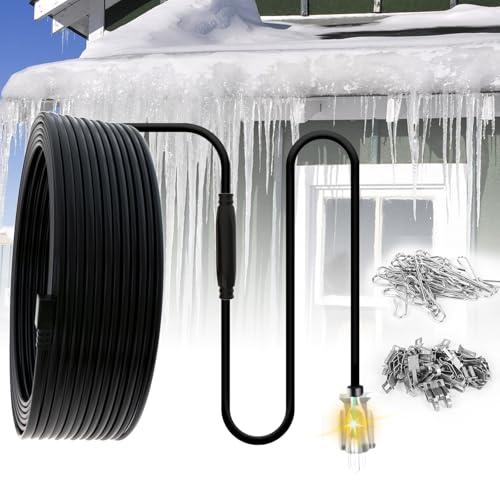
TOPDURE offers a certified safety-focused kit with 30 feet of 5 W/ft heat tape. ETL and CSA certifications cover both cable and plug safety, and the package includes a 6-foot 18/3 cold lead, clips, spacers, and a straightforward installation manual. The XLPE insulation with aluminum foil screening and a copper braid enhances durability and safety, making it a solid option for homeowners seeking a balanced, code-compliant solution for ice dam prevention.
MAXKOSKO 25FT Roof Gutter Heat Cable

MAXKOSKO’s 25-foot, 7 W/ft self-regulating cable combines a copper core with fluoropolymer outer sleeve for durability in freezing temperatures. The design automatically adjusts output to prevent overheating while maintaining effective de-icing on roofs, gutters, and downspouts. Its extended power lead aids installation in hard-to-reach areas, and the 120 V system is compatible with typical North American outlets. This option is well-suited for mid-sized roof runs seeking energy-efficient, adaptive heating.
WarmlyYours Roof Snow De-Icing Heat Cable — 100 ft

WarmlyYours offers a 100-foot de-icing cable at 5 W/ft, ideal for longer roof runs and larger gutter systems. The kit includes clips and spacers, enabling a do-it-yourself installation suitable for owners who want a DIY-friendly approach. The cable’s design aims to withstand severe winter conditions while delivering reliable heat to prevent ice dam buildup and related damage. It is a practical pick for homeowners needing extended coverage with straightforward installation.
Buying Guide: Key Purchase Considerations
When selecting a roof heat cable system, consider these factors to ensure optimal performance and safety:
- Length and coverage: Measure roof length, gutter runs, and downspouts to determine required cable length. Longer installs may benefit from self-regulating cables with higher wattage per foot to ensure even heat distribution.
- Wattage per foot: Higher wattage (8 W/ft, 7 W/ft) provides stronger heating, useful for very cold climates or larger roofs. Lower wattage can save energy in milder regions but might require longer runs or multiple lines.
- Self-regulating vs fixed power: Self-regulating cables adjust heat output with temperature changes, reducing risk of overheating and saving energy. Fixed-power cables maintain a constant heat, which may deliver peak performance but at higher energy use.
- Safety certifications: Look for ETL, CSA, or UL certifications, especially if the kit includes a plug and cord. Comprehensive testing of both cable and plug components matters for safety compliance.
- Durability and materials: Outer jackets of fluoropolymer or polyolefin, copper cores, and robust insulation layers contribute to long-term reliability in winter weather.
- Installation ease: Some packages include clips, spacers, and pre-attached power leads, which simplify DIY installation. Consider whether you need professional installation for complex roof shapes.
- Compatibility with roof types: Ensure the cable is suitable for your shingles, gutters, and downspouts. Some designs are better for metal gutters, while others suit plastic gutters or different roof textures.
- Energy efficiency: Self-regulating cables often provide better energy efficiency by adjusting heat output to demand, helping manage heating bills during prolonged cold snaps.
- Maintenance and replacement: Consider kits with widely available spare parts, clips, and replacement cables in case of wear or damage over time.
Practical Implementation Tips
- Plan layout before installation: Map out heat traces along the roof edge and gutters to minimize heat loss and maximize effectiveness.
- Follow manufacturer instructions: Use included clips and spacers correctly to prevent cable slippage and potential damage.
- Test before heavy snow: Plug in and test the system during a dry day to confirm heat output and wiring integrity.
- Consider a dedicated circuit: A single outlet or a dedicated circuit reduces the risk of overloading household circuits during peak winter use.
- Seasonal maintenance: Inspect cables annually for wear, corrosion, or damaged insulation, and replace as needed to maintain safety standards.