Best Flexible Roof Solar Panels for Off-Grid Power
Flexible roof solar panels are ideal for curved surfaces and portable setups. This guide highlights five top options, explains who each is best for, and helps you compare performance, weight, and installation ease. The buyers represented here range from portable camping kits to marine-grade panels designed for curved RV roofs. Use the summary table below to quickly compare key specs and suitability.
| Product | Best For | Key Benefit | Approx. Output |
|---|---|---|---|
| 200W Flexible Solar Panel Kit (2x100W) | Off-grid campers and boats | Very flexible, high total power | ~1000 Wh/day (depends on sun) |
| Renogy 100W Flexible Panel | Marine and RV projects | 240° bendability, light and efficient | ~500 Wh/day (depends on sun) |
| BougeRV Arch Pro 200W | RVs and curved surfaces | Stable output, higher efficiency cells | Depends on setup |
| Renogy 100W Semi-Flexible Panel | Compact stealth installs | Ultra-thin, very light | Depends on sun |
| Topunive 100W Flexible Panel | Off-grid trailers and boats | 9BB design with good efficiency | Depends on sun |
| ECO-WORTHY 2x130W Panels | Curved surfaces on RVs/boats | 270° flex, higher combined output | Depends on sun |
200W Flexible Solar Panel Kit (2x100W)

Best for off-grid campers and boats needing strong flexible power on curved surfaces. The kit includes two 100W panels with a bendable design that can curve to a wide radius, making it suitable for irregular roofs, trailers, boats, and tents. The system is designed to withstand heavy snow loads and high winds with waterproof junctions for reliability in harsh conditions. Use this when you value high total wattage in a flexible package.
Who it’s best for: Off-grid adventurers and small boats that require power aboard curved surfaces. Why chosen: It combines high flexibility with substantial total output, helpful in maintaining charge on extended trips. Caution: Check compatibility with your charge controller and battery wiring to ensure proper system integration.
Renogy 100W Flexible Panel
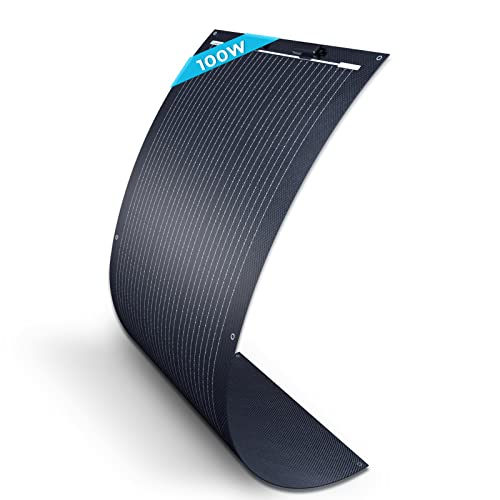
Best for marine and RV applications requiring efficient lightweight flexible panels. This 100W panel uses bendable construction with a 240° range, and its half-cut PERC cells improve energy capture. It’s a strong choice when you need easier transport and mounting on curved surfaces without adding significant weight.
Who it’s best for: Boat owners and campers needing a compact, high-efficiency solution. Why chosen: It offers a balance of low weight, bendability, and improved output efficiency. Caution: Ensure your battery system can accommodate its voltage and wiring setup before installing.
BougeRV Arch Pro 200W

Best for RVs and boats needing stable output on curved surfaces. BougeRV Arch Pro uses high-grade N-type 16BB cells and enhanced bypass diodes to improve low-light performance and series compatibility for 12V or higher battery banks. It excels in shaded conditions and larger installations where stability matters.
Who it’s best for: RV owners and boaters who face inconsistent light. Why chosen: The design emphasizes consistent power with shading resilience. Caution: Open-circuit voltage may vary; verify compatibility with your power station or battery setup before purchase.
Renogy Flexible 100W Panel (Semi-Flexible)

Best for stealth installs and lightweight setups. This Renogy panel weighs about a third of a rigid panel and is ultra-thin, making it ideal for projects where discretion and portability are important. It is bendable and well-suited for uneven surfaces where a rigid panel won’t fit.
Who it’s best for: Subtle installations on boats or campers with tight mounting spaces. Why chosen: Its low profile and light weight simplify installation. Caution: The panel remains semi-flexible, so plan mounting to minimize flex-induced wear over time.
Topunive 100W Flexible Panel

Best for versatile off-grid applications needing good efficiency on irregular surfaces. The 9BB design and 23% efficiency help maximize power capture on curved roofs like RVs, campers, boats, and cabins. It’s a practical all-round choice for varied installations.
Who it’s best for: Installers prioritizing efficiency on irregular surfaces. Why chosen: The 9BB mono cells improve energy yield and durability. Caution: Ensure the arc radius and mounting hardware align with your surface geometry to avoid stress on the panel.
ECO-WORTHY 2x130W Flexible Panels

Best for larger curved surface installs where more daily energy is needed. This two-panel 260W setup uses 270° ultra-flexibility to fit curved roofs on RVs, boats, and cabins. The higher combined output suits longer trips or higher power demands.
Who it’s best for: Power users needing more daily energy on curved surfaces. Why chosen: The higher combined wattage offers stronger daytime charging capability. Caution: The open-circuit voltage may require verification against your charge controller and battery bank specifications.
Buying Guide
What should you check before buying flexible roof solar panels?
- Flexibility range: How sharply can the panel bend? Consider the radius of curvature on your surface.
- Weight and thickness: Lighter and thinner panels are easier to install on mobile platforms.
- Cell technology: 9BB, PERC, and N-type cells affect efficiency and shade tolerance.
- Junction box and wiring: IP ratings and connector durability influence long-term reliability.
- Open-circuit voltage and system voltage: Verify compatibility with your charge controller and battery bank (12V, 24V, or 48V).
- Mounting options: Pre-drilled holes and the availability of marine-grade mounting hardware matter for curved surfaces.
- Weather resistance: Waterproofing and snow/wind load ratings are important for outdoor use.
How to choose among these options?
- Best for high total output on curved surfaces: 200W kit options provide more wattage, ideal for extended use off-grid power.
- Better for light, stealth installs: 100W Renogy or Renogy Semi-Flexible panels balance weight and appearance.
- Choose this if you need stable shading performance: BougeRV Arch Pro panels emphasize consistent power under partial shading.
- Avoid this if you have a low-voltage power station with strict input limits: Verify voltage compatibility before purchasing larger kits.
Maintenance and installation tips
- Mount panels on a clean, dry surface and use appropriate adhesives or hardware rated for curved surfaces.
- Inspect wiring and junction boxes after storms or heavy winds for damage or corrosion.
- Use a compatible charge controller sized for the panel array and your battery bank.
Frequently Asked Questions
- Q: Can flexible solar panels be installed on boat decks? A: Yes, many models are designed for curved or irregular surfaces including boat hulls and decks.
- Q: Do flexible panels require special mounting hardware? A: Often standard mounting hardware works, but some surfaces benefit from marine-grade adhesive or clamps designed for curved surfaces.
- Q: Are flexible panels as durable as rigid panels? A: They are generally durable but can be more susceptible to edge wear if not properly mounted on sharp curves.
- Q: Can I connect multiple panels in series or parallel? A: Yes, most flexible panels support series or parallel wiring; verify open-circuit voltage and current limits with your controller.
- Q: How much daily energy can I expect from a 100W panel? A: Output depends on sun availability; typical ranges are around 350–600 Wh/day under favorable conditions.
- Q: Do I need a charge controller for these panels? A: Yes, a charge controller is essential to protect batteries and regulate charging.