Best Grid Tie Power Inverter Models for Home Solar Systems
Answering the common buyer question: which grid-tie power inverter best matches your solar setup and grid connection? This guide presents five reliable options suited for different uses—from compact residential installs to larger grid-assisted systems. Each product is evaluated for best-fit scenarios, potential limitations, and why it stands out for specific buyers. A quick summary table follows to compare core specs at a glance.
| Product | Best For | Key Point |
|---|---|---|
| Y&H 600W Grid Tie Micro Inverter | Small residential arrays, waterproof installs | IP65, real-time AC monitoring |
| Y&H 1200W Grid Tie Inverter Power Limiter | Mid-size systems needing limiter | MPPT, LCD, open-circuit voltage range |
| Y&H 1000W Grid Tie Inverter Power Limiter | Battery-compatible mini systems | DC input 22-60V, limiter sensor |
| YINZINR 1000W Grid Tie Inverter | 36V solar panels and batteries | High MPPT efficiency, 99%+ |
| Usoraszkt 1200W Solar Micro Grid Tie Inverter | Home use with LCD monitoring | IP65, dual MPPT, 25%+ gain |
Y&H 600W Grid Tie Micro Inverter

The Y&H 600W grid tie micro inverter is designed for single-phase residential or small commercial solar arrays. It supports smooth installation with an IP65 waterproof body and an MC4 DC input connector that helps prevent polarity mistakes during wiring. It provides real-time AC performance data via the built-in AC digital meter, showing voltage, current, active power, energy, frequency, and power factor. This model is best for buyers who want simplified wiring, low DC voltage safety, and on-site monitoring without a large centralized unit.
Best for: small rooftop installations where durability in weather-exposed areas is critical and real-time output monitoring matters. Limitations: recommended for 50V DC input, which may constrain larger panels or long cable runs. Consider multiple units if expanding capacity is needed.
Y&H 1200W Grid Tie Inverter Power Limiter

This inverter features a limiter sensor to deliver only the power the load requires, helping optimize efficiency in solar-plus-load scenarios. It supports a higher input open-circuit voltage range (76-90V) and displays operating status via an LCD. It is suitable for solar systems with panels in the MPPT range and for users who want clear fault/status information. Choose this if you want precise load matching and real-time monitoring.
Best for: mid-size solar setups where avoiding excess export and maintaining tight control over output is advantageous. Caution: ensure your panel Voc stays within the 76-90V range and that wiring distances comply with the recommended limits to sustain efficiency.
Y&H 1000W Grid Tie Inverter With Limiter
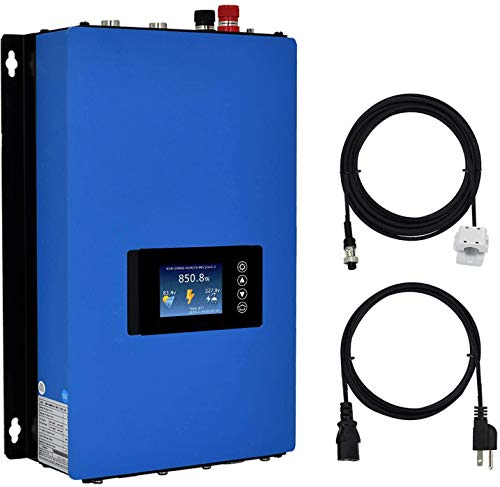
This unit emphasizes battery compatibility and a built-in limiter to tailor power delivery to the load or battery bank. It specifies a DC input range of 22-60V and notes a startup voltage of around 26V. It’s well-suited for small systems that may incorporate a 36V/48V battery bank and aim to optimize discharge depth automatically. Best for: buyers integrating solar with modest battery backup while needing reliable limiter behavior.
Caution: verify your battery voltage matches the inverter’s supported range and that the panel Voc remains within the stated limits to achieve optimal efficiency.
YINZINR 1000W Grid Tie Inverter

The YINZINR model highlights robust MPPT performance with claims of 99%+ efficiency and a design that supports 36V solar panel configurations and related battery setups. It stresses a rugged aluminum alloy construction and a focus on environmentally friendly energy conversion. Best for: buyers seeking high MPPT efficiency and a compact solution for 36V systems. Limitation: exact electrical compatibility with specific battery chemistries or panel types should be confirmed before purchase.
Usoraszkt 1200W Solar Micro Grid Tie Inverter

This IP65-rated micro grid tie inverter employs dual MPPT inputs to maximize harvest from panels that may experience partial shading. It includes an LCD to display status, voltage, current, and power, supporting a broader range of solar modules. It’s best for home-scale installations where weather protection and detailed live data are valuable. A potential limitation is ensuring panel arrays consistently meet MPPT operating ranges for best performance.
Buying Guide: Grid Tie Inverter Essentials
- DC input range and MPPT: Match the solar array’s open-circuit voltage (Voc) and voltage at maximum power (Vmp) to the inverter’s MPPT window for optimal efficiency.
- Grid compatibility: Ensure the inverter’s output voltage and frequency align with local grid standards (e.g., 120/240V, 50/60 Hz). Some inverters are designed for 240V grids and require proper installation.
- Battery integration: If you plan to couple with battery storage, verify DC input limits, starter voltages, and whether the unit supports battery discharging or a “limiter” mode.
- Protection and safety: Look for IP ratings (IP65 for outdoor use), proper wiring solutions, and clear fault/status indications to reduce installation risk.
- Monitoring and data access: LCD display or WiFi/app monitoring helps verify performance and troubleshoot quickly; consider dual MPPT for better shading resilience.
- Scalability: If you anticipate expansion, check whether multiple inverters can be stacked or paralleled, and verify any limits on parallel operation.
- Real-world constraints: Weather exposure, cable lengths, and panel combinations influence efficiency; plan layout to minimize losses.
FAQ
- What is a grid tie inverter?
A grid tie inverter converts DC from solar panels into AC synchronized with the utility grid for immediate use or export. - Do I need an inverter with MPPT?
MPPT improves energy harvest by tracking the panel’s maximum power point, especially under shading or varying light. - Can I use a grid tie inverter with a battery?
Some models support battery use; check DC input range, battery compatibility, and discharge controls before wiring. - Is IP65 protection important?
IP65 indicates protection against dust and water jets, making outdoor installations safer in varied weather. - How many inverters can I run in parallel?
Parallel operation allows higher total output, but confirm the model’s compatibility and installation guidelines before pairing units. - What maintenance is needed?
Routine inspections, secure wiring, and monitoring data checks help ensure consistent performance and safety.