Best Electrical Panel Watt Meters for Accurate Power Monitoring and Troubleshooting
Need an accurate watt meter to monitor voltage, current, and power for electrical panels, DIY projects, or solar setups? This guide outlines five reliable options best suited for different use cases, from RC hobbyists to home energy monitors. Each product is evaluated for readability, precision, and practical limitations to help you choose the right device for your setup.
The following table highlights key details for quick comparisons. It lists the five selected watt meters, their primary use case, and the typical measurement range they cover.
| Product | Best For | Voltage Range | Current Range | Notes |
|---|---|---|---|---|
| ANKG 150A Watt Meter Power Analyzer | DIY projects and RC enthusiasts needing high precision | 0-60V | 0-150A | High resolution; real-time readings |
| DROK AC Meter | General AC panel monitoring with all-in-one display | 80-300V | 0-100A | 6-in-1 meter; good for mains projects |
| bayite DC 8-100V 0-100A | Compact DC systems and battery testing | 8-100V | 0-100A | Data store on power loss; backlight control |
| MECHEER Upgraded Watt Meter Plug | Home appliance energy tracking | AC mains (typical 100-240V) | 0-15A typical (plug-in) | 7 display modes; energy cost estimation |
| HTRC 150A High Precision Power Analyzer | Battery testing and solar/DIY power projects | 4.8-60V | 0-150A | Wide DC range; high-precision readouts |
ANKG 150A Watt Meter Power Analyzer

The ANKG model provides real-time measurements of Current (A), Voltage (V), Watts (W), Amp-hours (Ah), Watt-hours (Wh), Peak Amps (Ap), Minimum Volts (Vm), and Peak Watts (Wp). It supports 0-150A current with 0.01A resolution and 0-60V with 0.01V resolution. This makes it a strong choice for precise battery testing, RC setups, and small solar or wind projects. Best for users who need tight current and voltage granularity for energy calculations.
Best for: hobbyists and engineers needing high-precision DC readings. Choose this if you require detailed real-time data across multiple electrical parameters. Caution: designed for DC systems within its specified ranges; exceeding limits affects accuracy and could harm the device.
DROK AC Meter
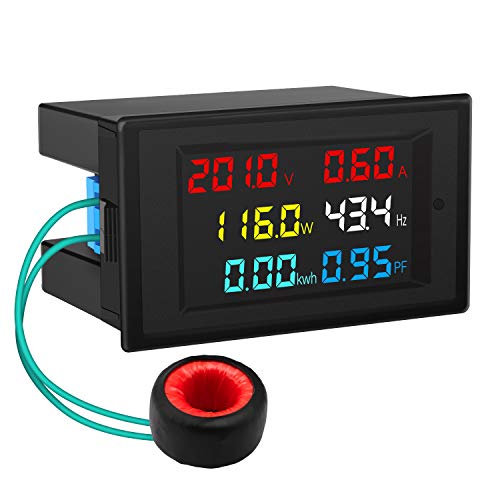
The DROK meter is a 6-in-1 multimeter-style device that displays voltage, current, active power, energy, frequency, and power factor on one interface. It measures AC voltage from 80 to 300V and current up to 100A, with a 0-30,000W power range and 0-99,999 kWh energy range. It is ideal for home mains projects or small garage electrical panels needing a compact, single-display monitor. Best for: homeowners wiring basic AC circuits or monitoring a single appliance. Limitation: not suitable for high-precision DC or high-current DC systems beyond its rated AC specs.
bayite DC 8-100V 0-100A Meter
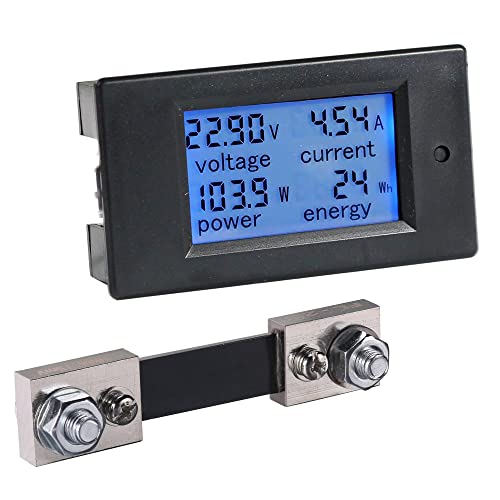
The bayite meter covers a DC voltage range of 8-100V and current 0-100A, with power and energy metrics also available. It stores energy data when power is off, and features a backlight that can be toggled on or off. Best for: small DC battery setups and portable test rigs where data persistence matters. Caution: ensure wiring matches the 100A shunt and respect the DC-only specification to avoid non-linear readings.
HTRC 150A High Precision Power Analyzer
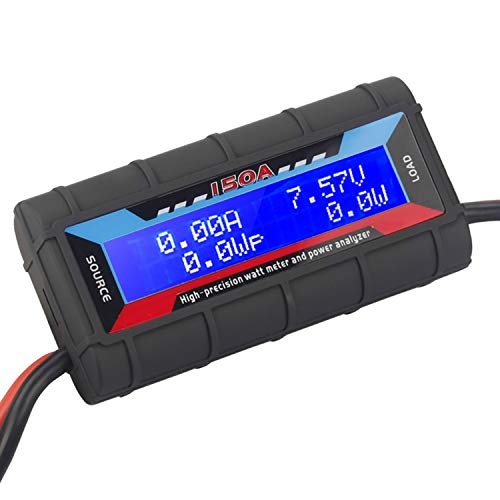
The HTRC model excels in measuring DC values with high accuracy, including 0-150A current (0.01A resolution) and 0-60V (0.01V resolution). It also reports energy and amp-hours with fine granularity. It is well-suited for analyzing DIY DC power projects, solar battery systems, and charger testing. Best for: users needing precise DC power analysis with a broad current range. Caution: designed for DC systems; ensure the auxiliary power setup and wiring are within the specified ranges to maintain accuracy.
Buying Guide
What should you consider when choosing a watt meter for electrical panels and DC/AC systems?
- Measurement type and range: Determine whether you need DC only, AC only, or both. Check voltage and current limits to fit your system.
- Display readability: Look for backlit LCDs with clear decimal resolution. Larger screens help when readings are in bright or dim environments.
- Data logging and memory: If your project may experience power interruptions, choose meters with data storage or easy data export.
- Accuracy and resolution: Higher resolution (e.g., 0.01A or 0.01V) improves precision for battery and solar testing.
- Wiring and connectors: Ensure compatibility with your wiring gauge (e.g., 12 AWG) and shunt requirements for current measurement.
- Stand-alone vs. plug-in: Plug-in meters are convenient for appliances; panel-mounted or inline meters suit larger or fixed installations.
- Environment and usage notes: Consider whether the device is rated for DC, AC, solar, RC, or EV systems to avoid misapplication.
FAQ
- What is the difference between AC and DC watt meters?
Answer: AC meters measure alternating current networks, while DC meters track direct current systems with different ranges and shunt configurations. - Can these meters monitor home solar or battery storage systems?
Answer: Yes, many models support solar or battery testing within their voltage and current ranges. Check the rated limits before use. - Do I need a separate shunt for high current readings?
Answer: Some meters include a built-in shunt; others require an external shunt compatible with the current range. - Which meter best suits hobbyist RC projects?
Answer: Meters with 0-150A current and DC ranges are typically ideal for RC and small DIY power setups. - Is data persistence important for power outages?
Answer: If you frequently experience outages, choose meters that automatically store last-test data or offer easy data export. - Can these meters read multiple parameters simultaneously?
Answer: Yes. Several models display voltage, current, power, energy, and related metrics in real time.