Best Clamp on Electric Meters for Safe, Quick Electrical Testing
Find the right clamp on electric meter for diagnosing electrical issues, whether you’re a professional electrician or a DIY homeowner. This guide highlights five reliable options, focusing on versatility, clarity, and safety features. Each product is chosen to address different use cases—from non-contact voltage testing to detailed AC/DC measurements. The table below summarizes the key takeaways to help you compare at a glance.
| Product | Best For | Notable Feature |
|---|---|---|
| Klein Tools CL120 | General electrical work and DIY projects | Backlit display, NCVT testing in clamp |
| AstroAI 2000 Counts CM2K0R | Budget-friendly versatile meter | Data hold and auto off, dual function for voltage/current |
| KAIWEETS D-Shaped 4000 Counts | Professional testing and NCV | D-shaped jaw, true RMS, wide measurement range |
| AstroAI 4000 Counts | Industrial and heavy-use scenarios | Broad feature set, NCV, backlit display |
| KAIWEETS HT206D | Temperature-inclusive measurements | True RMS, NCV, temperature |
Notes: All meters are designed for measuring AC current with a clamp and testing voltage or resistance via test leads. When using clamps, ensure the conductor being tested sits inside the jaw’s center. For voltage measurements, clamp testing is typically not used—voltage testing is done with the included leads. If you’re working with non-linear loads or variable frequency drives, look for true RMS capability and low impedance to reduce ghost readings.
Klein Tools CL120 Digital Clamp Meter
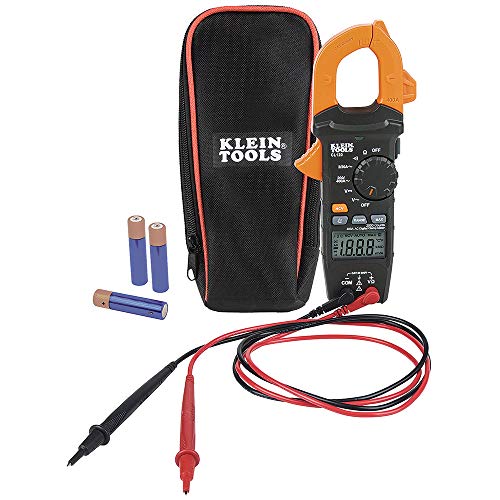
The Klein Tools CL120 is a compact, auto-ranging clamp meter that measures AC current up to 400 A and AC/DC voltage, resistance, and continuity via test leads. It also integrates a non-contact voltage tester (NCVT) into the clamp jaw, allowing quick status checks without touching conductors. The backlit LCD display improves readability in dim environments, making it suitable for service calls or residential work. This meter is best for technicians who need a single tool for basic current, voltage, and continuity tests, plus a quick NCVT check.
Best for: Electricians and DIYers who want a straightforward, all-in-one tool for routine electrical testing with clear visibility in low light.
Caution: The CL120’s NCVT is helpful for quick checks but should not replace proper voltage training or follow-up verification with a meter when precise voltage levels are required.
AstroAI Digital Clamp Meter 2000 Counts CM2K0R

The AstroAI CM2K0R offers a versatile measurement set, including AC/DC voltage and current, resistance, capacitance, and continuity. Note that it cannot test DC current via the clamp, so AC current testing requires clamping around a single conductor rather than the entire power cord. It provides a data hold feature, auto shut-off, backlit display, flashlight, and audible/visual alarms to support use in dim or noisy environments. This model is best for home electricians and hobbyists who want a cost-effective meter with essential safety alarms and easy readability.
Best for: Budget-conscious users who need a reliable baseline meter with comprehensive display features and alarms for everyday electrical work.
Caution: Do not use the clamp to measure DC current, and ensure the conductor is centered within the clamp for accurate AC current readings.
KAIWEETS True-RMS D-Shaped Clamp Meter

The KAIWEETS model features a D-shaped jaw that opens wide enough to clamp around various cables, with true RMS measurements for AC/DC current and voltage. It also includes temperature sensing, NCV detection, capacitance, resistance, and diode testing. Audible and visual alarms aid status indication, making it a strong choice for professionals dealing with complex electrical systems or solar installations. The wide jaw helps accommodate larger cables, which can be a practical advantage on many job sites.
Best for: Professionals who need accurate readings across a wide range of parameters and a comfortable, large-clamp design for larger cables.
Caution: The instrument’s weight and size may be less convenient for quick, one-hand checks in tight spaces.
AstroAI 4000 Counts Digital Clamp Meter
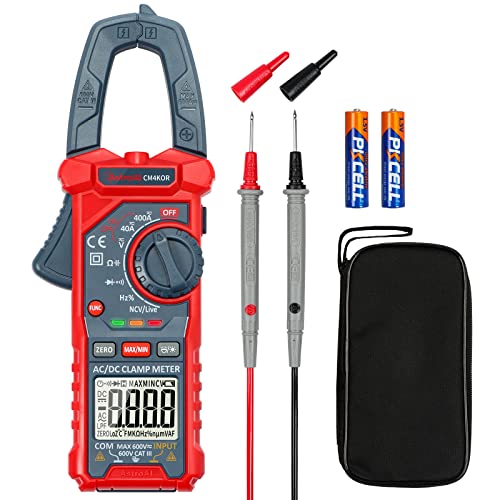
The AstroAI model with 4000 counts expands measurement capabilities to include AC/DC current and voltage, capacitance, frequency, and duty cycle, plus resistance, diode, continuity, and live wire testing. It features non-contact voltage detection with distinct alarms for weak vs. strong signals, a backlit LCD, and a flashlight to illuminate work areas. This meter is well-suited for industrial environments and more demanding electrical tasks where a broader measurement range and robust alarms improve safety and accuracy.
Best for: Industrial settings or workshops requiring extended measurement options and strong voltage detection cues.
Caution: When relying on the NCV feature, always verify readings with direct contact tests if safety permits, as NCV is a non-contact indicator and does not replace direct measurements.
KAIWEETS HT206D Clamp Meter With Temperature

The KAIWEETS HT206D adds a temperature measurement alongside True RMS AC/DC current and voltage, resistance, capacitance, frequency, diodes, continuity, and NCV. It supports auto-ranging with a 6000-count display, making it suitable for laboratories, factories, and skilled home use. The NCV feature helps in quick status checks without direct contact. This meter is ideal for projects where both electrical testing and thermal data are valuable, such as motor control or solar installations.
Best for: Professionals and advanced hobbyists who need temperature readings along with comprehensive electrical measurements.
Caution: Like many clamp meters, clamp only around one conductor for current readings to avoid inaccurate results; ensure the meter’s battery is fresh to maintain auto-ranging performance.
Buying Guide: Key Purchase Considerations
- Measurement range and precision: For general use, 4000-count meters with true RMS are sufficient. For industrial tasks, look for higher counts and broader ranges, including capacitance, frequency, and duty cycle.
- True RMS versus average-responding: True RMS handles non-linear loads more accurately, reducing measurement error on devices like variable frequency drives.
- Non-contact voltage testing (NCVT): Useful for quick status checks but should be followed by direct testing for precision and safety.
- Jaw design: D-shaped jaws accommodate larger cables and multiple conductors—helpful for panel work or multi-core cables.
- Display readability: Backlit LCDs and high-contrast displays improve accuracy in dim environments; reverse-contrast displays offer visibility in bright light.
- Safety and usability: Features like auto shut-off, data hold, max/min, and audible/visual alarms reduce errors and aid in field use.
- Included accessories: Test leads, magnets or hangers, and batteries enhance value and ready-to-use performance out of the box.
Frequently Asked Questions
- What is a clamp meter best for? It measures AC current without breaking the circuit and, with test leads, can also measure voltage, resistance, and continuity. It’s ideal for quick current checks and troubleshooting live circuits.
- Do I need true RMS? Yes, especially with non-linear loads like dimmers or motor drives. True RMS provides more accurate readings than average-responding meters.
- Can I measure DC current with a clamp meter? Some models can measure DC current, but many affordable meters only measure AC current via the clamp. Check the product specs before use.
- How should I use NCVT? NCVT helps detect presence of voltage without contact. It’s a safety check, not a replacement for live voltage testing with proper equipment.
- What jaw size should I look for? A larger or D-shaped jaw accommodates thicker cables and leads to easier, more secure clamping on conductors.
- Is backlighting important? Yes, a backlit or high-contrast display improves visibility in kitchens, basements, or outdoors where lighting varies.