Best Solar Tracker for Solar Panels: Boost Efficiency With Dual and Single Axis Systems
Solar trackers can significantly increase energy yield by properly orienting panels toward the sun. This article highlights five ECO-WORTHY solar tracker products that optimize light exposure, adapt to weather, and save space for homes, farms, and gardens. Each option offers dual-axis or single-axis tracking with smart sensors, helping you capture more sunlight throughout the day. Read on to compare capabilities, installation considerations, and how these trackers perform under wind and snow conditions.
| Product | Brand | Key Benefit | Lightning Quick Specs |
|---|---|---|---|
| ECO-WORTHY Dual Axis Tracking System | ECO-WORTHY | Up to 270° sun tracking; weather safety | 40% power increase; 270° rotation |
| ECO-WORTHY Expanded Dual Axis | ECO-WORTHY | Advanced light sensing; weather leveling | 270° tracking; automatic wind leveling |
| ECO-WORTHY Single Axis Tracking System | ECO-WORTHY | Simple, space-saving efficiency | At least 30% power gain |
| ECO-WORTHY 1200W Tracking System | ECO-WORTHY | High daily output for mid-scale installs | 6.5 kWh/day; ~39.2% more energy |
| ECO-WORTHY 2 Sets Single Axis | ECO-WORTHY | Save space; scalable for multiple panels | 270° adjustment; up to 8 panels |
ECO-WORTHY Dual Axis Tracking System

The ECO-WORTHY Dual Axis Tracking System uses two-axis driving and a sensitive sunshine sensor to rotate panels up to 270°, maximizing sun exposure from north, south, east, and west throughout the day. A wind-speed sensor enables automatic reorientation toward the horizon during gusty conditions, reducing the risk of damage. The base is designed for stability in high winds when anchored with expanding screws. This setup is ideal for larger yard or field installations seeking a substantial power uplift by tracking the sun’s path.
Expanded Dual Axis Tracking System

Enhanced with intelligent light sensing and a high-precision sensor, this expanded dual-axis tracker targets a 270° range of motion to capture more sunlight throughout the day. The system claims a 40% efficiency boost compared with standard brackets. It also includes wind-tolerance features: at wind speeds over a configurable threshold, the tracker automatically levels to a safe angle, and snow can be addressed via manual controller adjustments. This option is suitable for larger panel arrays up to several dozen modules with robust wind handling.
Single Axis Tracking System

The ECO-WORTHY single-axis tracking rack focuses on maximizing efficiency along one axis to keep modules facing the sun along the day’s arc. The system is compatible with a range of panel sizes and configurations, allowing up to four panels in narrower widths or three panels when wider. The design emphasizes straightforward after-sales support, ensuring diagnostics and replacements when needed. With at least a 30% power gain over fixed mounts, this option is a practical choice for space-constrained properties and smaller installations.
1200W Dual-Axis Tracking System

This higher-capacity kit uses six 195W monocrystalline panels and a dual-axis tracker to achieve about 6.5 kWh of daily output under four hours of full sun. The 270° rotation keeps panels oriented toward the sun, delivering approximately 39.2% more energy than fixed brackets. It’s designed for shed, farm, yard, or field use and provides comprehensive customer support pathways to address installation or performance questions.
2 Sets Single Axis Tracking System
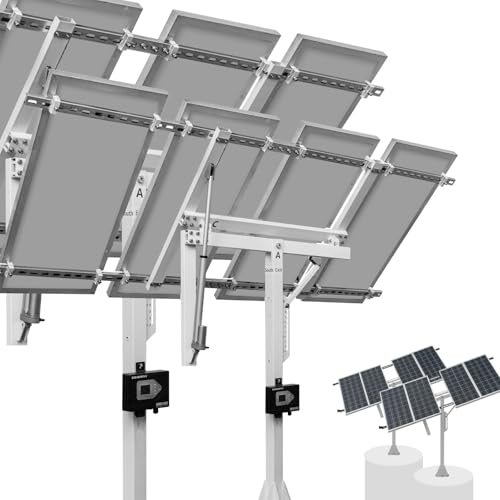
This configuration pairs two single-axis tracking brackets to hold 2–8 panels, depending on size, offering a space-saving alternative to traditional tripod setups. The single-axis design increases energy generation by at least 30% and features a 270° adjustment range, enabling the panels to follow the sun across southeast, north, and northwest orientations. It’s well-suited for homeowners seeking scalable, compact tracking with improved daily output while preserving yard space for family activities.
Buying Guide: Key Purchase Considerations For Solar Trackers
- Sun tracking capability: Dual-axis trackers offer 270° coverage and maximize sun exposure throughout the day, while single-axis options are simpler and space-efficient but still deliver meaningful gains.
- Wind and weather resilience: Look for built-in wind sensors, automatic leveling, and secure mounting options to protect against storms and heavy snow.
- Panel compatibility and space: Verify the number of panels supported, panel size constraints, and the required footprint of the tracker base to fit your installation area.
- Control and automation: Assess sensor accuracy, ease of setup, and whether the controller allows manual overrides for seasonal adjustments or snow removal.
- Maintenance and service: Consider availability of after-sales support, warranties, and replacement parts to minimize downtime.
- Installation complexity: Dual-axis systems may require more complex installation; plan for proper anchoring and potential professional installation for larger kits.
- Cost vs. yield: Compare the expected energy gains against upfront costs, panel wattage, and available space to determine payback period.
- Safety and aesthetics: Ensure the system does not pose safety risks to family members and fits the property’s landscape.