Best Clamp Meter With Temperature for Electrical Diagnostics and HVAC Work
Finding a clamp meter with temperature measurement helps you diagnose electrical and HVAC issues more efficiently. This guide features five reliable models suited for electricians, DIYers, HVAC techs, and automotive technicians. Each entry highlights who benefits most, what sets it apart, and any practical caveats. Whether you need true RMS readings, non-contact voltage detection, or a durable design for hot environments, this list delivers clear, objective comparisons to aid a confident purchase.
| Product | Best For | |
|---|---|---|
| KAIWEETS Digital Clamp Meter With D-Shaped Jaw | General electrical troubleshooting | True-RMS, temperature, NCV, D-shaped jaw |
| Klein Tools CL390 AC/DC Digital Clamp Meter | Professional electricians needing versatile testing | Auto-Ranging, NCVT, temperature, TRMS |
| Fieldpiece SC260 Compact HVACR Clamp Multimeter | HVACR service and field work | True RMS, backlight, NCV, temperature |
| Klein Tools CL220 Digital Clamp Meter | Compact, budget-conscious testing | TRMS, NCVT, temperature, backlit display |
| FNIRSI DMC-100 Clamp Meter | Diagnostics with data recording | 10,000 counts, curve recording, temperature, NCV |
KAIWEETS Digital Clamp Meter With D-Shaped Jaw

This True-RMS clamp meter measures AC/DC current and voltage, plus temperature via thermocouple. It also covers NCV, capacitance, frequency, resistance, continuity, and diode testing. Best for electricians, DIY enthusiasts, and field technicians who need a versatile tool in one compact package. The D-shaped jaw opens to 1.1 inches for easier clamping on larger conductors. A caution: the device relies on proper jaw placement for accurate readings; ensure the conductor is centered in the clamp.
Klein Tools CL390 AC/DC Digital Clamp Meter
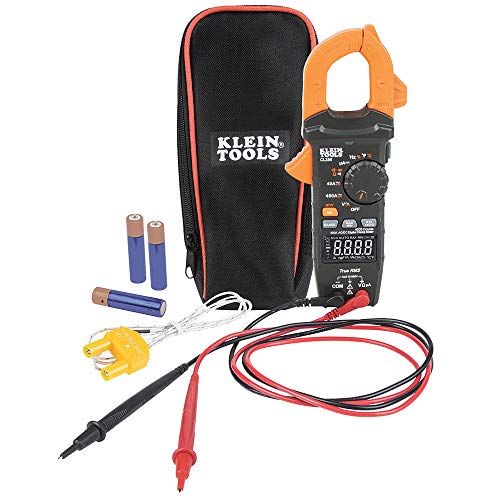
This versatile clamp meter covers AC/DC current and voltage, NCVT detection, resistance, continuity, and more. It adds a temperature measurement option via thermocouple and sports a high-visibility TRMS readout. Best for professional electricians who require reliable, broad-spectrum testing in a single tool. Choose this if you need robust measurement capabilities in a single instrument; a potential limitation is its size for very tight spaces.
Fieldpiece Compact HVACR Clamp Multimeter SC260

Designed for HVACR service in varied temperatures, this clamp meter emphasizes true RMS readings, temperature, capacitance, backlight, and NCV. It’s compact and durable for field use, making it well-suited for technicians who work in hot or cold environments. Best for HVAC pros who need reliable performance in tough conditions; however, learning to navigate its field-specific features may take a bit of time for beginners.
Klein Tools CL220 Digital Clamp Meter

This clamp meter provides AC current measurement via clamp, plus AC/DC voltage, resistance, and continuity with test leads. It includes temperature measurement and a backlit display for visibility in dim environments. Best for technicians seeking a compact, straightforward option with essential features. A limitation: it may lack some advanced functions found in higher-end models.
FNIRSI DMC-100 Clamp Meter

This 10,000-count TRMS clamp meter measures AC/DC current up to 600A, voltage, resistance, capacitance, frequency, and temperature. It adds NCV detection and live wire testing with a 2″ TFT display and curve recording. Best for technicians who need data logging to analyze intermittent faults. A drawback could be the user interface for occasional users who prefer simpler models.
Buying Guide: Key Purchase Considerations
What should I look for in a clamp meter with temperature?
- True RMS: Essential for accurate readings with non-linear loads like variable frequency drives.
- Temperature measurement: Confirm the thermocouple type is compatible with your needs (K-type is common).
- NCV detection: Helpful for safe testing without direct wire contact, especially in occupied panels.
- Clamp jaw size and design: A D-shaped or wide jaw helps clamp larger cables; check maximum conductor size.
- Display quality: Backlit or high-contrast screens improve readability in bright or dark environments.
- Data logging and curve recording: Useful for diagnosing intermittent faults in HVAC or automotive systems.
- Durability and form factor: Consider weather, heat exposure, and how portable you need the tool to be.
How to choose between models?
- For HVAC work in hot/cold environments, prioritize backlight, temperature, and durable construction (Fieldpiece SC260).
- For professional electrical contractors needing broad functionality, consider models with auto-ranging, NCVT, and TRMS (Klein CL390, Klein CL220).
- For budget-conscious beginners, a compact unit with essential readings and temperature may suffice (KAIWEETS D-Shaped, Klein CL220).
- If data capture is important, look for curve recording and multiple data stores (FNIRSI DMC-100).
Frequently Asked Questions
- What does TRMS mean, and why is it important?
True RMS provides accurate readings on non-sinusoidal waveforms common in modern electrical systems. - Can I measure temperature with any clamp meter?
Not all models include a thermocouple or temperature feature; verify thermocouple compatibility before purchase. - Is non-contact voltage detection safe?
NCV helps detect voltage without direct contact, but always follow safety procedures and manufacturer guidance. - Do clamp meters require calibration?
Some units include calibration or verification features, but most buyers rely on routine checks per usage guidelines. - Which model is best for DIY electrical work?
Entry-to-mid level meters with essential readings, temperature, and NCV are typically suitable for DIY projects. - Can I use these meters for automotive diagnostics?
Yes, several models measure current, voltage, and resistance; verify any auto-specific features if needed.