Best RV Solar Panel Kit With Battery and Inverter for Off-Grid Power
Finding a reliable solar kit for RV adventures involves matching panel power, battery capacity, and inverter output to your needs. This guide highlights five top-rated all-in-one kits that pair solar panels, lithium or lead-acid storage, and inverters for off-grid camping. Each option is designed for RV use, easy to install, and optimized for practical daily energy needs on the road.
Summary of Selected Products
- ECO-WORTHY 200W Complete Solar Kit with Battery and Inverter (B0FWRK8JN6)
- ECO-WORTHY 200W 12V Complete Kit with Battery and Inverter (B08MQGHWSZ)
- Mndstek 600W Solar Panel Kit with 300W Panels and 30A MPPT Controller (B0FHWGYNRL)
- ECO-WORTHY 200W 12V Kit with Battery, Inverter and Bluetooth Monitoring (B09RZZHHHM)
- ECO-WORTHY 12V 200W Kit with Battery and Inverter, SOC Display (B0G2K34NW1)
ECO-WORTHY 200 Watt 12V Complete Solar Panel Starter Kit

This complete 200W solar system provides an integrated off-grid solution with two 100W panels, a 100Ah lithium battery, a 1100W inverter, and a 30A PWM charge controller. It’s designed to deliver up to 800Wh daily and store about 1.28kWh, making it a practical RV setup. The kit covers essential connections and cables, offering a novice-friendly four-step installation.
Key features include a total one-stop package, compatibility with RV electrical loads, and long-term support for off-grid trips. The four-step installation process helps users connect panels, battery, controller, and inverter with straightforward steps for reliable power on the road.
ECO-WORTHY 200 Watt 12V Complete Solar Panel Starter Kit
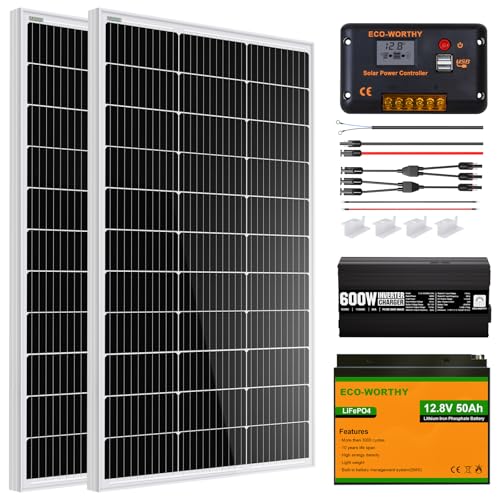
This beginner-friendly kit bundles 200W of solar panels with a 30A controller and a 50Ah Li battery, plus a 600W inverter in some configurations. It’s tailored for RVs, campers, boats, and cabins, boasting up to 800Wh daily output when sunlight is adequate. The panels use a durable aluminum frame and temperate glass, with IP65 protection for outdoor exposure. The LiFePO4 option in some variants delivers a longer cycle life and safer operation than traditional lead-acid batteries.
Mndstek 600 Watt Solar Panel Kit with 300W Panels

This kit upgrades to higher efficiency with 300W panels and an 18BB cell design, offering up to 24.6% efficiency. The kit uses premium monocrystalline silicon and includes built-in MC4 connectors for straightforward installation on RV mounts or rooftops. It emphasizes compact size with robust output for travelers seeking greater energy harvest and easier integration with existing systems.
ECO-WORTHY 200 Watts 12 Volt Kit with High Efficiency Panels

Designed for versatile off-grid use, this 200W kit targets RVs, campers, and small cabins. It emphasizes high efficiency monocrystalline panels and an IP65-rated junction box for protection against the elements. The kit is built for durability against wind and snow loads, with a corrosion-resistant frame and long service life, suitable for regular RV travel and remote camping.
ECO-WORTHY 12V 200W Solar Panel Kit With Battery And Inverter

This all-in-one 200W kit includes two 100W panels, two 100Ah lithium batteries with a SOC display, a premium 1100W inverter, and a 20A MPPT controller with Bluetooth. The setup supports real-time monitoring via Bluetooth and Wi-Fi, enabling remote performance tracking. It targets RV users who want an integrated system with monitoring capabilities and flexible control for off-grid living.
Buying Guide
Key purchase considerations help compare options beyond headline specs:
- Power and storage balance: Look for kits that align daily energy needs with battery capacity. For RVs, 600–800Wh per day is common; choose larger batteries if you run high-draw appliances.
- Battery type and lifecycle: Lithium iron phosphate (LiFePO4) offers longer cycles, better safety, and lower weight than lead-acid. Confirm built-in BMS protections.
- Inverter capacity: Ensure the inverter can handle your peak loads (air conditioner, microwave, etc.). A 600–1100W inverter suits most RV essentials; higher if you run heavy appliances.
- Charge controller: PWM suffices for simpler systems, while MPPT controllers maximize harvest in varied sun, especially on RV roofs with shading or orientation changes.
- Durability and mounting: Look for corrosion-resistant frames, IP ratings, and pre-drilled mounting holes for easier installs on RV roofs.
- Monitoring and connectivity: Bluetooth or Wi-Fi-enabled systems help track performance and diagnose issues remotely.
- Portability and expandability: If you plan to add more panels later, choose kits that support future expansion and compatible connectors.
Compared perspectives:
– All-in-one kits with built-in inverters simplify setup and reduce compatibility concerns, ideal for RV newcomers.
– Higher-efficiency panels save space on limited RV rooftops, especially when traveling in areas with less sun.
– LiFePO4 batteries provide longer life and safer operation, though at a higher upfront cost.
– MPPT controllers generally offer better energy harvest in fluctuating conditions, which is common during travel.