Best Car Battery Charge Controller for Solar Power Systems
Answering the common buyer question, a car battery charge controller helps protect the battery by regulating charging from solar panels or other power sources. This article profiles five practical controllers, highlighting who they’re best for, how they manage charging, and notable limitations. Ideal buyers include RV owners, boaters, off-grid setups, and DIY enthusiasts seeking reliable, straightforward battery protection and optimized lifespan. Use this guide to compare PWM and MPPT options, consider voltage compatibility, and determine which controller fits your battery chemistry and system size.
| Product | Best For | Key Benefit |
|---|---|---|
| Renogy Wanderer 10A | RV, Marine, Small Off-Grid | Four-stage charging and flexible loads |
| SOLPERK 8A | Outdoor use, Budget setups | IP67 waterproof, robust safety features |
| AeternaSol 20A PWM | Larger 12V systems | Higher current for faster charging |
| SUNER POWER MPPT 12W | Trickle charging, portable systems | Ultra-Smart MPPT with high efficiency |
| Depvko 30A PWM | Lead-acid focused, 12/24V | Dual USB for device charging |
Renogy Wanderer 10A PWM Charge Controller
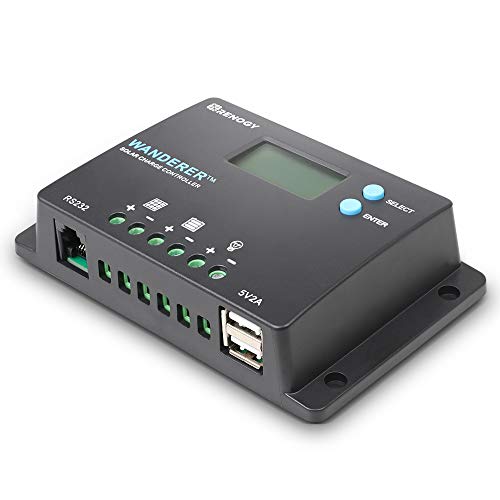
The Renogy Wanderer 10A is a negative-ground PWM controller designed for 12V/24V systems, compatible with AGM, Gel, Flooded, and Lithium batteries. It features a smart 4-stage charging (Bulk/Boost/Float/Equalization) intended to maximize battery life and solar efficiency. Best for compact RV, marine, or small off-grid setups where cost-conscious, reliable regulation is key. Caution: the Wanderer is PWM, so it charges with less efficiency than MPPT in space-limited, low-sun conditions. Suitable for smaller solar arrays and basic protection needs.
SOLPERK 8A 12V Solar Charge Controller

The SOLPERK 8A controller offers IP67 waterproof protection and six safety features to guard against reverse current, overheating, short circuits, overcharging, over-voltage, and reverse polarity. It uses intelligent LED indicators to show charging status. Best for outdoor or humid environments where weatherproofing and battery protection are priorities. Choose this if you need reliable protection in a budget-friendly package; flow control and display are straightforward, but expect fewer advanced features than higher-end MPPT models.
AeternaSol PWM Solar Charge Controller 12V20A
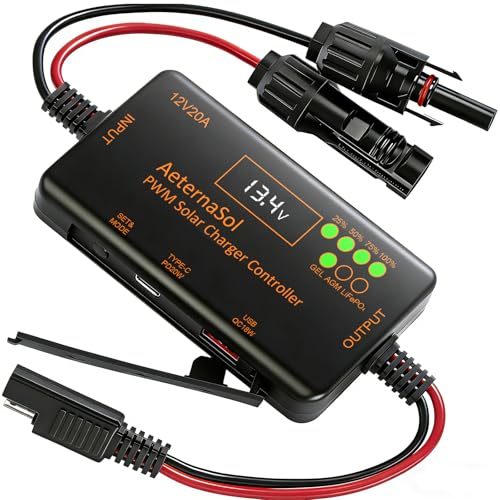
This 12V/24V PWM controller delivers upgraded 20A charging with precise compatibility for 12V battery systems and panels under 300W. It includes LCD monitoring, adjustable charging modes for lead-acid, lithium, and other batteries, and built-in protections like anti-reverse diodes. Best for medium to larger 12V installations where faster charging and clearer status readings matter. Limitation: it does not explicitly support higher voltage packs beyond 12V/24V and requires correct polarity connections to avoid damage.
[Upgraded] 30A Solar Charge Controller (Depvko)
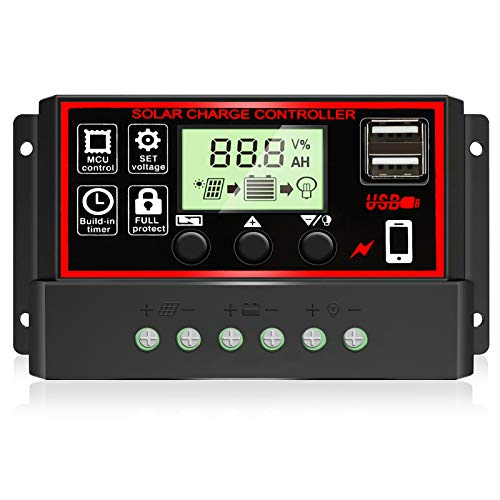
The Depvko 30A PWM controller supports 12V/24V systems with multiple protections and a built-in USB port for charging devices. It’s designed to improve system efficiency and battery lifespan with 3-stage PWM management. Best for larger 12V setups requiring higher current capacity and occasional charging of USB devices. Limitation: the product page notes suitability primarily for lead-acid types (OPEN, AGM, GEL); compatibility with lithium variants may vary and should be verified before use.
Buying Guide
- What type of controller do you need? PWM vs MPPT. PWM is simpler and cheaper; MPPT is more efficient, especially in hot climates or when panel voltage exceeds battery voltage.
- What is your battery chemistry? Confirm compatibility with AGM, Gel, Flooded, LiFePO4, or other chemistries. Some controllers explicitly support multiple chemistries, others are limited to lead-acid.
- What system voltage and power rating do you require? Ensure the controller supports 12V or 24V and has sufficient amperage for your panels and battery bank.
- Protection features. Look for safeguards against overcharge, reverse polarity, short circuits, and temperature effects. An LCD or LED status display helps with quick diagnostics.
- Environmental conditions. If the install is outdoors, water and dust resistance (IP rating) can extend controller life.
- Physical fit and installation. Check dimensions, mounting options, and whether you need negative or positive ground configurations for your setup.
- Future expansion. If you plan to increase panel count or battery capacity, choose a controller with headroom to avoid replacement later.
Frequently Asked Questions
- What is a car battery charge controller used for? It regulates charging from solar panels to protect and extend the life of 12V or 24V batteries used in vehicles, boats, RVs, and off-grid systems.
- Do I need MPPT or PWM for my system? MPPT offers higher efficiency, especially with mismatched panel voltages or larger arrays. PWM is adequate for small systems on a budget.
- Can these controllers charge lithium batteries? Some models support lithium chemistries; verify compatibility in the product specs before use.
- Is waterproofing important? Outdoors or marine applications benefit from water/dust resistance, reducing corrosion and damage.
- Will a higher amperage controller always be better? Not necessarily. Match the controller’s amperage to your panel output and battery capacity to avoid wasted energy and unnecessary cost.
- Do these controllers have built-in protections? Most include overcharge, short-circuit, reverse polarity, and temperature protection to safeguard the battery and wiring.