Best Air Flow Velocity Meters for HVAC and Drone Applications
Answering the need for precise air velocity and airflow measurements, these top air flow velocity meters are suited for HVAC installation, duct testing, drone operations, and outdoor activities. They help professionals and hobbyists accurately track wind speed, temperature, and CFM to optimize performance. Buyers can choose based on range, units, data logging, and mounting options. The following selections highlight models with clear measurement capabilities, portability, and practical features for different use cases.
| Product | Best For | Key Benefit |
|---|---|---|
| BTMETER BT-100 | HVAC pros, drone operators | Wide unit support; tripod mounting |
| BTMETER BT-816B | Outdoor enthusiasts, field pros | Auto/Manual modes; compact with backlight |
| TopTes TS-301 | Sports/outdoor activity lovers | Big backlit display; multiple units |
| AIOMEST AI-826A | HVAC techs, installers | Extensible reach; tripod-ready |
| Testo 405i | HVAC specialists | In-duct airflow with Bluetooth/app |
BTMETER BT-100 Handheld Anemometer

The BT-100 measures wind speed, wind temperature, and wind chill with a bright backlit LCD. It supports multiple units (m/s, km/h, ft/min, knots, mph) and displays temperature in ℃/℉. Two temp sensors and eight vanes improve sensitivity for low air flows, useful for HVAC duct work and CFM calculations. Best for: HVAC technicians performing duct testing and drone operators needing a lightweight, accurate wind gauge. Limitations: accuracy is stated around +/- 2% for wind speed and +/- 2℃ for temperature, which may vary with environmental conditions.
BTMETER Anemometer BT-816B

The BT-816B provides precise wind speed readings (0.3–30 m/s) with a backlit display and height-appropriate measurements, including wind chill and temperature in real time. It supports multiple units and modes (Max/Avg/Current) and is suited for sailing, drone work, and HVAC assessments. Best for: outdoor measurement tasks where rapid, portable wind readings are needed. Limitation: ±5% of reading accuracy, typical for compact consumer devices.
TopTes TS-301 Digital Anemometer
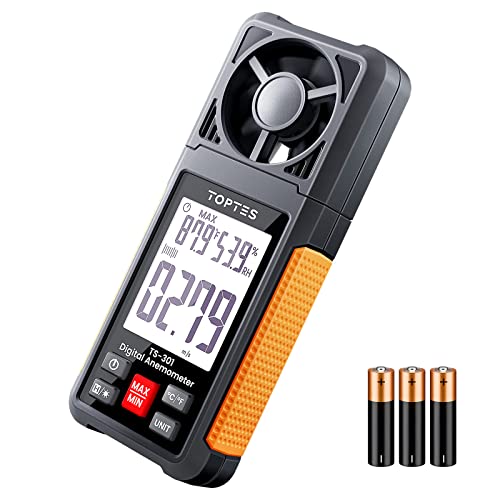
The TS-301 features a large 2.26-inch LCD backlit screen and six measurement units (ft/m, ft/s, mph, knots, km/h, m/s). It also provides wind humidity and wind temperature readings, with a humidity range of 0.0%–99.9%RH and temperature from -4.0°F to 140.0°F. Best for: outdoor sports, drone flying, and testing indoor airflow in HVAC with a readable display. Caution: humidity and temperature sensors may require up to 30 minutes to stabilize after environmental changes.
AIOMEST Pro HVAC Anemometer AI-826A

The AI-826A offers a broad wind speed range (0.001–100 mph) with ±5% accuracy and extends measurement reach with a 79-inch USB cable and telescopic rod. A 1/4″ tripod mount enables hands-free, continuous airflow data in HVAC installations or air vent inspections. Best for: professionals needing extended reach and easy mounting for duct work. Limitation: data is most actionable with a stable setup; field use may require careful setup to avoid cable interference.
Testo 405i Anemometer with Bluetooth

The Testo 405i is an in-duct airflow and temperature meter with extendable 15″ shaft and Bluetooth connectivity for app integration. It provides precise velocity and temperature readings and can calculate volume flow when duct dimensions are supplied. Best for: professional HVAC technicians performing ductwork assessments with wireless data access. Caution: Bluetooth features depend on app compatibility and device pairing success in the field.
Buying Guide
What should I consider when choosing an air flow velocity meter?
- Measurement range and units: Ensure the device covers your typical wind speed range and offers preferred units (m/s, mph, km/h, ft/min, knots).
- Temperature and humidity: If you need environmental context, select models with temperature and humidity sensors and note their accuracy ranges.
- Mounting and reach: For HVAC ducts or long-distance measurements, look for tripod mounts, extendable poles, or long cables that enable hands-free operation.
- Data logging and connectivity: USB data export or Bluetooth/app integration helps with record-keeping and analysis in a workplace setting.
- Display readability: A bright backlight and larger digits are beneficial for outdoor work or precise readings in tight spaces.
- Durability and versatility: Consider models with multi-mode measurement (Real-time, Max/Min/Average) and rugged designs for field use.
How do I decide between handheld meters and in-duct meters?
- Handheld meters: Ideal for quick checks, outdoor activities, and spot measurements without duct access.
- In-duct meters: Best for HVAC inspections, balancing airflow in ducts, and continuous monitoring where duct measurements are essential.
Frequently Asked Questions
- What is air flow velocity, and why is it important?
– Air flow velocity is the speed at which air moves through a space or duct, critical for balancing HVAC systems and ensuring drone flight stability in outdoor conditions. - Which unit is best for HVAC work?
– Many pros favor m/s or ft/min for direct readings, with CFM calculations useful when duct area is known. - Can these meters measure temperature?
– Most models include wind temperature sensors; accuracy varies by device and environmental conditions. - Do I need Bluetooth or USB data export?
– Bluetooth/app connectivity is convenient for field technicians; USB export is useful for office analysis and record-keeping. - How accurate are handheld meters?
– Accuracy ranges typically from +/- 2% to +/- 5% of reading, depending on model and environmental factors.