Best 3 HP Dust Collector Motors for Woodworking Shops
Answering the question for buyers: these 3 HP dust collector motors are designed to deliver strong air movement, decent filtration, and reliable performance for small to mid-size workshops. They’re best for hobbyists and small professional shops needing continuous dust collection without the heft of industrial systems. Below are five top options, with clear reasons to choose each one and practical trade-offs to consider.
Summary table of selected products:
| Product | Motor | Key Benefit | Best For |
|---|---|---|---|
| Oasis DC3000 Heavy Duty 3HP Wood Dust Collector | 3 HP | Compact 3-HP system with 1900 CFM | Small to mid-size workshops needing reliable suction |
| Powermatic TurboCone PM1900TX-CK1 | 3 HP | TurboCone separation and 2-micron canister | Precision filtration for fine dust |
| JET JCDC-3 Cyclone Dust Collector | 3 HP | High-efficiency cyclone with 2-micron filter | Best for high chip separation |
| Powermatic PM1900TX-CK3 | 3 HP | 2-micron canister with strong performance | Heavy-duty 3-HP setup for continuous use |
| Oasis DC5000 Heavy Duty 5 HP | 5 HP | High capacity and multi-tool hookups | When expanding to multi-tool cabinet setups |
Oasis DC3000 Heavy Duty 3HP Wood Dust Collector

The Oasis DC3000 uses a 3 HP, 220V single-phase motor rated at 3,450 RPM with a 12 A draw. It supports a 6″ maximum inlet and offers a 1900 CFM suction capacity, suitable for feeding multiple tools via a 3-way x 4″ inlet adapter. Best for small-to-medium shops that need steady dust collection without oversized equipment. Caution: ensure electrical setup matches 220V single-phase requirements to avoid tripping breakers during peak operation.
Powermatic TurboCone PM1900TX-CK1 3HP Dust Collector

The PM1900TX-CK1 features TurboCone technology to improve chip separation and bag packing efficiency. The 3-HP motor provides ample power for consistent airflow, and a remote-controlled digital timer enables programming up to 99 minutes. This model is best for precision dust collection in small to mid-size shops that need automated shutoff and improved filtration. Limitation: remote timer features rely on proper line-of-sight and battery status; consult installation for best results.
JET Cyclone Dust Collector JCDC-3

The JCDC-3 uses a 3 HP motor and cyclone-based design to capture a high percentage of smaller particles. It captures 99% of 2-micron particles and 86% of 1-micron particles, with remote timer options for extended runs. Best for users prioritizing fine dust control and convenience of automated operation. Caution: cyclone performance can depend on duct layout; ensure properly sized plumbing to maximize efficiency.
Powermatic PM1900TX-CK3 3HP Dust Collector
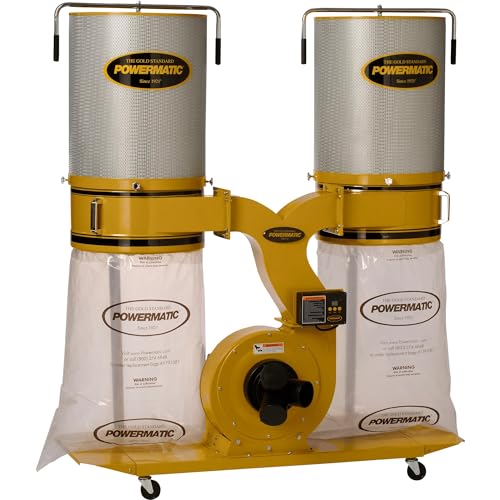
The PM1900TX-CK3 upgrades with a 2-micron canister filter and a robust 3-HP motor for heavy-duty use. The TurboCone design maintains improved separation and efficient bag packing. This option is best for shops needing strong, ongoing dust control with finer filtration. Limitation: 3-phase or single-phase electrical compatibility should be verified against your workshop power supply.
Oasis DC5000 Heavy Duty 5 HP Wood Dust Collector

The DC5000 uses a 5 HP motor and 2760 CFM, supporting multiple tools simultaneously via 3-way 4″ inlets and a larger 14.10 cubic feet bag volume. Best for expanding shops that need serious flow with the ability to connect several machines at once. Caution: higher upfront footprint and power requirements may require dedicated electrical planning and space planning for optimal performance.
Buying Guide: 3 HP Dust Collector Motors
- Power and airflow: Match CFM ratings to your tool lineup. More CFM is better for multiple tools; consider duct layout to minimize losses.
- Filtration type: 2-micron canisters offer finer dust capture than standard bags. If you generate fine dust, prioritize canister filtration.
- Inlet size and configuration: Common inlets are 4″ and 6″. Ensure the collector’s ports align with your workshop tools and ducting plan.
- Electrical requirements: Verify voltage, phase, and amperage. A 3 HP system typically runs on 208-240V; ensure circuits can handle startup surges.
- Remote control and timers: Timers can automate shutoff, improving efficiency in mixed-use shops.
- Footprint and noise: Larger units offer higher throughput but require more space and can be louder. Assess your noise tolerance and space constraints.
- Maintenance: Look for easy bag replacement, accessible filters, and simple filter-cleaning routines to minimize downtime.
FAQ
- What does 3 HP mean for dust collectors?
HP refers to motor power. A 3 HP unit delivers solid suction for small to mid-size workshops, suitable for single or a few tools running simultaneously.
- Is 2-micron filtration necessary?
For fine sawdust and particles, yes. 2-micron canisters capture finer dust than 30-micron bags, improving air quality and filtration efficiency.
- Can I use a 3 HP dust collector with a 4″ inlet?
Yes. Many 3 HP models use 4″ inlets or adapters. Check your tool’s dust port size and plan ducting accordingly.
- Should I choose a 3 HP or a larger motor?
Choose based on tool count, material volume, and space. A larger unit (like 5 HP) is better for multi-tool setups but requires more space and power.
- What maintenance is typical?
Regular bag/filter replacement, dust disposal, and occasional impeller inspection keep performance steady. Follow the manufacturer’s service guidelines.