Best 400 Watt Solar Charge Controller for Stable Off-Grid Power
Answering the buying question: a 400-watt solar charge controller is ideal for mid-size off-grid setups, RVs, boats, and cabins seeking efficient MPPT or PWM regulation. The right model will maximize energy capture, protect batteries, and suit your system voltage (12V, 24V, 36V, or 48V). This guide highlights five prominent options and explains who each is best for, with practical comparisons to help you decide.
| Product | Best For | Key Benefit | Battery Type Note |
|---|---|---|---|
| ECOBOSS 60A MPPT | Balanced off-grid systems, RVs | Ultra-efficient MPPT tracking and high safety features | Supports lithium and lead-acid varieties |
| Renogy Rover 40A | Extreme climates and metal environments | Strong protection and wide operating temperature range | Works with Gel, AGM, Flooded, Lithium |
| SolarEnz 400W Boost MPPT | Golf carts, EV adaptations, small solar kits | Boosts 12V to higher voltages for multi-battery systems | Lead-acid and Li-batteries supported |
| Victron SmartSolar MPPT (50A/30A variants) | System-wide optimization and scalability | Bluetooth-enabled, synchronized charging across controllers | Multiple chemistries supported |
| Depvko 30A PWM | Compact, budget-conscious setups | Adjustable LCD, dual USB, easy auto-adaptation | Lead-acid only |
ECOBOSS 60A MPPT Solar Charge Controller
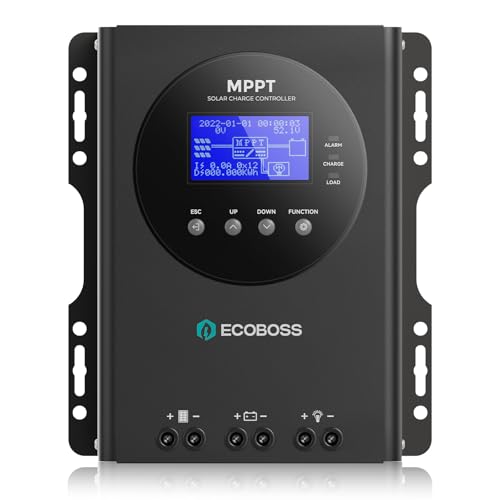
The ECOBOSS 60A MPPT controller uses advanced multi-peak MPPT technology with high efficiency (≥99.5% tracking and 97.5% conversion). It auto-detects 12V/24V/36V/48V battery systems, making it versatile for RVs, off-grid cabins, and marine applications. Best for users who want robust performance across varying light conditions and battery chemistries, including lithium and several lead-acid variants. A notable limitation is the need to verify compatibility with non-standard lithium chemistries beyond LiFePO4 or Li-NCM before purchase.
Who this is best for: Off-grid enthusiasts and small- to mid-size systems seeking high tracking efficiency and safety features. Choose this if you value real-time monitoring, automatic current and power limiting, and broad battery compatibility.
Renogy Rover 40A MPPT Charge Controller

The Renogy Rover 40A MPPT controller delivers high conversion efficiency and an all-weather design, suitable for Gel, AGM, Flooded, and Lithium batteries. It supports extreme temperatures and includes rust-resistant build with comprehensive protections, including reverse polarity, overcharge, and short-circuit safeguards. Best for installations in harsher environments where reliability matters. A potential limitation is the 40A rating, which may require a higher-capacity unit for larger 400W-plus arrays in future expansions.
Who this is best for: Off-grid systems in variable climates where dependable protection and efficient charging are priorities. Choose this if you need solid protection plus automatic adaptation to battery type.
SolarEnz 400W Boost MPPT Solar Charge Controller
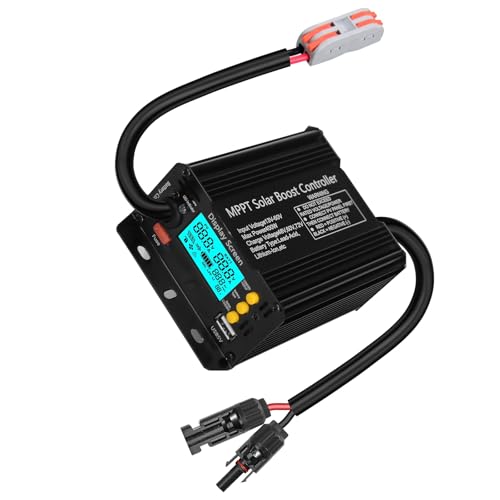
The SolarEnz Boost MPPT controller focuses on boosting solar panel voltage to charge higher-voltage batteries in golf carts, EVs, and similar setups. It supports 24V/36V/48V/60V/72V battery systems and protects the system from overcharging, reverse polarity, and temperature-related issues. Best for users who want to extract more value from a smaller solar array by boosting voltage. Limitation: it is designed primarily for lead-acid and some lithium types; confirm compatibility with your exact lithium chemistry before use.
Who this is best for: Golf cart and small EV setups needing voltage boosting without adding more panels. Choose this if you plan a compact system with a boost capability to reach higher-battery voltages.
Victron Energy SmartSolar MPPT (50A) Bluetooth

Victron SmartSolar MPPT controllers are known for synchronized charging and Bluetooth convenience. The 50A variant provides fast maximum power point tracking and intelligent charging algorithms to optimize energy harvest, especially when panels are partially shaded. They excel in scalable systems where multiple controllers can behave as a single unit. A caution: Victron devices often require familiarization with the app and system setup to unlock full features.
Who this is best for: Systems that may scale in the future or operate in mixed shading conditions. Choose if you want remote monitoring and coordinated charging across multiple controllers.
Victron Energy SmartSolar MPPT (Bluetooth) 30A

This Victron 30A model provides the same Bluetooth-enabled SmartSolar MPPT features in a lighter package. It’s well-suited to small to mid-size installations with frequent shading or where battery longevity is a priority. Best for compact systems where performance and remote management matter. Limitation: lower current rating means it may be less suitable for higher-wattage arrays without additional controllers.
Victron Energy SmartSolar MPPT 15A (Bluetooth)

Victron’s 15A Bluetooth-equipped model is designed for tiny to small off-grid systems or as a dedicated charger for a single bank. It offers synchronized charging and robust MPPT performance at a compact scale. Best for auxiliary charging or highly budget-conscious builds. Limitation: the 15A rating may not suffice for a 400W solar array depending on panel voltage and configuration.
Depvko 30A PWM Solar Charge Controller

The Depvko PWM controller offers an adjustable LCD and dual USB output for mobile device charging, with automatic adaptation for 12V or 24V systems. It is compatible with lead-acid chemistries and includes protections against reverse polarity, overcharging, overload, and short circuits. Best for budget-minded users building small systems or as a secondary controller for simple setups. Limitation: PWM efficiency is typically lower than MPPT, which may reduce energy harvest in hotter conditions or with higher-voltage panels.
Buying Guide: Key Considerations For a 400W Solar Controller
- System voltage and battery chemistry: Ensure the controller supports your battery type (lead-acid variants or lithium) and the system voltage you run (12/24/36/48V).
- MPPT vs PWM: MPPT controllers generally harvest more energy, especially in partial shade or cooler environments. PWM can be cost-effective for small systems but is less efficient with higher panel voltages.
- Current rating vs array size: A 400W array at 24V typically needs a controller that can handle at least 15-20A; higher voltages may require different current ratings. Choose a model with a margin to accommodate future expansion.
- Protection and safety: Look for overcharge, over-discharge, short-circuit, reverse polarity, and temperature protections, plus corrosion resistance for outdoor placement.
- Monitoring and connectivity: Bluetooth or app support helps in long-term maintenance and optimization. Consider models that synchronize across multiple controllers if you plan larger or modular systems.
- Physical environment: For extreme temperatures or humid climates, prefer rugged housings and wide operating ranges. Check for IP ratings if you install outdoors.
- Expansion potential: If you anticipate adding panels or batteries, choose an MPPT unit with higher current tolerance or plan for a compatible next step in your system.
Frequently Asked Questions
- What is the difference between 400W and 60A MPPT controllers?
- Do I need MPPT for a 400W system?
- Can I mix battery chemistries with one controller?
- Is Bluetooth monitoring essential?
- What should I consider for outdoor installations?
- Can I upgrade to a higher-wattage controller later?
400W refers to the panel power handling, while 60A MPPT indicates the charging current capacity. The right pairing depends on panel voltage and system voltage; MPPT efficiency and current tolerance determine how much energy you can safely transfer to the battery bank.
MPPT is generally preferred for higher efficiency, especially if your panels operate at higher voltage or you experience shading or long wire runs. It helps maximize energy harvest compared to PWM in most configurations.
Some controllers support multiple chemistries, especially Lithium and various lead-acid types. Verify the exact supported chemistries for your model before connecting incompatible batteries.
Bluetooth or app monitoring is convenient for ongoing system management but not strictly essential. It can help you optimize charging stages and detect issues early.
Choose a controller with robust protection features and a weather-resistant build. Ensure proper mounting, cable sizing, and ventilation to prevent overheating in hot climates.
Yes, but plan for system voltage and battery type compatibility. A future upgrade often involves parallel controllers or a higher-current MPPT unit that can handle the expanded array.
Summary Of The Chosen Products
The products above were selected for a range of common 400W-class setups, balancing efficiency, protection, and adaptability. For high-efficiency systems in variable light, MPPT models from ECOBOSS, Renogy, and Victron provide strong tracking and safety features. For compact or specialized builds, SolarEnz and Depvko offer boost and PWM options suitable for smaller arrays or budget-conscious configurations.