Best Solar Panel Power Controllers for RVs and Off-Grid Systems
The best solar panel power controllers balance battery longevity with efficient charging across common battery chemistries. This guide highlights five top options suited for RVs, boats, and off-grid setups, including PWM and MPPT types. Choose based on your battery type, system voltage, and space constraints. The top picks are ideal for users seeking reliable, easy-to-configure controllers that maximize solar intake while protecting the battery bank.
| Product | Best For | Key Benefit |
|---|---|---|
| Renogy Wanderer 10A | Small RV/off-grid setups with 12V systems | Advanced 4-stage charging with LCD, compact design |
| Renogy Wanderer Li 30A | Lithium and mixed battery types in medium grids | Lithium-friendly with robust 4-stage charging |
| Renogy Adventurer 30A | RV and marine installations needing LCD monitoring | Flush-mount design and real-time data |
| Victron Energy SmartSolar MPPT 30A | Maximize power with MPPT for shaded or variable sun | Smart synchronization across multiple controllers |
| AeternaSol 20A PWM | 12V systems needing USB outputs | 20A PWM with clear LCD and integrated USB |
Renogy Wanderer 10A PWM Negative Ground Controller
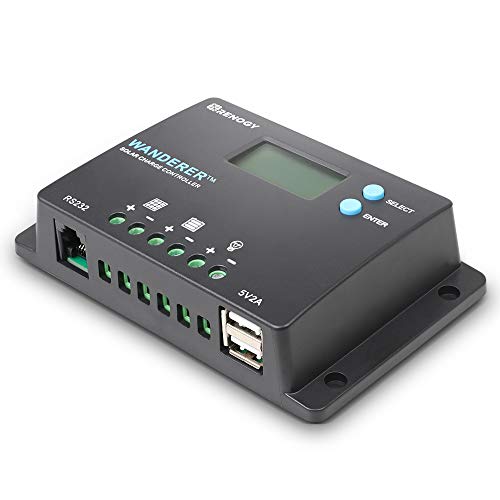
Product overview: Renogy Wanderer 10A is a PWM solar charge controller designed for 12V/24V systems with a negative ground design. It supports AGM, Gel, Flooded, and Lithium batteries. It includes a compact form factor (5.2×3.1 inches) and an LCD display for real-time status. The controller is suitable for RV electrical cabinets or marine control panels and features four-stage charging: Bulk, Boost, Float, and Equalization, to maximize battery life.
Best for: Small RVs, boats, or off-grid cabins using 12V power with varied battery chemistries. The 10A capacity is ideal for compact solar arrays and limited loads.
Why selected: It offers a balance of simplicity, safety, and battery protection with an LCD readout and robust protection features (overcharge, over-discharge, short circuit, reverse polarity, and temperature compensation).
Caution / Limitation: Not ideal for large arrays or high-load systems; use when panel output is modest and battery capacity aligns with 10A charging.
Renogy Wanderer Li 30A PWM Controller

Product overview: Wanderer Li 30A is a PWM regulator designed for 12V systems with support for Lithium, AGM, Gel, and Flooded batteries. It uses four charging stages (Bulk/Boost/Float/Equalization) and adds a lithium-optimized charging curve. It features a compact footprint and LEDs for real-time monitoring, suitable for RVs, boats, and off-grid installations.
Best for: Medium-size off-grid systems and RVs using Lithium or AGM batteries, needing robust protection and straightforward controls.
Why selected: It combines higher current capacity with Li-friendly charging and a small form factor for tight installations.
Caution / Limitation: Not compatible with lithium chemistries beyond those listed; verify battery type compatibility before use.
Renogy Adventurer 30A PWM Controller

Product overview: Adventurer 30A is a 12V/24V PWM solar charge controller with a flush-mount design, compatible with Sealed, Gel, Flooded, and Lithium batteries. It features four-stage charging and a real-time LCD display for monitoring. Aims at smooth integration into RV/marine walls with a sleek look and easy setup.
Best for: RVs or boats where a built-in LCD readout and a flush-mount design simplify installation and daily monitoring.
Why selected: The Adventurer line provides proven PWM performance with safe, multi-battery compatibility and a compact, integrated look.
Caution / Limitation: Not recommended for high-current lithium-only configurations beyond its 30A rating; consider MPPT for faster charging in shaded conditions.
Victron Energy SmartSolar MPPT 30A

Product overview: Victron SmartSolar MPPT 30A is an MPPT solar charge controller designed to maximize power output and extend battery life. It supports 12/24V systems and can synchronize with other SmartSolar units to behave as a single system, enabling efficient energy management in larger microgrids or multi-panel setups.
Best for: Off-grid systems seeking maximum efficiency, especially in partially shaded conditions, and multi-controller synchronization for larger installations.
Why selected: MPPT technology offers superior efficiency under variable sun, and synchronization adds system-wide optimization for broader solar arrays.
Caution / Limitation: MPPT units may be more complex to configure; ensure compatibility with battery type and wiring practices.
AeternaSol PWM Solar Charge Controller 20A
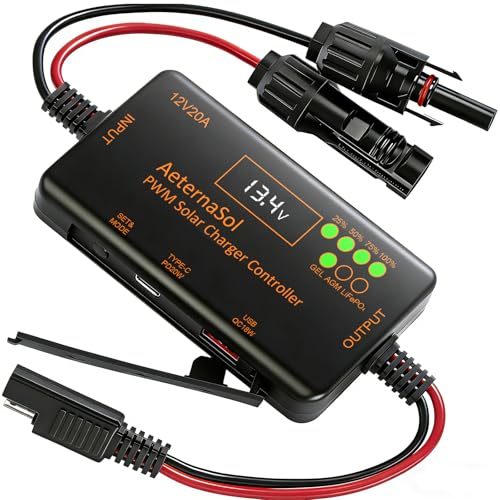
Product overview: AeternaSol offers a 20A PWM controller with a 12V system focus and a PD 22W/QC 18W USB-C output. It provides a clear LCD display, dual USB outputs, and support for lead-acid batteries (not suitable for Lithium). It is designed for compact installations and straightforward monitoring.
Best for: Small off-grid rigs or portable setups needing USB charging alongside battery management, with simple 12V battery support.
Why selected: The USB outputs add convenient device charging while preserving battery health through three-stage PWM control.
Caution / Limitation: Not compatible with Lithium battery chemistries; ensure battery type matches the controller’s supported options.
Buying Guide: How to Choose the Right Solar Panel Power Controller
- System voltage and battery type: Confirm whether your system runs at 12V or 24V and whether you use Lead-Acid (Open, AGM, Gel, Flooded) or Lithium batteries. MPPT controllers maximize efficiency with higher panel voltages and mixed chemistries, while PWM controllers are simple and cost-effective for smaller arrays and common battery types.
- Current rating vs. panel output: Match the controller’s amperage rating to the maximum current your solar array can safely produce. Oversizing adds durability, but the controller should be able to handle peak current without overheating.
- Charging profile and stages: Four-stage charging (Bulk, Boost, Float, Equalization) helps extend battery life. Lithium-friendly profiles and automatic stage switching can improve performance for specific chemistries.
- Protection features: Look for overcharge, over-discharge, short-circuit, reverse polarity, and temperature compensation protections to guard batteries and wiring.
- Monitoring and interface: LCD displays and mobile app compatibility improve visibility into charging status, voltage, and stage. Consider flush-mount or compact designs for tight installations.
- Physical design and installation: Negative-ground compatibility, waterproof ratings (IP), and mounting options influence placement inside RVs, boats, or outdoors.
- Future expandability: For larger systems, MPPT controllers that synchronize with others can simplify adding more panels or batteries later.
Frequently Asked Questions
- What’s the difference between PWM and MPPT controllers? PWM controllers regulate charging by reducing the panel voltage to match the battery, while MPPT controllers actively convert excess voltage into additional charging current, improving efficiency, especially with higher panel voltages or cooler conditions.
- Can I use these controllers with Lithium batteries? Some PWM models support Lithium with proper settings; verify each product’s battery compatibility. MPPT options like Victron SmartSolar often provide robust Lithium support with appropriate configurations.
- Do I need a separate battery monitor? While not required, a battery monitor helps you track state of charge, health, and temperature, enabling better long-term management of the system.
- Is a flush-mount design important? For RVs or boats, a flush-mount controller reduces bulk and helps with clean interior installations, though it is not essential for all setups.
- What happens if the panel voltage is too high? Controllers have maximum input voltages. Exceeding these may damage the controller or reduce charging efficiency; always verify open-circuit voltage (Voc) relative to the controller’s specs.
- Can I connect multiple controllers for a larger system? MPPT controllers can synchronize in some cases to operate as a single system. PWM controllers generally operate independently unless a dedicated bus is used.