Best 3 Hp AC Motor Options for Home and Workshop Applications
The top picks for a 3 hp or near-3 hp AC motor lineup are evaluated for reliability, compatibility, and ease of use in common setups like air compressors, HVAC fans, and general machinery. This guide targets buyers seeking durable single- or multi-speed motors for industrial, agricultural, or DIY projects. Below, five suitable options are highlighted with who they’re best for, key specs, and practical tips.
Summary of chosen products:
| Product | Frame / Power | Voltage / RPM | Best For |
|---|---|---|---|
| VEVOR 3/4HP Electric Motor | 56C Frame | 115V/230V, 1725 RPM | General equipment, light air compressor work |
| HHQ RV Air Conditioner Motor | Various (2-speed) | 115V, 1675/1080 RPM | RV AC replacement, Coleman Mach models |
| A.O. Smith ORM5458 (Century) | 48Y Frame | 208-230V, 1075 RPM | Condenser or condenser-fan duties |
| VEVOR 3 HP Electric Motor | 184T Frame | 230V, 1750 RPM | Air compressors, higher torque needs |
| CNMXIAN ORM5458 Condenser Fan Motor | 48Y Frame | 208-230V, 1075 RPM | HVAC unit fans, OEM replacements |
VEVOR 3/4HP Electric Motor 1725 RPM

Key specs include a 0.75 HP, single-phase design with dual voltage options: 115V or 230V at 60 Hz. The motor runs at 1725 RPM with a service factor of 1.15 and uses a 56C frame. A 5/8″ keyed shaft and 0.188″ keyway support versatile attachment to agricultural or general equipment. Reversible CW/CCW rotation simplifies wiring for various installations.
Best for: Small to mid-size machinery, agricultural equipment, and air compressors requiring a compact, reversible motor. Choose this if you need flexible voltage options and a compact 56C frame.
Caution: Verify shaft length and mounting clearance to ensure compatibility with your existing equipment. The dual rotation option requires correct wiring to avoid misrotation on initial startup.
HHQ RV Air Conditioner Motor with Capacitor

This motor is a 1/3 HP model with two speeds: 1675 RPM and 1080 RPM, designed for RV air conditioning systems. It includes a capacitor (7.5 μF/370V) and a double shaft configuration. It’s engineered as a direct replacement for common Coleman Mach and similar models with long-standing compatibility references in its feature list.
Best for: RV owners performing a direct rotor or fan motor replacement in Coleman Mach units with legacy part numbers. It’s a solid fit for retrofit projects needing a two-speed fan motor with capacitor included.
Caution: Confirm compatibility with your specific Coleman Mach model and the included capacitor’s rating, as mismatches can affect start/load behavior and efficiency.
A.O. Smith ORM5458 1/3-1/6 HP Condenser Motor

This motor covers a 1/3 to 1/6 HP range with 1075 RPM operation at 208-230 volts, housed in a 48Y frame and sleeve bearing design. It is positioned as a condenser motor option, aligning with HVAC applications and similar equipment requiring modest horsepower and efficient operation.
Best for: HVAC condenser fan duties and small-scale cooling units that require a compatible ORM5458 family motor. It is a practical choice for OEM-like replacements where 48Y frame fit is critical.
Caution: Confirm the exact frame and shaft specifications before ordering to avoid insertion issues in existing housings or mounting brackets.
VEVOR 3 HP Electric Motor 184T Frame
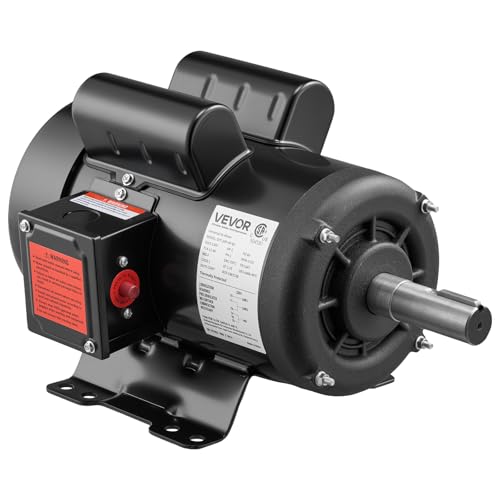
This 3 HP motor is designed for high-demand tasks and is built around a 184T frame with a 1.125″ shaft diameter and 2.75″ shaft length. It features a 12 N.m torque rating and operates on 230V single-phase power at 1750 RPM. The motor supports reversible CW/CCW rotation for flexible installation and has TEFC cooling for robust duty cycles.
Best for: High-torque air compressors, heavy machinery, or shop equipment requiring more horsepower and a sturdy frame. Choose this if your application demands stronger torque and a larger shaft than smaller 56C frames offer.
Caution: Ensure your mechanical footprint accommodates the 184T frame and confirm shaft dimensions align with your coupling or pulley system.
Buying Guide: Key Considerations For 3 Hp AC Motors
- Power and speed: Match horsepower and RPM to your load. Higher HP supports heavier, torque-demanding tasks, while RPM affects speed and efficiency.
- Voltage and single vs. dual voltage: Confirm your power source is compatible (115V, 230V, or dual). Single-phase motors are common in residential and workshop settings.
- Frame size and shaft: The frame (56C, 48Y, 184T, etc.) determines mounting compatibility. Check shaft diameter and length for pulleys or couplers.
- Rotation direction: Reversible CW/CCW can simplify wiring and enable flexible drive configurations. Verify rotation matches your driven equipment.
- Cooling and duty: TEFC (Totally Enclosed Fan C cooled) designs typically withstand harsher environments; sleeve bearings vs ball bearings affect life and maintenance.
- Auxiliary components: Some motors include capacitors or require compatible capacitors for proper operation in HVAC or refrigeration apps. Ensure you have matching components if not included.
- Installation considerations: Vibration, mounting, and alignment are essential for longevity. Check shaft alignment and mounting surface flatness.
FAQ
- What’s the difference between 56C and 184T motor frames?
Answer: Frame size determines mounting footprint and shaft dimensions. 56C is smaller and common in light-duty equipment, while 184T suits higher horsepower and heavier shafts. - Do these motors require external capacitors?
- Can I run a 3 HP motor on a standard home outlet?
- Is CW/CCW rotation always reversible without rewiring?
- Which motor is best for HVAC condenser fans?
- What should I check before buying a motor for an air compressor?
Answer: Some models include capacitors (as noted on the HHQ RV motor), while others do not. Always verify capacitor needs for your replacement unit.
Answer: No. A 3 HP motor typically requires 230V and proper electrical infrastructure or a dedicated circuit with appropriate protections.
Answer: Reversible rotation usually requires simple wiring changes or a specific terminal setup; follow the manufacturer’s wiring diagram to avoid incorrect rotation.
Answer: Motors in the ORM5458 family (208-230V, 1075 RPM) are commonly used for condenser fans and similarly sized HVAC components.
Answer: Check horsepower, RPM, frame size, shaft diameter, mounting compatibility, voltage, and rotation direction to ensure proper coupling and performance.