Best Dual Battery Isolator Solutions for Reliable Power Management
Answering common questions about dual battery isolators, this guide highlights five top options that help you keep a primary battery charged while allowing a secondary battery to power accessories. These products are best for vehicle owners, RV travelers, boaters, and outdoor enthusiasts who need reliable separation of auxiliary power without draining the starter battery. The overview below includes quick-fit criteria and a buyer-friendly table to compare key features at a glance.
| Product | Best For | Key Benefit |
|---|---|---|
| VEVOR Split Charge Relay Kit | RV, Marine, Truck | Easy install with complete accessories |
| KeyLine Chargers Dual Battery Isolator Kit (12V, 140A) | Off-road, Marine, Work trucks | Smart VSR with robust durability |
| VEVOR Dual Battery Isolator Kit (300A, LCD) | High-capacity systems | Manual and automatic modes with voltmeter |
| KeyLine Chargers Dual Battery Isolator Kit (12V, 140A) | Automotive and RV use | Same compact size, strong performance |
| NVX XSBI200 Dual Sensing Smart Relay | Audio systems, high-current setups | Microprocessor-controlled with dual sensing |
| Nilight 12V 140AMP Dual Battery Isolator | Truck, RV, Boat | IP66-rated for rugged environments |
VEVOR Split Charge Relay Kit, 6mtr 12V

Best choice for beginners and DIY installers who want a straightforward dual-battery solution. The kit automatically engages at 13.3 volts and disengages at 12.8 volts to protect the main battery while charging two batteries simultaneously. The rugged plastic housing is designed to resist shock and dust for long-lasting use. It ships with complete installation accessories and detailed instructions, reducing install time.
Who it suits: Ideal for RV, marine, and small-to-mid sized vehicles where an automatic, plug-and-play setup is preferred. This kit emphasizes reliability and ease of installation, making it a strong pick for users seeking a safe, affordable dual-battery arrangement.
Caution: As with any weather-exposed electronics, ensure proper mounting to avoid excessive heat or direct water exposure. Confirm compatibility with your specific vehicle wiring before purchase.
Dual Battery Isolator Kit 12V – 140 Amp (VSR) by KeyLine Chargers

This kit uses a voltage-sensitive relay (VSR) to manage two batteries without voltage drop, making it a strong option for marine and off-road applications. Its compact 2.6 x 2.6 x 2 inch design fits under-hood spaces and is versatile for battery relocation or auxiliary power setups. The IP65 rating supports water and dust resistance, which helps in tough environments.
Who it suits: Best for users who need reliable dual-battery charging with a compact footprint and robust durability for marine, off-road, and daily driver use. It’s particularly well-suited when minimizing power loss is a priority.
Limitation: Although compact, installation may require careful routing in tight engine bays; confirm that the fittings suit your vehicle’s battery tray and cables.
VEVOR Dual Battery Isolator Kit, 12V 300 Amp
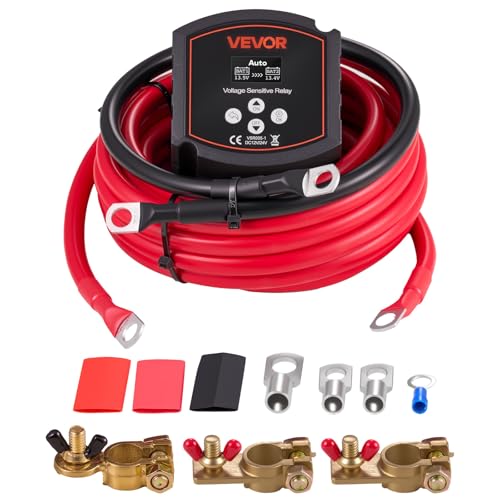
This high-current isolator kit supports large dual-battery systems, with an LCD display for real-time voltage monitoring. It offers both manual and automatic modes, including a voltmeter and smart control, enabling precise management of battery health. It’s suited for UTVs, trucks, and vehicles requiring heavy power handling and easy monitoring.
Who it suits: Choose this if you operate high-capacity batteries and want visibility into voltage levels. It’s better for users who value manual override and live readouts to prevent unexpected battery drain.
Caution: Ensure your wiring gauge and alternator capacity align with the 300A rating to avoid overheating or voltage drop under load.
KeyLine Chargers Dual Battery Isolator Kit (12V, 140A) – Automatic Disconnect

This kit mirrors the standard 140A VSR design with a focus on reliability across marine, truck, and RV setups. It emphasizes automatic switching to prevent drain while preserving a solid connection between the main and auxiliary batteries. The IP65 rating makes it suitable for wet or dusty environments, including off-road adventures and boat usage.
Who it suits: A solid pick for users who want a durable, water-resistant system with straightforward automatic operation and compatibility with a range of vehicles and off-grid applications.
Limitation: Users should verify cable lengths and mounting options to accommodate under-hood installations or tight spaces.
Nilight 12V 140 AMP Dual Battery Isolator with Voltmeter

Nilight’s model provides a VSR-based solution with built-in voltmeter for real-time monitoring. It is designed to ensure the primary battery remains charged while the auxiliary battery powers accessories, with strong weather resistance (IP66) for off-road and marine use. It’s a versatile option for campers, trucks, and boats.
Who it suits: Choose this if you want clear voltage feedback while maintaining automatic battery isolation. It’s well-suited for off-road enthusiasts and RV owners who value reliable performance with a visible readout.
Limitation: The included wiring and connectors should be checked to ensure compatibility with your vehicle’s electrical layout and fuse protection requirements.
Buying Guide
What should you consider when selecting a dual battery isolator? Key factors include current capacity, voltage thresholds, and whether you need manual as well as automatic control. For high-demand systems or larger battery banks, a higher amperage (200–300A) may be necessary. If you rely on auxiliary power for audio systems or specialized equipment, a smart relay with a voltmeter can help prevent depletion of the starter battery.
How does VSR versus manual switching affect reliability? VSR models automatically engage at a predetermined voltage to prevent over-discharge, while manual modes provide control during service or battery relocation. Both have merits depending on how you use your vehicle and the importance of always starting reliably.
What about installation considerations? Look for kits with complete hardware, clear instructions, and weather-resistant housings. Check fitment under the hood or in the battery compartment, and verify compatibility with lithium, lead-acid, or other battery chemistries if applicable.
Durability and environmental resistance matter. IP66 or IP65 ratings protect against dust and water during off-road, marine, or camping use. A compact footprint helps in tight engine bays or under-vehicle installations.
FAQ
- What is a dual battery isolator? A device that automatically connects or disconnects a second battery from the main battery to prevent drain while allowing charging from the alternator.
- Why choose a VSR over a diode-based isolator? A VSR reduces voltage drop and improves charging efficiency, especially for the auxiliary battery, compared with traditional diode-based systems.
- Can I use lithium batteries with these isolators? Many kits advertise compatibility with lithium and lead-acid; check the product specs for your exact chemistry and charging profile requirements.
- Is installation difficult? It varies by kit; some include complete hardware and instructions, making it a feasible DIY project for camper or boat upgrades.
- What maintenance is required? Periodic inspection of cables, fuses, and connections is recommended to ensure clean connections and prevent corrosion.
- Do these units support manual operation? Several models include both manual and automatic modes for flexibility during maintenance or relocation tasks.