Best 30 Amp Power Converters for RVs and Travel Trailers in 2026
If you need reliable 30 amp power conversion for RVs, campers, or travel trailers, choose a converter that reliably auto-detects battery type, supports multi-stage charging, and protects your battery and electronics. The following five models are among the most capable 30A options, each suited to a different user profile—from budget-conscious weekenders to tech-savvy full-timers who demand Lithium compatibility and smart charging.
| Product | Best For | Key Benefit |
|---|---|---|
| KMHGD WF-8735-AD / WF 8735-AD | RV owners who want automatic 3-stage charging | Intelligent detection for Lead Acid and LiFePO4, 30A main, 6 DC + 5 AC circuits |
| MAOYUMAO WF-8735-AD RV Converter Charger | Campers who need fast charging and safety features | Three-stage auto-detect with 13.2/13.6/14.4V modes, overcharge and temperature protection |
| IOTA Engineering DLS30 | Compact, straightforward 30A charging | Simple 30A converter with compact package |
| Progressive Dynamics PD9330V (Inteli-Power 9300 Series) | Lithium-capable, advanced mode switching | Voltage sensing, Lithium support, auto mode selection |
| PowerMax PM4-35A | Smart 4-stage charging for diverse battery chemistries | 35A output, four-stage charging, wide battery compatibility |
KMHGD WF-8735-AD / WF 8735-AD RV Converter Charger
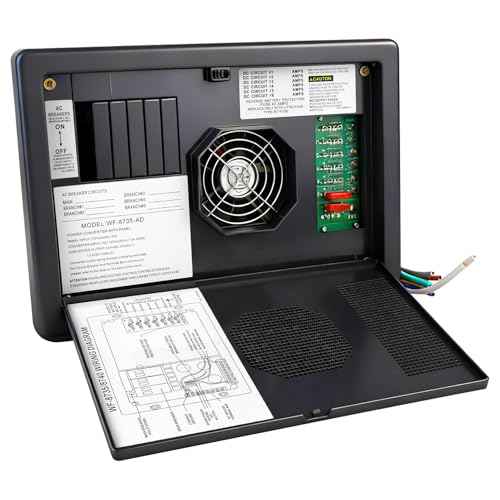
The WF-8735-AD family is designed for RVs and travel trailers requiring a robust 30–35A charging center. It supports auto-detect for different battery chemistries and offers three smart charging stages (floating, absorbing, high-capacity) at 13.2VDC, 13.6VDC, and 14.4VDC. It includes one 30A main circuit with multiple DC and AC circuits for organized distribution. Best for owners who want automatic battery maintenance with broad compatibility and a single, integrated charger for multiple circuits. Caution: Ensure your battery bank matches the unit’s supported configurations and confirm cable gauge can handle 30A through the main line.
Why selected: This model provides a solid mix of automatic charging, battery protection features, and clear wiring architecture for RVs. It’s a good match for users replacing an older charger with a capable, future-ready unit.
MAOYUMAO WF-8735-AD RV Converter Charger

This WF-8735-AD RV converter focuses on efficiency and safety. It delivers up to 35A DC output and uses an advanced three-stage automatic charging process with auto-detect technology. The unit automatically adjusts charging modes to extend battery life and includes built-in protections such as overcharge and short-circuit safeguards. Best for RVers who want strong output and automatic mode switching without manual toggling. Caution: Verify battery type compatibility (Lead Acid vs. Lithium) before installation to prevent mischarging behaviors.
Why selected: It offers a robust combination of fast charging, battery-friendly modes, and built-in safety features ideal for frequent RV living and multi-battery setups.
IOTA Engineering DLS30 30 Amp Power Converter
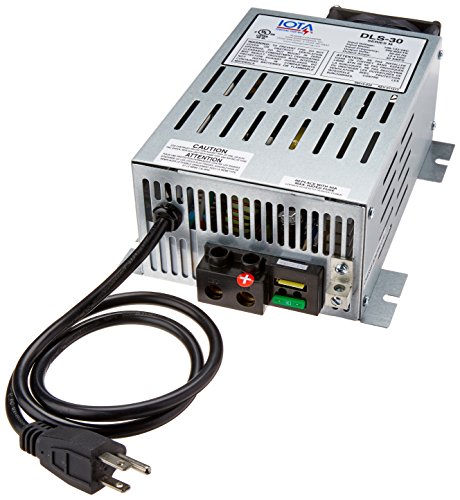
The IOTA DLS30 is a compact 30A power converter that focuses on reliability and simplicity. The listed dimensions suggest a small form factor suitable for tight spaces in RVs. It provides steady 12V output suitable for running basic RV essential systems. Best for buyers who need a straightforward, space-saving solution and are comfortable with standard 30A charging capability. Caution: The listing omits detailed charging stages and battery-type specifics, which may require cross-checking with existing battery configurations.
Why selected: Its compact size makes it a strong candidate for smaller RV installations where space is at a premium, while still delivering dependable 30A charging.
Progressive Dynamics PD9330V 9300 Series Converter

The PD9330V is part of Progressive Dynamics’ 9300 series, offering a 30A output with smart sensing. It differentiates itself with targeted charging logic that automatically selects the proper operating mode, including a boost function when voltage dips. It provides a clear path toward Li-ion or lead-acid support through battery sensing. Best for RV users who value adaptive charging and a known brand in the RV electrical market. Caution: Some models in the PD family rely on compatible capacitors and wiring, ensure installation matches spec sheets for your RV configuration.
Why selected: The PD9330V brings advanced voltage sensing and mode switching that can optimize battery health for mixed chemistries, a key advantage for tech-forward RV setups.
PowerMax PM4-35A RV Converter Charger

The PowerMax PM4-35A is a 35A RV converter with a four-stage smart battery charger. It supports multiple battery chemistries, including Lithium, and provides automatic voltage regulation to maintain proper charging profiles. It’s designed for RVs needing a robust, flexible charging system that can adapt to different trips and battery types. Best for RVers who want a versatile charger that emphasizes battery longevity and multi-chemistry compatibility. Caution: Check current draw and wiring capacity to ensure the main feed can safely handle 35A, especially on older RVs.
Why selected: Its four-stage charging and broad battery compatibility make it a solid all-rounder for varied RV power needs and longer trips.
Buying Guide: 30 Amp Power Converters For RVs
What to prioritize
Key factors include charging stages (three-stage vs four-stage), battery chemistry support (Lead Acid, LiFePO4, Lithium), automatic battery sensing, protection features (overcharge, short circuit, high temperature), and compatibility with your RV’s electrical layout (DC distribution, AC circuits).
How to compare models
- Charging modes: Look for three-stage or four-stage charging for battery health and efficiency.
- Battery compatibility: Ensure the unit supports your battery types and chemistries.
- Protection features: Prioritize units with overcharge protection, short-circuit protection, temperature control, and current limiting.
- Output and wiring: Confirm the main 30A circuit capacity and the number of DC/AC circuits align with your RV’s needs.
- Space and installation: Consider form factor for tight spaces and required mounting hardware.
Which one should you choose?
For overall versatility and future-proofing, consider models with auto-detect technology and multi-chemistry support. If you have Lithium batteries, prioritize units with LiFePO4/Lithium-specific modes. If space is limited, a compact DLS30-style converter may be preferable. For exceptionally long trips and diverse loads, a four-stage charger with robust protection offers the best long-term battery health.
Installation considerations
- Verify input voltage and frequency match your shore power (120V, 60Hz in the US).
- Ensure your RV’s electrical panel can accommodate the converter’s 30–35A output.
- Plan for proper venting and heat management to avoid overheating.
- Follow manufacturer installation instructions and consider professional wiring if unsure.
FAQ
- What does a 30A RV power converter do? It converts 110V AC shore power to 12V DC to run and charge onboard batteries and DC devices.
- Do I need Lithium-specific charging mode? If you use LiFePO4 or Lithium batteries, yes; Lithium-specific modes optimize charging profiles for these chemistries.
- Is auto-detect technology important? Yes, it helps tailor charging to the connected battery type, reducing aging and extending life.
- Can I replace an old charger with a 30A unit? In most cases yes, but confirm compatibility with your RV’s electrical panel and wiring gauge.
- What safety features should I look for? Overcharge protection, short-circuit protection, reverse polarity protection, and temperature monitoring are important.
- Is 35A acceptable if labeled 30A? Yes for many RV systems, but verify wire sizing and panel capacity to avoid overloading circuits.