Best Wind and Solar Controller for Efficient Hybrid Power Systems
Answering the needs of off-grid and hybrid power setups, a wind and solar controller manages charging from both wind turbines and solar panels. This guide highlights five top options that balance efficiency, ease of use, and reliability for homes, boats, and street-light installations. Each product is evaluated for who it suits best, plus practical cautions to consider before purchase.
| Product | Best For | Key Benefit |
|---|---|---|
| VNATWGOO 15000W Hybrid Charge Controller | Higher-capacity systems | Boost MPPT with LCD display |
| iSunergy 1000W Hybrid Controller | Compact projects | Digital display and efficient PWM control |
| PIKASOLA 1400W Off Grid Hybrid | Budget-friendly setups | Auto battery matching and MPPT boost |
| VQP 2000W Hybrid Controller | Versatile multi-source | Large input range, dump load support |
| Himopuer 6000W-12000W Hybrid Controller | Heavy-duty installations | Broad voltage compatibility and LCD |
VNATWGOO 15000W Wind Solar Hybrid Charge Controller

The VNATWGOO hybrid controller supports 24V and 48V battery systems, including lithium options. It is designed for wind-solar combinations with large maximum inputs, suitable for home, boat, or street-light projects that require robust charging from both sources. The unit features MPPT boosting for consistent charging even at low wind speeds and PWM-based solar charging with a dump-load option for stability. Best for high-capacity setups where steady, automated control is essential.
Who it’s best for: large off-grid homes or commercial installations needing strong wind and solar integration. Why selected: high wattage handling, intelligent voltage control, and an LCD for easy monitoring. Caution: initial wiring and configuration can be more complex due to its advanced features.
iSunergy 1000W Hybrid Charge Controller

The iSunergy controller combines wind and solar management in a compact form, with PWM solar charging and an LCD display showing voltage and battery status. Its design emphasizes ease of use and practicality for small to mid-sized off-grid systems. The user-friendly interface helps tailor settings to different environments and wind speeds, making it a good choice for beginners or hobbyists.
Who it’s best for: small homes, cabins, or boats seeking straightforward wind-solar integration. Why selected: clear LCD readouts and simple operation. Caution: power limits mean it’s not ideal for larger wind or solar arrays without upgrading to a higher-capacity unit.
PIKASOLA 1400W Off Grid Hybrid Controller

The PIKASOLA controller is designed for 12V/24V systems with a practical max of 800W wind and 600W solar inputs. It uses MPPT boosting for wind charging and PWM for solar charging, with an auto battery-type setup for convenience. The unit emphasizes intelligent control and stable charging, making it suitable for mid-sized off-grid projects like cabins or small homes.
Who it’s best for: budget-conscious hybrids needing reliable performance in modest setups. Why selected: strong spec balance and real-time maximum current tracking for solar. Caution: wind input limits may constrain larger turbines or solar arrays.
VQP 2000W Wind Solar Hybrid Controller
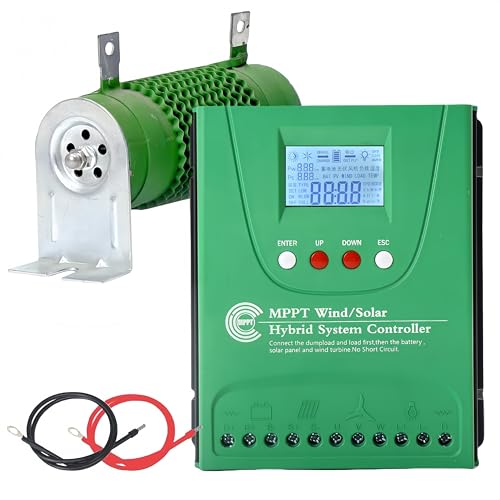
The VQP model supports up to 1000W wind and 1000W solar inputs, delivering a broad 12V/24V battery compatibility and dump-load capability for robust off-grid lighting or power systems. It uses boosted MPPT for wind charging and PWM for solar charging, helping maximize energy capture from both sources. Best for mid-large installations that require flexible input handling.
Who it’s best for: users with mixed wind and solar resources needing scalable performance. Why selected: high combined input capacity and dump-load support. Caution: system setup may require careful heat management due to dual-source operation.
Himopuer 6000W-12000W Hybrid Controller

The Himopuer controller targets heavy-duty applications, with a broad voltage range (12V/24V/48V) and support for large wind and solar inputs. It features an LCD display and advanced MPPT-PWM integration for stable, efficient charging, even under low wind speeds. This unit suits larger off-grid homes, farms, or street-light networks requiring substantial energy management.
Who it’s best for: heavy-load off-grid installations needing broad compatibility. Why selected: high power handling and integrated LCD for real-time monitoring. Caution: larger units may require dedicated ventilation and mounting considerations.
Buying Guide: Wind And Solar Controller Essentials
- What system voltage do you need? Common options are 12V, 24V, and 48V; choose a controller that matches your battery bank.
- How much wind and solar input do you have? Pick a model with adequate wattage capacity for both sources to maximize energy capture.
- MPPT vs PWM: MPPT controllers optimize energy harvesting from wind and solar, while PWM offers simplicity and reliability at lower costs.
- Dump-load and protection features: Dump-load options protect batteries during overproduction; ensure proper wiring and safety clearances.
- Display and controls: An LCD/LED interface helps monitor voltage, current, and generation. Consider ease of configuration for your skill level.
- Thermal management: Higher-capacity units generate more heat. Look for good heat dissipation and, if needed, ventilation options.
- Expandability: If you anticipate higher future loads, choose a controller with scalable input ranges or modular design.
Frequently Asked Questions
- What is a wind solar hybrid charge controller? It manages charging from both wind turbines and solar panels to protect batteries and optimize energy capture.
- Do I need MPPT for wind charging? MPPT helps maximize wind energy capture, especially at variable wind speeds, but PWM can be sufficient for smaller systems.
- Can these controllers work with lithium batteries? Many listed models support lithium battery configurations; verify compatibility for your exact battery type.
- Is a larger controller always better? A controller should match your system size. Oversizing adds cost and complexity without improving performance.
- What maintenance is required? Regular inspection of wiring, fuses, and intake/dump-load components helps maintain safe operation and efficiency.
- Are these controllers suitable for boats or mobile setups? Yes, many models are designed for mixed environments, but ensure mounting and protection against moisture for maritime use.