Best Vacancy Motion Sensor Wall Switches for Energy Savings
Answering the need for hands-free lighting, these vacancy and occupancy sensor wall switches respond to motion to save energy and simplify daily routines. They’re best for small to medium rooms like bathrooms, hallways, garages, laundry rooms, and closets. The top picks emphasize reliable motion sensing, easy installation, and flexible mode settings for occupancy or vacancy use.
| Product | Best For | Key Benefit |
|---|---|---|
| Lutron MS-OPS2 Series (2-Pack) – White | Residential bathrooms and closets | Proven motion sensing with automatic on/off; compact white design |
| Lutron MS-OPS2 (Single) – White | Small to mid-size rooms | Industry-leading sensing tech for reliable activation |
| Maxxima Occupancy Vacancy Motion Sensor Wall Switch | Commercial or residential spaces with flexible mode | Dual operation and adjustable time delay |
| TOPGREENER TDOS5-HL-W Series | Wiring-flexible, no-neutral installations | No-neutral, easy retrofits with selectable OCC/VAC modes |
| TOPGREENER TDOS5-HL-W-2PCS | Two-switch setups in same box | No-neutral/no-ground option with learning function |
Source products and features below to help buyers compare installation needs, sensor behavior, and mode options for each space.
Lutron Maestro Motion Sensor Switch – White (2 Pack)

- Features: Automatic ON/OFF with motion; suitable for bathrooms, garages, laundry rooms; single-pole operation; supports any bulbs.
- Best for: Homeowners who want a straightforward, reliable vacancy/occupancy solution in small-to-medium rooms.
- Why selected: Lutron’s established sensing approach reduces false offs and simplifies daily routines.
- Caution: Works best with standard wiring; verify single-pole setup in retrofit projects.
Lutron Maestro Motion Sensor Switch – White (Single)

- Features: Automatic activation; XCT sensing technology provides reliable on when you enter and avoids premature shutoff during minor motion.
- Best for: Rooms where you need dependable motion detection even with light activity like reading or typing nearby.
- Why selected: Patented sensing technology reduces nuisance shutoffs, enhancing energy savings.
- Caution: Advanced sensing may require a brief adjustment period in very low-motion spaces.
Maxxima Occupancy Vacancy Motion Sensor Wall Switch

- Features: Dual ON/OFF modes; 180° PIR sensor with green LED backlight; includes wall plate and wire nuts; adjustable delay, sensitivity, and light level sensing.
- Best for: Commercial or residential spaces needing flexible occupancy/vacancy operation and precise control.
- Why selected: Versatile mode switching supports a wide range of rooms, from hallways to closets.
- Caution: Includes more adjustable settings—take time to dial in for your space to avoid false activations.
TOPGREENER TDOS5-HL-W
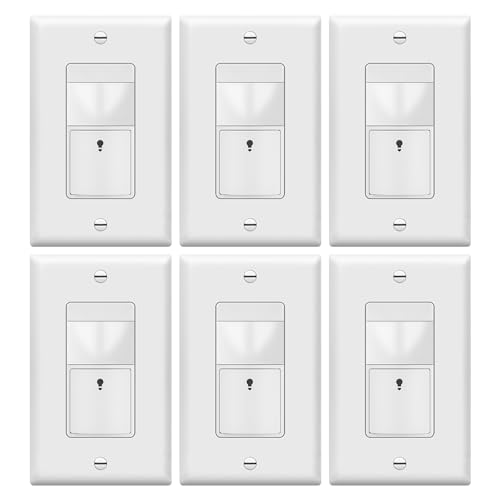
- Features: Occupancy and vacancy modes; no neutral or ground required; universal wiring with interchangeable hot/load wires; auto ON/OFF with motion; time-delay options include 15 sec (Test) to 30 min.
- Best for: Retrofits in older homes where neutral wiring is unavailable or difficult to access.
- Why selected: No-neutral/no-ground design expands compatibility for many older installations.
- Caution: Some installations may require careful wiring planning in multi-gang boxes.
TOPGREENER TDOS5-HL-W-2PCS

- Features: Two-switch pack; no neutral and no ground required; OCC/VAC mode switch under the face; adjustable time delays; learning function helps adapt to usage patterns.
- Best for: Shared spaces or multi-gang installations where consistent motion sensing is needed across two devices.
- Why selected: Learning function improves long-term energy savings by adapting to routines.
- Caution: For some older wiring configurations, confirm compatibility with your circuit before installation.
Buying Guide: How to Choose a Vacancy Motion Sensor Wall Switch
What to consider before buying:
- Wiring and compatibility: Check whether a neutral wire is required and if the unit is suitable for single-pole installations or two/three-way setups.
- Mode options: Decide between occupancy (auto-on, auto-off) and vacancy (manual-on, auto-off) to match your space usage.
- Sensing technology: Look for sensors with reliable on-activation, even with minor motion, and low false-off risk in your typical room activity.
- Adjustability: Choose models with time-delay settings, sensitivity, and light-level sensing to tailor behavior for hallways, bathrooms, or closets.
- Installation environment: Consider spaces with higher humidity (bathrooms, garages) versus dry interiors; ensure product rating matches your region and electrical code.
- Retrofit considerations: If replacing an older switch, ensure the product fits the box size and wiring layout; no-neutral options simplify retrofits in older homes.
Frequently Asked Questions
- What is the difference between occupancy and vacancy sensor switches?
– Occupancy switches automatically turn lights on when motion is detected and off after a delay. Vacancy switches require manual turning on but still auto-off after motion ends. - Do these require a neutral wire?
– Some models require a neutral; others offer no-neutral options for retrofits in older wiring. Check product specs for your home. - Are there models that work without a ground wire?
– Yes, several TOPGREENER models offer no-ground installations, but verify building code compliance where you live. - Can I install these in bathrooms or damp areas?
– Many models are designed for indoor residential use, including bathrooms and garages; match product ratings to your space’s humidity. - Are there energy-saving considerations beyond motion sensing?
– Yes, delay times and sensitivity settings influence energy savings; longer delays save more energy but may reduce convenience in high-traffic areas. - What installation difficulty should I expect?
– Most switches are single-pole and can replace standard switches with common wiring; some models with no-neutral wiring are slightly more involved.