Best Off Grid Solar Power Kit for Home Use
Exploring off grid solar power kits helps homeowners gain energy independence, reduce utility dependence, and prepare for outages. This guide highlights five top ECO-WORTHY and related kits that balance capacity, expandability, and ease of setup. Each option includes solar panels, inverters, and storage designed for typical American homes, cabins, or RVs. Read on to compare configurations, performance, and practical installation considerations.
Summary Table Of Selected Products
| Product | Output Power | Panels (W each) | Battery Type | Key Feature |
|---|---|---|---|---|
| ECO-WORTHY 48V Off Grid System 1200W | 1200W | 195W x 6 | 48V LiFePO4 | WiFi monitoring, UPS switching |
| ECO-WORTHY 9.36KWH 2340W System | 5000W inverter (up to 9.36KWh/day) | 195W x 12 | 48V LiFePO4 | All-in-one inverter/charger |
| ECO-WORTHY 1.6KWH RV Kit | 1.6KW | 100W x 4 | 12V/AC setup | Tracker option, dual-axis |
| ECO-WORTHY 10KW Home System | 10KW (up to 20KW peak) | 410W x 12 | UL-listed LiFePO4 | Split-phase, plug-and-play |
| ECO-WORTHY 5KW Off Grid Kit | 5KW (10KW peak) | 195W x 12 | LiFePO4 Rack Battery | Scalable, all-in-one inverter/charge |
ECO-WORTHY 48V Off Grid System 1200W

This complete off grid kit targets home use with six 195W N-Type bifacial solar panels and a 3500W inverter. The system is designed to deliver around 4.68KWh per day under four peak sun hours, making it suitable for powering essential appliances like air conditioners, TVs, refrigerators, and coffee makers. The 48V LiFePO4 server rack battery provides solid storage, while the built-in 80A MPPT controller and WiFi monitoring add convenience and oversight. The inverter supports parallel connection to expand capacity to meet growing energy needs, with 21kW total potential when six units are paralleled. The design emphasizes reliability in varying weather and loads, helping households maintain critical circuits during outages.
ECO-WORTHY 9.36KWH 2340W System
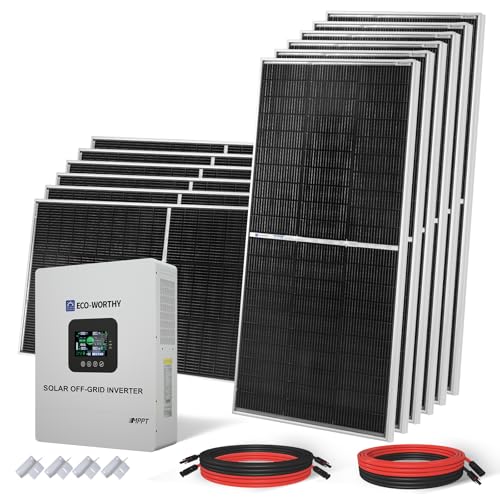
This larger ECO-WORTHY kit provides about 9.36KWh per day under optimal sun with 12 panels of 195W each. The 5000W 48V DC-110V AC pure sine wave inverter, paired with a 100A MPPT controller, supports 4 charging modes and solar/mains hybrid operation. It emphasizes durability with IP68-rated solar cells, tempered glass, and corrosion-resistant materials, aiming for a 30-year lifespan. The system is designed for homes, cabins, farms, or energy backups, offering robust continuous power and reliable backup performance when grid access is unavailable.
ECO-WORTHY 1.6KWH RV Kit

Designed for RVs and mobile setups, this kit yields about 1.6KWh per day under four hours of sun. It includes four 100W panels, a 40A MPPT controller, a 2000W upgraded pure sine wave inverter, and a Bluetooth module for monitoring. Optional dual-axis tracking and mounting brackets can boost production by up to 40% with a tracker and up to 20% with adjustable brackets. The selection prioritizes portability and quick installation for travelers or temporary off-grid living spaces, while still delivering meaningful daily power for essential appliances.
ECO-WORTHY 10KW Home Off-Grid System

This top-tier off-grid package includes 12x410W mono solar panels for substantial daily generation, a 10KW inverter with 20KW peak capacity, and a UL-listed 48V 100Ah rack-mounted LiFePO4 battery system. It supports single-phase and split-phase outputs and can be paralleled with additional inverters to reach higher AC power, making it suitable for full-home energy independence. The kit emphasizes safety, long-term reliability, and ease of use through a plug-and-play approach and integrated monitoring for real-time system performance.
ECO-WORTHY 5KW Off Grid Kit

Equipped with 12x195W panels totaling 2340W and a 5KW all-in-one inverter with built-in charge controller, this kit focuses on modular expansion. The 48V can support parallel operation to scale capacity, and the integrated batteries and wiring simplify installation for off-grid homes or cabins. The system’s design emphasizes safety with UL listings, CAN/RS485 communication compatibility, and a compact footprint for space-conscious setups, while delivering practical power for everyday home electronics and appliances.
Buying Guide: Key Purchase Considerations
- Power needs: Estimate daily energy consumption (kWh/day) and plan for at least 1.5x to cover high-load days or outages. Inverters should meet peak surge requirements for appliances like refrigerators and air conditioners.
- System scalability: Consider whether the kit supports additional panels, more batteries, or parallel inverters to grow capacity without replacing components.
- Storage chemistry: LiFePO4 batteries offer longer cycles and better safety than traditional lead-acid; ensure BMS and CAN/RS485 compatibility if integrating with other inverters.
- Panel technology: N-Type bifacial panels can deliver higher efficiency and shading tolerance; ensure mounting and space permit the expected array footprint.
- Inverter features: Look for pure sine wave output, multiple charging modes (solar, grid, generator, battery), WiFi/remote monitoring, and appropriate AC output (120V or 240V as needed).
- Durability and rating: IP ratings, tempered glass, snow/wind load tolerances, and warranty terms are critical for long-term performance in varied climates.
- Installation and safety: Verify compliance with local electrical codes, securing mounting hardware, and ensuring proper wiring gauge and protection devices for safe operation.
- Maintenance: Evaluate battery replacement intervals, monitoring app capabilities, and ease of component replacement to minimize downtime.
- Cost of ownership: Compare total system price, potential grants or incentives, and the expected lifespan of panels, inverters, and batteries to assess long-term value.