Best Time Delay Push Button Solutions for Quick, Controlled Power on and Off
Time delay push buttons offer a simple, reliable way to control loads with a programmable delay. Ideal for access control, automation, and safety interlocks, these devices let a user trigger a circuit and have it automatically disengage after a set period. Below is a curated selection of five reliable options that cover general consumer and professional needs, including push-to-exit styles and programmable timers. Each entry includes a brief description of its core capabilities, intended use, and standout features to help you compare at a glance.
| Product | Brand | Key Feature |
|---|---|---|
| CM-5085RPTE Single Gang Pneumatic Pushbutton | Camden | 1–60 sec pneumatic time delay; red button |
| Dortronics 5221-P23DA | Dortronics | Pneumatic time delay, single gang plate |
| Visionis VIS-7013 No Touch With Delay | Visionis | LED indicators; adjustable 0.5–22 s delay |
| Visionis VIS-7100 Push To Exit Button | Visionis | Green LED; timer delay for door access control |
| Rutherford Controls 991E-PTD X 32D | Rutherford Controls | Pneumatic delay, 1–45 s; 1NO/1NC |
Camden CM-5085RPTE Pneumatic Pushbutton

The Camden CM-5085RPTE is a single-gang pneumatic pushbutton featuring a 2-3/8″ faceplate and a spring-return action. It is designed for time-delay applications with durability for indoor or outdoor settings. The time-delay range is 1 to 60 seconds, making it suitable for exit and control applications where a brief, manual activation is required before the circuit de-energizes. Its red pushbutton is clearly visible and easy to locate in low-light environments, improving user interaction in security or automation workflows.
Dortronics 5221-P23DA Pneumatic Time Delay

The Dortronics 5221-P23DA offers a compact, single-gang plate with a pneumatic time-delay characteristic. This model emphasizes tamper resistance and reliable mechanical operation. It is commonly used in access control setups where a user presses a button to initiate a timed lock-release or door control sequence. While compact, the unit supports practical delays and stable performance, making it compatible with standard 12V systems and existing wiring in many commercial installations.
Visionis VIS-7013 Indoor No Touch Push Button

The Visionis VIS-7013 combines stainless steel aesthetics with a no-touch interface and a built-in time delay function. Configured for door access control, the unit provides a contact rating compatible with typical access hardware and a visible LED indicator to confirm status. Its adjustable timer accommodates a range that suits entry control routines, while its robust construction ensures long-term reliability in demanding environments.
Visionis VIS-7100 Push To Exit
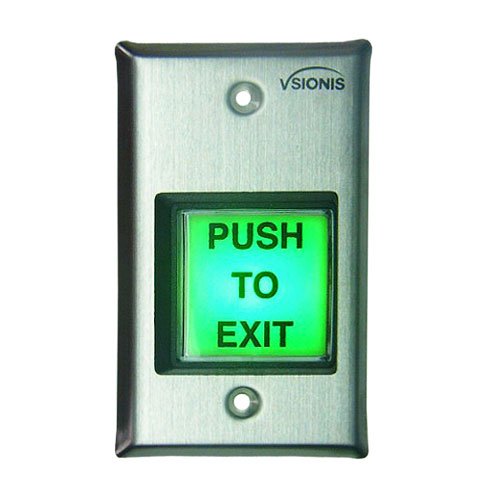
The Visionis VIS-7100 is a green LED square exit button designed for door access control with timer delay functionality. It provides a standard single-gang fit and includes push-to-exit labeling. The device is built for indoor use and features a flexible timer that supports delayed release actions, which can optimize access control sequences in commercial settings or high-traffic entry points.
Rutherford Controls 991E-PTD X 32D
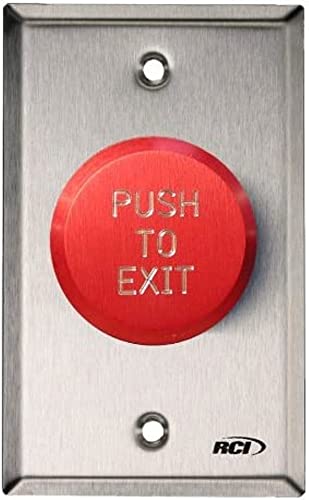
The Rutherford Controls 991E-PTD X 32D is a pneumatic time-delay exit push button with a 1–45 second range and a 1NO/1NC configuration. It features a brushed stainless steel faceplate and rugged construction suitable for high-usage environments. The unit is designed for quick installation in single-gang boxes and is well-suited for security doors or controlled exits where a timed release mechanism is required to improve safety and traffic flow.
Buying Guide: Time Delay Push Button Considerations
- Timing range and accuracy: Determine whether you need a short delay (under a few seconds) for quick de-energization or a longer delay for door release, pedestrian flow, or machine cycling. Check whether the timer is adjustable via a potentiometer, DIP switch, or external control signal, and review tolerance specifications for stable operation.
- Actuator type and durability: Pneumatic pushbuttons are common for robust environments and longer mechanical life. Consider the operating environment (indoor/outdoor, weather exposure) and the mounted size to ensure compatibility with existing boxes or panels.
- Electrical compatibility: Verify supply voltage (commonly 12V DC for timer modules) and current ratings for the load you intend to control. Ensure the unit’s NO/NC contacts align with your wiring plan and that it can safely switch the intended load.
- Interface and indicators: LED indicators and clear status displays help users confirm activation and timing progress. For no-touch models, consider hygiene, accessibility, and user experience in entryways or public spaces.
- Integration with access control: If using in doors or gates, ensure compatibility with the access control system and any required relays or interlocks. Some models are designed to pair with electromagnetic locks or door sensors for synchronized operation.
- Form factor and installation: Look at single-gang plates and the physical footprint to fit standard boxes. Consider front-face labeling or engravings for quick recognition in busy installations.
- Maintenance and serviceability: Choose devices with replaceable potentiometers or capacitors for longer service life in high-use areas. If extended delays are needed, assess whether component upgrades are feasible.
Time delay push buttons are a practical addition to security, automation, and interlock systems. When selecting a unit, consider the environment, required delay range, and how it will integrate with existing control hardware. The examples above provide a range of form factors—from tactile, traditional pushbuttons to modern no-touch variants—covering both simple and more complex timing needs while keeping installation straightforward for both hobbyists and professionals.