Best Thermostats With Battery Backup for Reliable Comfort
For buyers who want a dependable thermostat that can keep functioning during power interruptions, a thermostat with battery backup is essential. This guide highlights five models that offer battery power options or built-in batteries to maintain programming and settings when main power is unavailable. This is ideal for renters, people who frequently experience outages, and households that want to avoid losing schedule settings. The table below helps compare core points at a glance.
| Product | ||
|---|---|---|
| SASWELL T21 Programmable Thermostat | Dual Power Options: 24VAC or AA batteries (no C-wire required) | Keep basics running during outages; strong compatibility with single-stage systems |
| Climapeak Non-Programmable Thermostat | Batteries Included; simple power options | Simple control with backlit display; suitable for straightforward setups |
| New! Honeywell Home RTH20B | Battery-backed capability as a basic programmable unit | Reliable scheduling and easy replacement for older thermostats |
| Honeywell Home RTH7600D | 7-day programming with touchscreen convenience | |
| Emerson Sensi Wi‑Fi Smart Thermostat ST55 | Power via HVAC system with battery backup considerations in some installations | Smart features and remote access with energy insights |
SASWELL T21 Programmable Thermostat

The SASWELL T21 provides dual power options, operating on 24VAC or two AA batteries, so you can avoid frequent battery changes in typical use. It supports single-stage heating and cooling, plus some heat pump configurations, making it versatile for many homes. The model advises using the C-wire for optimal stability when possible, which reduces battery dependency over time. Best for: households that want a battery option and easy installation without worrying about C-wire availability. Limitation: not compatible with some multistage or heat pump setups.
Climapeak Non-Programmable Thermostat

This blue-backlit, non-programmable thermostat includes batteries and is designed for straightforward control of 1 Heat/1 Cool systems. It’s DIY-friendly and avoids complex setup, making it a good backup option where battery power is a priority. Best for: users who want a simple, reliable backup thermostat that works well in single-stage homes. Caution: lacks advanced scheduling or smart connectivity.
New! Honeywell Home RTH20B

The RTH20B is positioned as a direct replacement for older Honeywell models, offering a familiar 5-2 day scheduling option plus a large display for easy visibility. It is well suited for buyers who want a straightforward, dependable programmable thermostat with a simple setup. Best for: homeowners replacing an older Honeywell unit with a familiar interface. Limitation: may lack some advanced connectivity features found in newer smart thermostats.
Honeywell Home RTH7600D 7-Day Programmable

The RTH7600D offers a 7-day, menu-driven programming experience with a large touchscreen display. It supports a weekly schedule and flexible hold settings for absences. Best for: users who want detailed weekly programming and an easy-to-use interface. Limitation: not marketed with explicit battery backup, so power reliability relies on your home electrical system.
Emerson Sensi Wi‑Fi Smart Thermostat ST55
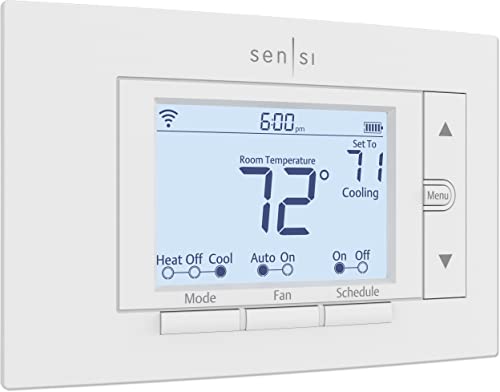
The Sensi ST55 focuses on energy savings and remote control with a modern interface. It emphasizes privacy protections and accessibility, aiming to reduce energy use by offering flexible scheduling. Best for: smart-home enthusiasts who want remote access and energy reports. Limitation: relies on HVAC power; battery backup specifics are not a primary feature in this model.
Buying Guide
- Power options: If you want true battery backup, prioritize thermostats that explicitly offer battery power or dual power options, such as the SASWELL T21. Check whether the device can operate without a C-wire.
- Programming needs: For strict schedules, select models with 7-day or 5-2 programming. If you prefer simple operation, non-programmable or fewer daily segments can reduce setup complexity.
- System compatibility: Confirm your heating and cooling setup (single-stage, heat pumps, boilers) aligns with the thermostat’s listed compatibility. Some models flag exclusions for multistage or certain HVAC configurations.
- Display and usability: Large, backlit displays and intuitive menus improve daily use, especially for visually inspecting temperatures and settings quickly.
- Smart features: If remote access and energy reports matter, consider Wi‑Fi-enabled thermostats with app support. Remember that these often depend on a steady power supply and network connectivity.
- Future-proofing: Some models offer compatibility checkers or software updates. If you want ongoing features, prefer manufacturers that provide software upgrades.
Frequently Asked Questions
- What is battery backup in a thermostat?
Answer: Battery backup ensures the thermostat can retain programming and basic operation during a power outage or when main power is unstable. - Do battery-powered thermostats work with all HVAC systems?
Answer: Battery-powered models may be limited to specific configurations (often single-stage). Always verify compatibility with your system before purchase. - Can a thermostat with battery backup save energy?
Answer: Yes, by maintaining correct temperature schedules during outages and preventing temperature drift when power returns. - Is a C-wire necessary for battery-powered thermostats?
Answer: Some battery-powered models don’t require a C-wire, but using a C-wire can improve stability and reduce battery usage over time. - Do these thermostats require professional installation?
Answer: Many are designed for DIY installation, but if your wiring or HVAC system is unusual, professional assistance is recommended.