Best Tankless Water Heater for RVs and Electric on Demand Hot Water
Discover the best tankless water heaters for RV life and off-grid use that run on electric power or 12V/DC systems. This guide helps you pick units that deliver instant hot water, save energy, and fit compact RV spaces. The top picks are ideal for travelers, full-time campers, and tiny-home enthusiasts who want reliable hot water without bulky tanks. Below, find concise product highlights, best-use cases, and simple buying guidance.
| Product | Best For | Power Type | Notes |
|---|---|---|---|
| NOVIEEX RV Water Heater | Full-time campers needing 60k BTU and anti-freeze | Propane + 12V DC | CSA certified, 3.6 GPM |
| AIYEZIDT Tankless Water Heater | Small-space kitchens and RV sinks | 110V Electric | Digital display, safety protections |
| CAMPLUX Tankless Water Heater Electric 120V | Under-sink point-of-use in RVs | 120V Electric | Compact, self-modulating |
| CAMPLUX Tankless Water Heater Electric 240V | Tiny homes and RVs with higher power | 240V Electric | Self-modulating, space-saving |
| APUS RV Tankless Water Heater | High-heat, RV showers on the move | Propane + 12V | 3.9 GPM, CSA certified |
Novieex RV Water Heater

The Novieex unit provides 60,000 BTU and 3.6 GPM of hot water. It is propane-fed with 12V DC operation and includes a 15″×15″ white door for RV installations. Best for full-time campers who want dependable on-demand hot water with anti-freeze protections. Choose this if you need robust performance at higher altitudes; it supports a consistent temperature range and is CSA certified. Limitation: propane operation may require fuel planning for trips in remote areas.
AIYEZIDT Tankless Water Heater
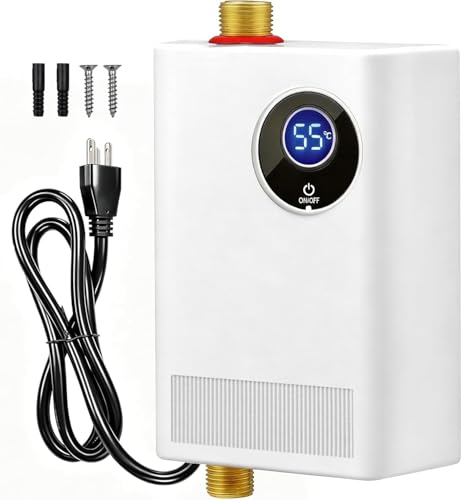
AIYEZIDT’s 110V electric tankless unit delivers instant hot water in 3–5 seconds, with a maximum of 55°C (131°F). It is compact and wall-mounted, making it suitable for kitchens, bathrooms, RVs, and camping setups. Best for small spaces needing quick, on-demand hot water at the sink. It includes an LCD display and safety protections such as leakage monitoring. Limitation: 55°C maximum may require careful temperature management for very cold inlet water.
CAMPLUX Tankless Water Heater Electric 120V

This 120V CAMPLUX unit serves as a point-of-use, under-sink heater. It heats water in about 3 seconds with a modest temperature rise and is designed for compact spaces like RV kitchens or wash stations. Best for single-sink setups where space is limited. It saves energy through self-modulating operation. Limitation: best suited for low to moderate flow rates; not ideal for simultaneous multiple fixtures.
CAMPLUX Tankless Water Heater Electric 240V

This 240V CAMPLUX model targets spaces that can accommodate higher power while maintaining a compact footprint. It uses self-modulating technology to adjust power to flow, reducing energy use and delivering hot water quickly. Best for RVs with access to higher electrical capacity or when you need faster heater response. Avoid this if your RV’s electrical system cannot support 240V reliably on all outlets.
APUS RV Tankless Water Heater

APUS offers a propane-on-demand system with 68,000 BTU and 3.9 GPM, plus a 12V connection for RVs and a remote control. Best for RV families that require strong water flow and high-altitude performance. The 12V compatibility makes it a flexible option for remote trips. Limitation: propane-based units require venting and fuel logistics; choose this if you’re comfortable managing fuel for trips.
Buying Guide
Key considerations when choosing an RV-friendly tankless water heater that runs on electric or 12V power:
- Power source and availability: Ensure your RV electrical system supports the unit’s voltage (110V/120V or 240V) and can sustain continuous operation without overloading circuits.
- GPM and BTU output: Higher flow rates (GPM) mean more simultaneous hot water usage. Match BTU/GPM with expected consumption, such as showers plus kitchen use.
- Altitude and climate: Units designed for high altitude will maintain performance in mountainous or remote areas. If you travel elevation, prioritize models with altitude-ready specs.
- Size and installation space: Measure installation opening and wall space. Point-of-use models fit tight sinks, while larger units may require more cabinet space.
- Safety features: Look for leakage protection, dry-fire protection, and automatic shutoffs. A digital or remote control can improve ease of use.
- Maintenance: Consider ease of cleaning heat exchangers and accessibility for routine service. Propane models require venting and gas line considerations.
Frequently Asked Questions
- What is the advantage of a tankless water heater for RVs? Answer: They provide continuous hot water on demand, reduce weight, and save space compared with traditional tank heaters.
- Do these units work with RV electrical systems and inverters? Answer: Yes, models with 110V/120V or 240V power can integrate with RV electrical setups; ensure the inverter capacity matches peak power draw.
- Is propane necessary for some RV tankless heaters? Answer: Some models run on propane with optional 12V or 110V support; others are purely electric. Check the fuel source in the product specs.
- Can I replace a traditional RV water heater with a tankless one? Answer: Many tankless units are designed to retrofit or replace existing RV water heaters, but check opening sizes and mounting compatibility for your RV model.
- What maintenance do these require? Answer: Regular inspection of connections, venting (for gas models), and heat exchanger cleaning help preserve efficiency and safety.
- What should I consider for high-altitude use? Answer: Choose a unit marketed as “high altitude ready” with stable flame/ignition adjustments and sealed control systems.