Best Step Up Voltage Converters From 110V to 220V for US Use
Consumers in the United States often need reliable 110V-to-220V step up solutions to run European, Asian, or other international appliances. The following article highlights five strong options, covering compact, heavy-duty, and high-wattage converters. Each product is assessed by capacity, build quality, and Safety features to help make an informed choice for everyday or occasional use.
| Product | Wattage Range | Best For |
|---|---|---|
| UMI 120V to 220V Step Up Converter | 300W | Lightweight travel and small appliances |
| UMI 2000W Step Up Converter | 2000W continuous | Mid-range household devices |
| UMI 2400W Step Up Converter | 2400W continuous | Heavier appliances |
| TONCHEAN 3000W Step Up Converter | Up to 3000W | High-power European/Asian appliances |
| VEVOR 5000W Step Up/Down Transformer | Up to 5000W | Very high power, multiple outlets |
UMI 120V To 220V Step Up Converter 300W

This compact unit converts 120V to 220V and supports two outlets, enabling two European or other 220V appliances to operate simultaneously. It uses a toroidal transformer with a slim design (8.46 x 6 x 2.05 inches) and a weight around 6.0 pounds. Features include plastic shell insulation and leakage protection to reduce electric shock risk. Its 300W rating suits small devices like chargers, small kitchen gadgets, or travel appliances. Ideal for travelers or occasional use where high wattage is not required.
UMI 2000W Step Up 110V To 220V Converter

With a continuous rating of 2000W and a 4000W intermittent peak, this unit can run many common 220V appliances in the US. Built around a high-performance toroidal transformer with pure copper coils, it offers stable 220–240V output, low energy consumption, and quiet operation. It’s designed for a broad range of devices such as hair dryers, coffee makers, rice cookers, blenders, and other high-power 220V equipment, making it suitable for households and larger setups needing more energy than a compact model provides.
UMI 2400W Step Up Voltage Converter

This 2400W converter targets heavy-duty usage with an intermittent rating of 4600W and continuous 2400W capacity. It uses a robust toroidal transformer with copper coils for stable output and efficiency. Weighing about 8.4 kg, it remains comparatively compact given its power. Suitable for long-running 220V or 230V appliances such as kitchen machines, hair tools, or robust electronics, provided the load stays within continuous rating guidelines.
TONCHEAN 3000W Step Up Voltage Converter

This upgraded converter achieves 3000W continuous power with a compact profile and ultra-thin ring-type transformer. It’s designed for 110V to 220V operation with Europe and Asia devices, including hair dryers and other high-wattage appliances. The model emphasizes safe usage with a recommended rule of thumb: at least 1.3 times the appliance wattage for continuous operation. A two-outlet design supports multiple 220V devices, with a compact footprint and a weight around 17 pounds for easier portability.
VEVOR 5000W Step Up/Down Transformer
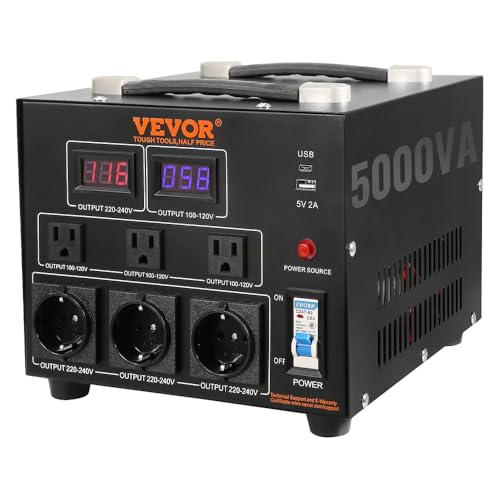
This heavy-duty transformer supports up to 5000W with multiple outlets, including three US sockets and three European sockets, plus a 5V USB and Type-C port. Real-time voltage readouts on dual displays help prevent overload, and built-in safety features include overload, overcurrent, and short-circuit protections. It is CE and FCC certified, making it suitable for extended use with high-power appliances and international devices requiring 110V–220V compatibility. It is best for households with diverse voltage needs or multi-device setups.
Buying Guide: Key Considerations For 110V To 220V Converters
Voltage converters vary in wattage, performance, and safety features. The following considerations help users select the right model for different scenarios.
- Power rating vs. appliance load: Choose a converter with a continuous wattage rating higher than the appliance’s running wattage. If a device surges at startup, a higher headroom is essential to avoid triggering protection or damage.
- Continuous vs. intermittent rating: Some converters list higher intermittent (surge) ratings. For long-term use, rely on continuous ratings to prevent overheating and wear.
- Outlets and compatibility: Look for universal or dual outlets that support both US and 220V plug configurations. Verify that the sockets can handle the intended devices simultaneously if you plan to run multiple appliances.
- Transformer type and efficiency: Toroidal transformers are common in higher-end units and often provide better efficiency and quieter operation than traditional laminated-core designs.
- Safety features: Leakage protection, short-circuit protection, overload protection, and CE/FCC certifications are indicators of reliability and safety for household use.
- Portability vs. capacity: Slim, lightweight models suit travel, while bulky, high-wattage units fit stationary home use. Consider storage space and the typical environments where you will operate the converter.
- Heat management and duty cycle: Prolonged operation at high loads generates heat. Check if the unit includes fans, vents, or thermal safeguards to maintain safe temperatures.
- Color-coded or labeled input/output: Clear labeling reduces misconfiguration. Some units require operations to switch voltage before powering on.
When selecting a converter, always confirm compatibility with the destination country’s voltage and plug standards, and ensure the device’s wattage does not exceed the converter’s continuous rating. For frequent or professional-grade usage, prioritize models with higher continuous wattage, robust construction, and comprehensive safety features.