Best Sound Level Meter Manufacturers and Top Picks
Choosing a reliable sound level meter (SPL meter) hinges on understanding measurement accuracy, weighting options, data logging, and durability. The following selections highlight popular models from well-known manufacturers, each offering features suited for home use, workplaces, and educational settings. This guide compares units by range, weighting (A/C), data hold, calibration, and portability to help buyers identify options that meet different noise-monitoring needs.
| Product | Brand | Model | Notable Feature |
|---|---|---|---|
| Decibel Meter TS-501B | TOPTES | TS-501B | Backlit 2.25″ LCD, A/C weighting |
| SM-130DB Digital Meter | LATNEX | SM-130DB | Calibration certificate, Type 2 |
| Tadeto Digital Sound Level Meter | Tadeto | HT-80A | A/C/C weighting, fast/slow |
| Extech Low/High Kit | Extech | 407732-KIT | USB data logging, multi-readouts |
| RISEPRO HT-80A | RISEPRO | HT-80A | Wide range, ±1.5 dB precision |
The following sections present five representative models in detail. Each entry notes the device’s measurement range, weighting options, data capabilities, and typical use scenarios to help compare suitability for different environments such as homes, offices, classrooms, or industrial settings.
TOPTES TS-501B Sound Level Meter

The TOPTES TS-501B provides a compact, portable solution for on-site noise monitoring. It features a 2.25-inch backlit LCD, enabling readings in dim environments. It supports A-weighting and C-weighting to reflect both human hearing sensitivity and high-noise scenarios. The device covers a practical range from 30 to 130 dB with a measurement precision around ±1.5 dB and a broad frequency span of 30–8000 Hz. A MAX/MIN mode records peak levels, while the data hold function freezes readings for later review, making it suitable for enforcement checks, workshop auditing, and personal sound exposure studies.
LATNEX SM-130DB Digital Decibel Meter
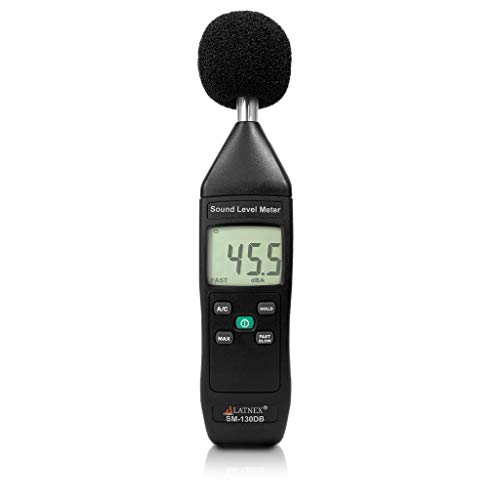
The LATNEX SM-130DB is positioned as a Type 2 sound level meter with a calibration certificate, intended for environmental and mechanical noise monitoring. It measures 35–130 dB (followed by an EN 61672 Type 2 standard alignment) and suits applications from offices and classrooms to manufacturing floors. A calibration certificate helps validate performance for compliance checks, QA, and facilities management, while the device’s EN 61672 Type 2 compliance indicates robust measurement reliability for non-industrial to semi-industrial environments.
Tadeto Digital Sound Level Meter HT-80A
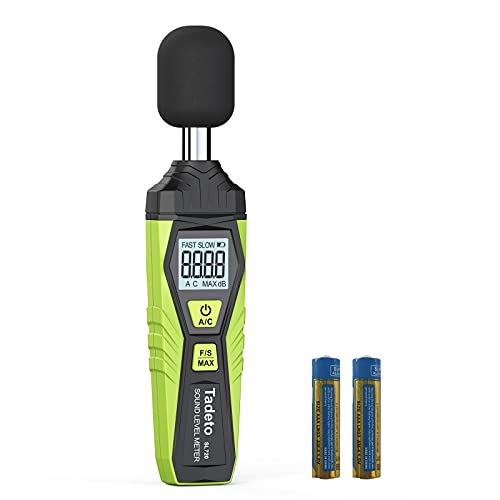
The Tadeto HT-80A emphasizes accurate, real-time monitoring with a measurement range of 30–130 dB and an accuracy around ±2.0 dB. It provides A-weighted and C-weighted readings for different analysis needs—A-weighting aligns with human hearing sensitivity, while C-weighting helps assess high-intensity machine noise. The unit supports fast and slow response modes to capture quick changes or steadier noise levels, making it useful for home environments, studios, and light industrial settings. The backlit LCD screen enhances readability in various lighting conditions.
Extech 407732-KIT Low/High Range Meter

The Extech 407732-KIT offers capabilities for data logging and detailed environmental testing. It can store up to 16,000 readings via USB data transfer, and it displays humidity, temperature, and date, which is helpful for ambient condition tracking during long monitoring sessions. Programmable via keypad or PC, this kit is geared toward classrooms, offices, research facilities, and facilities management where compiling historical noise data is important for audits and compliance documentation.
RISEPRO HT-80A Digital Sound Level Meter

RISEPRO’s HT-80A offers a broad 30–130 dB measurement range with a stated accuracy of ±1.5 dB. It features fast (125 ms) and slow response settings to differentiate quick spikes from longer-duration noise. The device supports A-weighting for general environmental monitoring and is aimed at home, office, and industrial contexts where quick, reliable readings are necessary for safety checks or noise compliance assessments. The dual-range capability aids in distinguishing subtle changes in quieter environments and louder industrial spaces.
Buying Guide: Key Purchase Considerations
- Measurement Range and Accuracy — Look for SPL meters that cover a broad range (30–130 dB is common) and offer accuracy around ±1.5 dB to ±2.0 dB, depending on the application. Higher precision is essential for occupational health or product testing.
- A-Weighting and C-Weighting — A-weighting approximates human hearing at typical sound levels, while C-weighting helps analyze high-intensity noises. Devices with both provide flexibility for multiple use cases.
- Response Time — Fast (roughly 125 ms) and slow (1 s) modes capture dynamic environments, from concerts and workshops to factory floors. Choose based on how rapidly noise levels change in the environment you monitor.
- Data Logging and Export — Consider models with memory storage or USB/PC export for trend analysis, compliance reporting, and long-term monitoring. Data logging is valuable in classrooms, offices, and industrial settings.
- Calibration and Certification — Some meters come with calibration certificates (Type 2 or higher). Certificates support regulatory and QA workflows and improve confidence in readings for audits.
- Display and Readability — A backlit LCD helps visibility in dim environments, while a clear interface and legible units reduce interpretation errors during fieldwork.
- Portability and Durability — For on-site checks, compact, battery-powered meters with durable housings are advantageous. Consider weight, battery life, and ease of use in the field.
- Specific Use Case — Home use, classrooms, offices, or industrial settings may demand features like data hold, MAX/MIN logging, or alarm indicators. Assess which features align with your monitoring goals.
- Calibration Maintenance — Some devices support regular recalibration services or do-it-yourself verification. Plan for calibration intervals to maintain accuracy over time.
- Price-to-Performance — Balance the device’s features against budget. Entry-level meters may suffice for basic monitoring, while advanced units with data logging and certificates suit professional environments.
In choosing a sound level meter, align the device’s capabilities with your monitoring needs. For casual home use, readability, a clear A-weighting option, and a simple MAX/MIN function may suffice. In professional or industrial environments, calibration certificates, data logging, USB exports, and a robust measurement range become more important to support compliance and documentation requirements. The models listed above provide a spectrum of choices across use cases, enabling informed comparisons among popular brands.