Best Smoke Alarms That Alert Your Phone for Modern Home Safety
Smart smoke alarms that push alerts to your phone offer faster updates, remote monitoring, and easier evacuation planning. This guide highlights top devices from X-Sense and other reliable brands, comparing how they connect, alert, and scale with a smart home. Read on to discover five strong picks, a quick product summary, and rigorous buying advice to fit your needs and Wi‑Fi setup.
Summary of chosen products:
| Product | Brand | Model | Key Features |
|---|---|---|---|
| X-Sense Smart Smoke Detector Fire Alarm | X-Sense | XS01-WX | 2.4 GHz Wi-Fi only, real-time app notifications, no base station |
| X-Sense Combination Smoke and CO Detector | X-Sense | XP0A-MR31 | Interconnected via base station, voice location alerts, app alerts |
| X-Sense Smart Detectors With SBS50 | X-Sense | FS51 | Base station hub, up to 50 devices, open-air range |
| 6-Pack Smart Smoke Detector | Soewolit | 6-Pack | 10-year replaceable battery, 85dB alarm, Smart Life app |
| X-Sense Smart Wi-Fi Detector With Voice Alerts | X-Sense | XS0B-iR | Voice alerts with location, direct 2.4 GHz Wi-Fi, no base station |
These picks cover standalone Wi‑Fi models, voice-location alerts, and systems that scale with a base station. Each option supports phone notifications, and several offer full interconnection across multiple devices for broader home safety coverage.
XS01-WX: 1-Pack Smart Smoke Alarm

The XS01-WX connects via 2.4 GHz Wi‑Fi and delivers real-time notifications through the X-Sense Home Security app. It operates without a base station, enabling quick setup and remote monitoring when you’re away. It’s compact for easy placement in hallways or living areas and emphasizes direct, device-to-app communication for timely alerts.
XP0A-MR31: Combination Smoke And CO Detector

This model pairs smoke and carbon monoxide sensing with voice-location alerts and base station connectivity. App alerts notify you of danger, and the interconnected system keeps everyone in sync when one unit detects an issue. It supports sharing with up to 12 family members for broader awareness of safety events.
FS51: Smart Detectors With SBS50 Base Station

The FS51 kit works with the SBS50 base station to create a scalable safety network. It supports up to 50 devices and offers a wide open-air range to cover larger homes or multi-story layouts. Immediate phone alerts synchronize with audible alarms across the base and linked devices for rapid evacuation guidance.
6-Pack Soewolit Smart Smoke Detectors
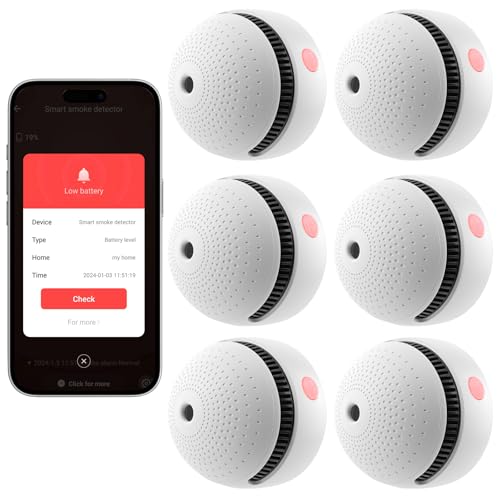
Designed for larger homes or multiple rooms, this 6-pack features 10-year replaceable batteries and a loud 85dB alarm. It uses Wi‑Fi to push notifications to the Smart Life app, aiding remote monitoring. The long-life battery reduces maintenance while delivering dependable smoke detection across spaces such as homes, RVs, and vacation properties.
XS0B-iR: Wi-Fi Detector With Voice Alerts

Compact and lightweight, the XS0B-iR delivers voice alerts with location details. It connects directly to the 2.4 GHz Wi‑Fi network without a base station, allowing quick setup and fast notifications to the paired app. The device focuses on precise location messaging to help occupants evacuate more efficiently during a fire event.
Buying Guide
Key considerations when selecting a phone-alert smoke alarm system:
- Network compatibility: Most models require 2.4 GHz Wi‑Fi. Verify your router’s band settings to avoid connection issues.
- Base station vs. standalone: Base stations enable broader interconnection and scalable networks; standalone units offer simpler setups with direct app alerts.
- Interconnectivity: If you want every unit to sound when one detects smoke, choose systems labeled as interconnected or compatible with a base station that supports multi-device syncing.
- Voice location and alerts: Some models provide spoken location details, which can speed evacuation by identifying where danger is located.
- Battery life and replacement: Look for long-life or replaceable batteries. Ten-year options reduce maintenance while ensuring reliable performance.
- Professional monitoring options: Some features, like optional Protect+ monitoring, can dispatch responders after verification; weigh the value against privacy and cost.
- App experience: Consider notification speed, fault reporting, and how easily you can share access with family members or roommates.
- Device type: Separate smoke vs. smoke+CO detectors; CO sensors add a critical layer of safety but require compatibility with your home setup.
- Placement strategy: Place detectors on every floor, near sleeping areas, and in kitchens or garages, while avoiding nuisance triggers from cooking or humidity.
Practical considerations for a unified system:
- Single-brand ecosystems can simplify setup and maintenance, but mix-and-match options may still provide strong performance if they share similar connectivity and alert capabilities.
- If you have 5 GHz Wi‑Fi in your home, ensure the chosen device supports 2.4 GHz exclusively, or set up a dedicated 2.4 GHz band for compatibility.
- Test routines are essential; schedule periodic checks to verify that phone alerts, base station sirens, and inter-device signaling work as intended.