Best Solid State Speed Controls for Fans
Discover reliable solid-state speed controls designed for fans and ventilation systems. This guide highlights five top options that balance safety, performance, and ease of use. Each product is evaluated on compatibility, ease of installation, and key features to help you choose the right speed controller for your 115V or equivalent fan setup. Use the quick reference below to compare core specs at a glance.
| Product | Brand | Key Benefit |
|---|---|---|
| KB Electronics 8811007 | KB ELECTRONICS | High amp rating with standard wall-box fitment |
| KB Electronics 8811006 | KB ELECTRONICS | Compact, versatile for 2.5–amp loads |
| Fantech WC 15 | FANTECH | Rotary control with on/off and simple install |
| iLiving ILG8SFST | iLiving | Thermospeed temperature-enabled speed control |
| iLiving ILG8SFSC | iLiving | Precision solid-state speed with on/off and brushed plate |
KB Electronics 8811007 Solid State Controller

The 8811007 model from KB Electronics is a solid-state variable speed controller designed for standard 2″ x 4″ electrical wall boxes. It supports up to 6.0 amps at 115 volts and is UL and CSA approved. Not suitable for capacitor-start or capacitor-run motors, this unit focuses on steady, reliable speed control for compatible fan motors in residential or light commercial setups.
KB Electronics Solid State Variable Speed AC Electric Motor Control 15.0 Max amps

This KB Electronics unit is designed for larger loads, rated up to 15 amps at 115V, with a standard 4″ x 4″ wall box footprint. It provides robust variable speed control for heavier-duty fans and ventilators, making it suitable for larger garage or workshop fans. It carries UL and CSA approvals and should not be used with capacitor-start or capacitor-run motors.
Fantech WC 15 Speed Control

The Fantech WC 15 is a rotary-type speed controller with a simple on/off switch, designed to fit standard single-gang boxes. It offers adjustable speed control for ventilation fans and is suitable where straightforward control is preferred. The unit emphasizes ease of installation and compact form factor for airflow management in ducted or exhaust applications.
iLiving ILG8SFST Thermospeed Controller
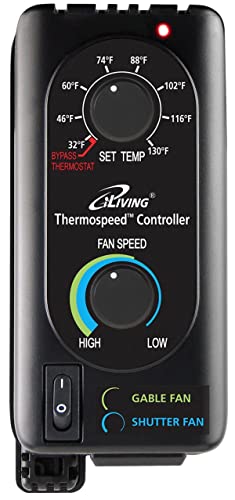
The iLiving ILG8SFST combines speed control with a temperature-based auto-cycle feature. It includes an NTC temperature sensor for precise regulation and a plug-and-play design that supports easy integration with compatible exhaust fans. Ideal for spaces where ambient temperature can influence airflow needs, such as bathrooms or kitchens with ventilation fans.
iLiving ILG8SFSC Solid State Controller

The ILG8SFSC provides precision solid-state control with a rotary on/off function and a brushed aluminum faceplate. This model is designed for precise speed adjustments at 120V and helps maintain optimal airflow with a clean, simple control interface. It is suitable for modern home or workshop ventilation setups seeking reliable performance.
KB Electronics 8811006 Solid State Controller

Designed for standard 2″ x 4″ electrical wall boxes, the 8811006 model handles up to 2.5 amps at 115V. It carries UL & CSA approvals and is not intended for capacitor-start or capacitor-run motors. This compact option suits smaller fans or ventilation devices where modest speed control is sufficient.
Buying Guide
Key considerations when choosing a solid-state speed control for a fan include electrical compatibility, motor type, and enclosure fit. Ensure the controller supports the fan’s voltage (commonly 115V in the U.S.) and current draw (amps). For capacitor-start or capacitor-run motors, verify the unit is rated accordingly or avoid use to prevent motor damage. Wall box compatibility matters; many controls fit standard 2″ x 4″ or 4″ x 4″ boxes, while some compact options suit single-gang enclosures. Consider control type (rotary, thermostatic, or programmable) based on the desired balance of simplicity and automation. Safety certifications (UL CSA) indicate compliance with electrical standards. If precise airflow management is required, models with temperature or humidity sensing (thermo- or humidity-based) or remote control options may offer added value. Finally, verify compatibility with your fan’s speed-controllability: not all fans support full 100% to 50% range, and some devices are intended for ventilation units rather than general-purpose motors.