Best Solar Wind Charge Controllers for Off-Grid Power Systems
Answering the needs of off-grid homeowners, boaters, and rural property managers, this guide spotlights top solar wind charge controllers that efficiently manage wind and solar inputs. Each option is tailored for 12V/24V systems and common battery chemistries, including lithium. The top picks balance MPPT and PWM technology, easy configuration, and robust handling of mixed energy sources. This overview helps buyers choose the right hybrid controller based on wind and solar capacity, system voltage, and installation needs.
| Product | Best For | Key Advantage |
|---|---|---|
| Pikasola 1400W Off Grid Hybrid | Small homes, boats, street lights with mixed inputs | Stepless wind dumping, auto battery type optimization |
| VQP 2000W Wind Solar Hybrid | All-around wind-solar hybrids for scalable setups | Boost MPPT charging for wind, PWM solar charging |
| VNATWGOO 15000W Hybrid | Larger off-grid systems needing high wattage | Wide voltage support, intelligent control, dump load |
| iSunergy 1000W Wind Solar Hybrid | Compact systems with clear LCD feedback | Integrated display, MOS tube PWM solar charging |
| Himopuer 6000-12000W Hybrid | Mid-to-large solar-wind setups | LCD display, MPPT boost, dump-load option |
Pikasola 1400W Off Grid Hybrid Wind Solar Controller

This hybrid controller supports 12/24V batteries, including lithium, and handles up to 800W from wind and 600W from solar. It uses booster MPPT for wind charging and PWM for solar panels. The system auto-sets parameters to the chosen battery type and allows user adjustments. Best for small homes, boats, and street-light projects needing reliable wind-solar balance. Caution: performance depends on wind consistency and solar exposure; ensure correct dump-load configuration for efficiency.
VQP 2000W Wind Solar Hybrid Controller
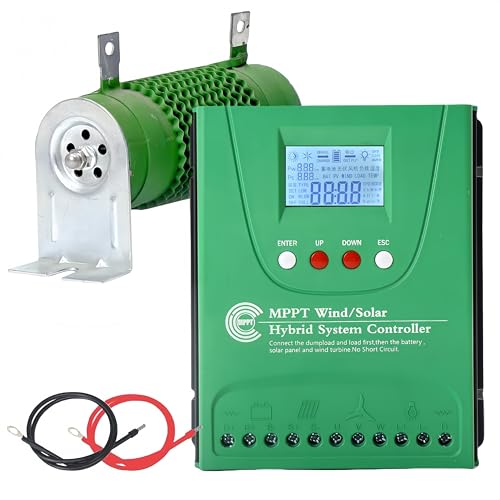
Designed for 12V/24V systems with up to 1000W wind and 1000W solar inputs, this controller is versatile for home, boat, and street-light projects. It uses boosted MPPT charging for wind to maximize energy capture at low wind speeds and PWM solar charging for safe, efficient solar input. Best for mid-sized hybrids seeking scalable wind and solar input. Limitation: very high input power may require larger cabling and proper heat dissipation.
VNATWGOO 15000W Hybrid Charge Controller

This high-capacity hybrid controller fits 24V and 48V batteries, including lithium, with a wind and solar input setup for large off-grid systems. It features booster MPPT charging and a stepless discharge function with an external dump charge resistor. Best for larger installations such as rural homes or marina lighting. Caution: higher wattage requires careful heat management and proper DC wiring sizing.
iSunergy 1000W Wind Solar Hybrid

Ideal for compact systems, this PWM-based solar charger pairs with wind inputs under 1000W. It integrates an LCD display showing battery voltage and charge status, and offers customizable parameters to suit different environments. Best for simplified installations where clear feedback is valued. Limitation: Solar charging relies on PWM without MPPT for solar alone, which can affect efficiency in fluctuating sun conditions.
Himopuer 6000-12000W Hybrid

This hybrid controller supports 12V/24V/48V systems and both wind and solar inputs with MPPT boost charging and PWM solar charging. It includes a large LCD display to monitor wind, solar, battery, loads, day/night cycles, and cumulative power. Best for mid-to-large scale off-grid setups needing robust monitoring. Caution: Heavy unit—ensure mounting and ventilation are adequate for heat dissipation.
Buying Guide: How To Choose The Right Solar Wind Charge Controller
- System Voltage and Battery Type: Confirm the controller supports your system voltage (12V, 24V, or 48V) and battery chemistry (including lithium). This ensures safe charging voltages and protection features.
- Power Handling: Match the maximum wind turbine and solar panel input ratings to your planned setup. A controller rated close to your total input avoids energy loss or overheating.
- MPPT vs PWM: MPPT controllers maximize energy harvest from solar panels, especially in shaded or low-sun conditions. PWM controllers are simpler and less expensive, suitable for smaller solar inputs and steady sun.
- Dump Load & Dump-Load Options: Dump-load resistors protect batteries by dissipating excess energy. This is important in wind-dominant or high-output solar installations.
- Display and Diagnostics: LCD displays help monitor voltage, current, and generation. A readable interface reduces guesswork during setup and routine checks.
- Expansion and Future-Proofing: If you plan to scale, choose a controller with higher input limits or modular capabilities to accommodate larger solar arrays or wind turbines later.
- Installation Considerations: Check for ventilation, heat sinking, and access to wiring paths. Larger units may require robust mounting and weather protection for outdoor use.
FAQ
- What is a solar wind hybrid charge controller? It is a device that manages charging from both wind turbines and solar panels, optimizing energy flow to batteries and loads.
- When should I choose MPPT over PWM for solar charging? MPPT is better when solar input is variable or high and efficiency matters; PWM is suitable for smaller, simpler systems.
- Can I use lithium batteries with these controllers? Yes, most listed controllers support lithium batteries alongside other chemistries.
- Do all controllers include a dump-load function? Several do, but confirm the model supports external dump-load or integrated dumping for wind or solar input management.
- Is a display necessary? While not mandatory, an LCD display helps with real-time monitoring and easier setup.
- Will these controllers work in a marine environment? Many are designed for off-grid and outdoor use, but verify IP rating and weather considerations for marine installations.