Best Solar Panels to Grid: Top Kits for RVs and Homes
Answering a buyer’s search for reliable solar-to-grid solutions, this guide spotlights five solid options from ECO-WORTHY and Renogy. Each product suits different needs—from compact RV setups to full home backup systems. The best picks balance efficiency, ease of installation, and clear use cases. This article helps you compare who each kit is best for, what you gain, and where to avoid trade-offs.
| Product | Best For | |
|---|---|---|
| ECO-WORTHY 200W Kit | Small RV/Off-Grid Vehicle | Compact 200W panel with PWM controller |
| ECO-WORTHY 1.6KWh Complete Kit | Mid-Size RV or Shed Backup | 400W panels with MPPT controller and lithium storage |
| ECO-WORTHY 7.168KWh Kit | Full RV/Off-Grid System | 800W panels + UPS inverter charger + lithium batteries |
| Renogy 100W N-Type Panel | Compact rooftop or boat applications | High-efficiency 25% cells, durable design |
| Brand-agnostic Note | N/A | MPPT advantages vs PWM in larger systems |
Buyer profiles covered:
– Weekend RVers needing dependable off-grid power.
– Off-grid cabins or sheds seeking backup power.
– Small boats or campers needing space-efficient panels.
– Homeowners exploring grid-tied or hybrid backup setups with more capacity over time.
ECO-WORTHY 200 Watts Solar Panel Kit
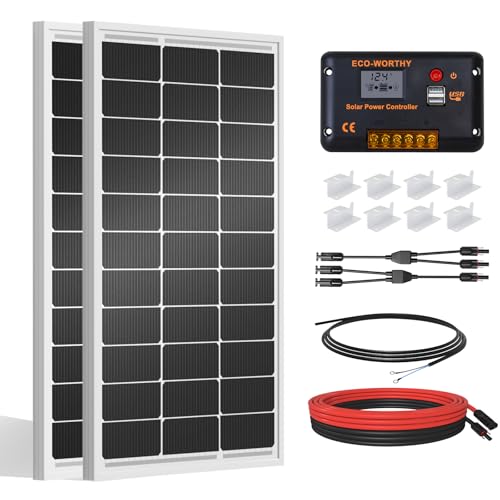
Best for smaller mobile setups or light off-grid needs. Features high-efficiency monocrystalline cells and a 30A PWM charge controller. The panel uses corrosion-resistant aluminum framing and an IP65-rated junction box for durability in harsh outdoor conditions. Ideal for RVs, campers, or backup power in cabins. A limitation is PWM efficiency under variable sunlight; MPPT alternatives can extract more energy in fluctuating conditions.
ECO-WORTHY 1.6KWh Complete Solar Panel Kit 400W

Best for RVs or small cabins needing a robust, multi-component system. This kit includes 400W of solar panels, a 40A MPPT controller, a 12V 100Ah lithium battery, a power inverter, and Bluetooth module. It targets higher daily outputs (up to 1.6KWh under ideal sun) and supports 110V appliances. Choose this for better efficiency and smarter charging; avoid if you need a simpler PWM-only setup or limited installation space.
ECO-WORTHY 7.168KWh 800W Kit

Best for full RV off-grid or home backup with substantial energy needs. Four 200W bifacial panels provide strong daytime generation; the kit includes a 3000W inverter/charger, two 12.8V 280Ah lithium batteries, and a 60A MPPT controller with Bluetooth. This is designed for powering most RV appliances, including air conditioning and refrigerators. Limitation: higher upfront cost and more complex setup; ensure space and wiring readiness.
Renogy 100W N-Type Panel

Best for compact rooftop installs or marine use where space is at a premium. The 25% high-efficiency N-type cell design reduces heat-related performance losses and minimizes hot spots. The 16BB cell structure supports longer life and better durability in challenging environments. Opt for this if you need steady performance in hot climates; avoid if you expect to power heavy AC loads with a small panel alone.
Buying Guide: Key Purchase Considerations
What size system do you need? Assess daily energy use and available sun hours. For RVs, a 200W to 400W setup is typical for weekend trips; for cabins or larger RVs, plan 800W–1.6kW or more. Is MPPT worth the upgrade? MPPT controllers generally yield more energy in variable light and cold conditions, especially in open-field or shaded scenarios. Do you need lithium storage? Lithium batteries offer longer life, deeper discharge, and faster charging, but come at higher cost. Consider installation space, weight, and mounting options—bifacial panels can boost output in reflective environments, such as snow or light-colored ground. Finally, assess weatherproofing and durability: look for corrosion-resistant frames and IP-rated junction boxes.
Installation and System Design: Practical Tips
- Plan wiring layout with safety in mind; use appropriate gauge cables and fuses.
- Place panels where they receive maximum sun exposure, typically south-facing in the U.S.
- Consider expansion potential: choose a kit that allows adding more panels or batteries later.
- Match controller type to system size: PWM for small, MPPT for larger, variable-light setups.
FAQ
- What is the difference between PWM and MPPT controllers? MPPT controllers optimize energy capture under varying conditions and generally improve efficiency, especially with higher panel voltage and larger systems. PWM screens are simpler and cost-effective for smaller setups.
- Can I run household appliances from solar panels? Yes, with enough capacity and a compatible inverter, you can power 110V devices, but you must size the system to meet peak loads.
- Are bifacial panels worth it? They can offer higher output in certain reflective environments, such as snow or light-colored surfaces, but depend on installation geometry and cost.
- Do I need batteries for solar power? Batteries are needed for off-grid usage to store energy for cloudy days or nighttime. Lithium options provide longer life and deeper discharge than lead-acid.
- Is stainless or aluminum framing better for outdoors? Both are durable; aluminum frames resist corrosion and are common for outdoor panels.
- How do I choose the right kit size? Base your choice on daily energy needs, available sun hours, and whether you want future expansion.