Best Solar Roof Exhaust Vent Solutions for Attics
Looking for efficient, solar-powered attic cooling? This guide reviews five top solar roof exhaust vents designed to reduce heat, manage humidity, and lower cooling costs. Each product below leverages solar energy to vent hot air from rooftops, garages, or sheds—without needing a wired electrical hookup. Compare capabilities, installation options, and thermostat or remote controls to pick the best fit for your space.
| Product | Brand | Main Benefit | |
|---|---|---|---|
| iLiving Hybrid Ready Smart Thermostat Solar Roof Attic Exhaust Fan | iLiving | Smart control with wide coverage | 40W, 1150 CFM, up to 2900 sq ft |
| 25W Solar Roof Vent Fan with 8-Inch Roof Vent | SwellishColor | Compact, high-efficiency solar vent | Up to 240 CFM, IP68 motor |
| Solar Attic Fan 32W 1600CFM | DC House | High airflow with weatherproof design | 1600 CFM, off-grid operation |
| Hon&Guan Solar Attic Fan with Thermostat | Hon&Guan | Thermostat-controlled cooling | 2000 CFM, 12″ diameter |
| OmniPV Smart Hybrid Solar Attic Exhaust Fan Pro | OmniPV | High capacity with smart control | 2850 CFM, 50W panel |
Note: All products listed operate primarily on solar power with various control options, mounting configurations, and airflow capacities to fit different attic sizes and climate conditions. The table above highlights headline benefits and standout features to guide your selection.
iLiving Hybrid Solar Roof Attic Exhaust Fan

The iLiving model combines solar power with a smart thermostat control that operates between 50°F and 122°F. It features an IP68-rated brushless motor for durability and a 15-year warranty. The adjustable solar panel supports multiple tilt angles (0°/15°/30°/45°) to optimize sun exposure, delivering up to 1150 CFM and cooling capacity for spaces up to 2900 square feet. This unit integrates heating and cooling considerations without requiring grid power.
Design emphasis centers on remote control and flexible installation. The fan’s smart thermostat enables enable/disable options and temperature-triggered activation, helping maintain a stable attic environment during peak sun. With its rugged construction and sizable airflow, this model suits larger homes or spaces with extensive attic volume that demand consistent venting during hot months.
SwellishColor 25W Solar Roof Vent Fan

This compact solar roof vent uses a 25W monocrystalline solar panel paired with an IP68 waterproof brushless DC motor. It delivers up to 240 CFM of attic ventilation, helping to reduce heat gain and lower cooling demands. Its galvanized steel construction with a corrosion-resistant coating and reinforced aluminum mesh offers durability and pest protection in a variety of climates. The unit relies on direct solar power, and its tempered glass panel and aluminum frame enhance solar absorption, providing reliable performance for years to come.
Installation flexibility and energy savings are central to its design. The unit is well-suited for homeowners seeking a balance between performance and budget. While airflow is solid, it is most effective in moderate to mid-sized attics or spaces where a single vent suffices to push hot air out and draw cooler air in from other vents.
DC HOUSE Solar Attic Fan 32W
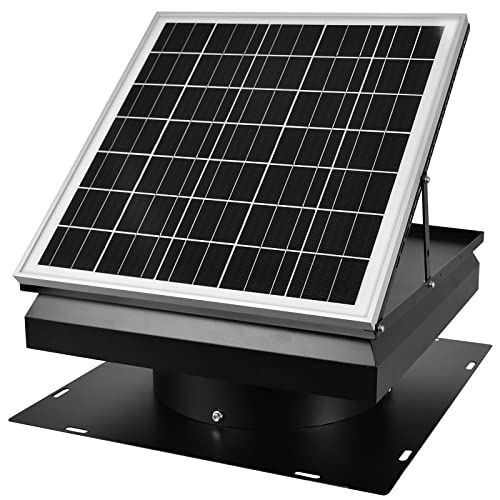
The DC HOUSE model is built around a 32W solar array and a powerful 1600 CFM output for robust attic cooling. It operates off-grid and includes weather-ready components designed to withstand various weather conditions. The design claims resistance to wind and temperature extremes while maintaining reliable operation. The product highlights suggest it’s capable of reducing attic temperatures by up to 30°F, which can mitigate AC load on the main living spaces.
Customers may value its weatherproofing, aerodynamic blade design, and ability to pair with existing roof vent configurations for enhanced overall airflow. This option is especially attractive for homeowners who want substantial airflow without the need for electrical wiring, yet still require dependable daily operation during the sunniest months.
HNRLOY 25W Solar Roof Vent Fan with 8 Inch Roof Vents

This high-efficiency solar attic fan employs a 25W solar panel with IP68-rated waterproof hardware and a galvanized steel housing. An aluminum mesh guards against pests while a tempered glass surface and aluminum frame maximize solar energy capture. The design emphasizes energy savings and long service life, with a claimed 10+ year performance window. It is suitable for garages, shops, and roof installations where additional airflow is desired without extending electrical wiring.
For installation versatility, the unit’s 8-inch vent diameter simplifies mounting on a variety of roof penetrations. It is a practical choice for spaces needing consistent ventilation in sun-drenched regions while maintaining a compact footprint and straightforward maintenance requirements.
OmniPV Smart Hybrid Solar Attic Exhaust Fan Pro

The OmniPV Pro unit uses a 50W solar panel to deliver up to 2850 CFM, capable of cooling and dehumidifying spaces up to 4000 square feet. It features a German-engineered brushless DC motor for efficiency and a temperature control system that can be set between 50°F and 104°F, with an option to run continuously. The design supports flexible mounting with tilt and orientation adjustments, enabling optimal solar exposure regardless of roof angle or sun position.
Applications span residential attics, warehouses, barns, greenhouses, and other large spaces where high airflow is needed without grid power. The combination of strong airflow, weather resistance, and advanced control makes it a compelling option for long-term cooling and humidity management in sunny environments.
Buying Guide: Solar Roof Exhaust Vent Considerations
- Attic size and airflow requirements: Match CFM or air changes per hour to the space. Larger attics typically need higher CFMs (1000+). For smaller spaces, 500–1000 CFM can suffice.
- Power source and controls: Decide between manual thermostats, built-in smart thermostats, or remote control options. Thermostat-enabled models help automate operation based on temperature thresholds, while off-grid solar-only models maximize energy savings.
- Mounting and roof compatibility: Check vent diameter, mounting depth, and tilt capability. Some models offer adjustable solar panel angles (0°–45°) to maximize sun exposure, improving efficiency in winter or during varying sun angles.
- Weather resistance and durability: Look for IP ratings, brushless DC motors, corrosion-resistant housings, and wind tolerance to ensure reliable operation in your climate.
- Energy savings and maintenance: Solar attic fans reduce cooling demand but require periodic cleaning, mesh checks for pests, and motor lubrication where applicable. Warranty length can reflect expected lifespan.
- Noise and comfort: Many models run quietly (often under 30 dB). If noise is a concern, review decibel ratings and consider installation location relative to living spaces.
- Integrated or hybrid options: Hybrid systems with AC adapters or auto-switch features provide 24/7 operation in changing weather, useful for year-round performance.
- Installation considerations: Some units are easier to install with existing vents or 8–12 inch roof openings. Professional installation may be preferred for complex roofs or high-watt systems.
- Future scalability: If you plan to vent multiple rooms or larger spaces, prioritize higher-CFM models, scalable configurations, and compatible mounting hardware.