Best Solar Panels Direct From Manufacturer: Top Off-Grid Kits
Direct-from-manufacturer solar panels are ideal for buyers seeking consistent supply, clear warranties, and straightforward installation. This guide highlights five top options that fit various off-grid needs—from compact RV setups to home backup power. The selections favor durable builds, clear performance data, and practical use cases. Best for campers and small setups, the ECO-WORTHY kit emphasizes value and reliability; the STAR 860W panel targets larger, space-constrained installations; the FlexSolar panel suits portable power needs; ZOUPW offers compact versatility for on-the-go power; and Renogy’s starter kit appeals to new off-grid systems with included accessories.
Buyer’s quick-reference table
| Product | Best For | Key Benefit | Limitations |
|---|---|---|---|
| ECO-WORTHY 200W Kit | RV, caravan, off-grid cabins | High efficiency mono cells, durable frame | Smaller system size, 200W max input |
| STAR 860W 2-Pack | Residential, off-grid homes with limited space | High power density, long lifespan | Higher upfront cost |
| FlexSolar 100W Portable | Camping, emergencies, small power stations | Ultra-portable, multiple outputs | Lower total energy in one go |
| ZOUPW 100W Portable | Remote camping, RVs, off-grid | IP67 waterproof, universal 5-in-1 cables | Limited wattage per panel |
| Renogy 100W Starter Kit | New off-grid setups | Includes PWM controller, cables, brackets | Starter kit, not top-end efficiency |
ECO-WORTHY 200 Watts Kit
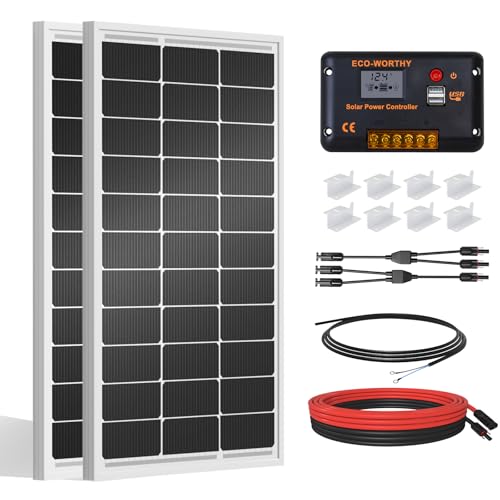
The ECO-WORTHY 200 Watts Kit uses high-efficiency monocrystalline cells to deliver strong daily output suitable for RVs, campers, and off-grid cabins. Best for buyers who want a straightforward, durable kit with flexible 12V/24V operation and a rugged, corrosion-resistant frame. The panel is designed to withstand wind and snow loads, with IP65 protection on the junction box for weather resilience. A caution: system sizing remains important to match daily energy needs to avoid underutilization in low-sun periods.
860W Bifacial Solar Panels (2x430W)

This pair of bifacial 430W panels focuses on space-saving design and high peak output. Best for homeowners and small farms needing strong power density in limited roof or yard space. The panels feature a long 30-year service life with durable glass and transport-ready assembly. They are suitable for RVs and off-grid cabins that require substantial energy in a compact footprint. A limitation to note: bifacial gains depend on mounting angle and reflected light; performance can vary with shading and installation conditions.
FlexSolar 100W Portable Panel

FlexSolar offers a compact, ultra-portable 100W panel with multiple outputs including PD3.0 USB-C, USB-A, and DC. Best for camping, emergency power, and charging small devices or power stations on the trail. The panel packs enough power for phones, tablets, and small power banks while staying light and easy to transport. Limitation: its wattage is lower, so larger loads or continuous high-demand equipment may require additional panels or storage capacity.
Renogy 100W Starter Kit
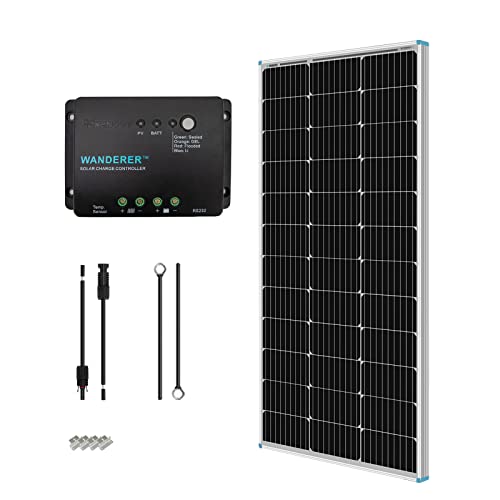
The Renogy Starter Kit pairs a 100W monocrystalline panel with a 30A PWM charge controller, plus brackets and tray cables. Best for first-time off-grid users who want a complete, ready-to-install package. It supports RV, camper, and other off-grid applications with clear safety and performance standards. A caution: PWM controllers may be less efficient than MPPT options for areas with varying sunlight; plan for potential efficiency differences in shaded or diffuse light conditions.
Buying Guide: Key Purchase Considerations
- System size and energy needs: Match wattage to daily energy consumption. Larger homes or high-demand campsites benefit from higher-wattage kits or multi-panel arrays.
- Type of cells and design: Mono-crystalline cells offer higher efficiency is typical for space-limited installs; bifacial designs can boost output in the right conditions.
- Durability and weather resistance: Look for frame materials, IP ratings, and wind/snow load specs to ensure longevity in your climate.
- Controllers and wiring: PWM controllers are common in starter kits; MPPT controllers optimize energy harvest in variable conditions but can cost more.
- Portability vs. permanence: Portable panels suit travelers and emergencies; fixed installations favor long-term energy generation with higher total output.
- Compatibility: Check compatibility with existing power stations, inverters, and battery banks to ensure a smooth setup.
- Warranty and service: Favor products with clear coverage for materials and workmanship and extendable service plans where available.
Frequently Asked Questions
- What is the difference between mono-crystalline and polycrystalline panels?
Mono-crystalline panels typically offer higher efficiency and better performance in low-light conditions, making them ideal for compact spaces. Polycrystalline panels are usually more affordable but slightly less efficient. - Do I need an MPPT controller or is PWM okay?
MPPT controllers extract more energy from the panels, especially in colder or cloudier conditions, but PWM controllers are simpler and cheaper for small systems. - Can bifacial panels increase my output?
Yes, bifacial panels can produce more energy by capturing light from the rear side, especially with proper mounting and reflective surroundings. - Is portable solar suitable for long-term off-grid use?
Portable panels are great for temporary setups and emergencies, but fixed, high-wattage installations are typically more cost-effective for regular off-grid living.