Best Off-Grid Solar Panels for True Energy Independence
For households seeking reliable power without relying on the public grid, off-grid solar kits offer scalable, self-sufficient energy. This article highlights five practical options that balance capacity, expandability, and ease of installation. Each selection provides detailed specs, typical use cases, and key considerations to help buyers compare performance, storage, and compatibility with inverters and battery banks.
Summary of chosen products
| Product | Key Capability | Typical Use | Storage Focus |
|---|---|---|---|
| ECO-WORTHY Complete Off-Grid Solar Kit | 5kW inverter, 24x195W panels, 2x48V 100Ah LiFePO4 batteries | Residential backup and independence | Up to 76.8 kWh expandable via parallel batteries |
| ECO-WORTHY 9.36KWH System | 5000W inverter, 12x195W panels, 4x48V100Ah batteries | Home or cabin backup with compact footprint | Rack-mounted LiFePO4 storage, scalable with 4 batteries |
| ECO-WORTHY 5KW Off-Grid Complete Kit | 5kW hybrid inverter, 12x195W panels, 4x LiFePO4 batteries | Simple, all-in-one off-grid power | Large capacity via 4 batteries in rack |
| ECO-WORTHY 10000W Complete Kit | Two 5kW inverters, 12x195W panels, 4x LiFePO4 batteries | High-demand households, cabin or ranch setups | 10 kW battery bank, expandable solar and parallel inverters |
| ECO-WORTHY 200W Starter Kit | 200W kit with 100Ah battery and small inverter | RVs, boats, or compact off-grid needs | Portable, easy to move and store |
ECO-WORTHY Complete Off-Grid Solar Kit

The ECO-WORTHY Complete Off-Grid Solar Kit provides a robust, scalable system designed for energy independence. It includes two 48V 100Ah LiFePO4 batteries with CAN/RS485 communication, a 5000W hybrid inverter, a 100A MPPT solar charge controller, and a substantial set of cables and mounting hardware. The kit supports single-phase 120V output and parallel 240V configurations, with the option to expand up to six inverters for up to 30kW AC output. Real-time monitoring via Bluetooth/WiFi enhances system visibility and control, while modular battery banks enable growth as energy needs evolve. This is well-suited for homes needing reliable off-grid operation and future expansion.
Key features include high output flexibility, networked battery management, and the ability to tailor AC inputs to maximize savings and reliability. Prospective buyers should consider roof or ground mounting space, wiring best practices, and whether their location requires additional protection against weather or wildlife. The system’s modularity means it can start small and scale up as power demand grows, making it a versatile option for long-term off-grid living.
Jackery Solar Generator 1000 v2 with 2x100W Solar Panel

The Jackery Solar Generator 1000 v2 combines a portable LiFePO4 power station with compact solar input, offering a practical off-grid option for temporary needs or small households. It delivers up to 1,500W continuous power with a 1,070Wh battery capacity, and fast charging enables a 0-100% recharge in about an hour under optimal conditions. The system is designed for outdoor use, emergencies, RVs, and light home backup scenarios. The included 200W or 100W solar panel configuration (depending on bundle) supports rapid replenishment of stored energy and provides a viable source of power when grid access is unavailable.
Considerations include the balance between portability and total energy capacity, charging speed with available sunlight, and the need for higher continuous loads. This option excels for occasional outages and mobile applications but may require expansion for full home off-grid duty. Its ecosystem and app-based monitoring add a level of user-friendly control for monitoring and settings adjustments.
Jackery Solar Generator 1000 v2 with 200W Panel

This Jackery configuration pairs a high-capacity 1,070Wh LiFePO4 battery with a substantial 1,500W continuous output and a strong surge capacity, making it suitable for powering essential appliances during outages. The 1-hour fast charging feature and a long battery lifespan—driven by a durable LiFePO4 pack—help extend usability in daily life and outdoor adventures. The overall package is designed for portability and quick deployment, offering practical backup power for RVs, campsites, and smaller off-grid setups.
Key considerations include whether the total energy capacity and peak load fit daily needs, the convenience of charging from solar panels, and the desire for a compact, transportable system versus a fixed, larger off-grid installation.
ECO-WORTHY 9.36KWH 2400W Off-Grid System Kit

This kit targets users who want a higher storage and power level in a compact footprint. It combines a 5000W inverter with 12x195W panels and a 4x48V100Ah LiFePO4 rack system, enabling significant daily energy production and substantial storage capacity. The included mounting brackets and pre-attached cables simplify installation, and the system supports versatile configurations with a focus on uninterrupted power for essential loads. The hybrid inverter and MPPT controller optimize charging, while the scalable battery bank supports future expansion.
It’s important to assess climate conditions, available sun hours, and the need for space to install the panels along with a suitable enclosure for the rack-mounted batteries. The rack design also accommodates potential upgrades and easier maintenance over time.
ECO-WORTHY 5KW Off Grid Complete Kit
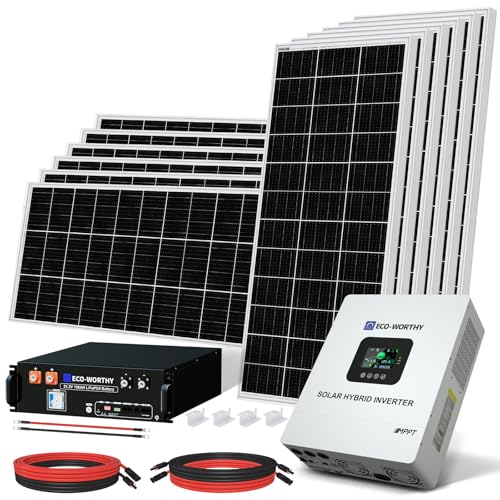
This all-in-one kit is designed to provide a straightforward off-grid solution with a 5KW hybrid inverter and 12x195W panels, plus 4x LiFePO4 batteries. It emphasizes simple setup with a series-connected panel array and battery bank designed for plug-and-play operation. The system supports parallel operation across multiple inverters for higher outputs, enabling 240V configurations when needed. The included batteries offer safe, long-life storage with CAN/RS485 communication for monitoring compatibility with popular inverters.
Key considerations include evaluating the total daily energy needs, plan for future expansion, and ensuring adequate ventilation and enclosure for the rack-mounted batteries. The kit is well-suited for homeowners seeking a reliable off-grid backbone with room to grow as power demands rise.
ECO-WORTHY 10000W Complete Off-Grid Kit
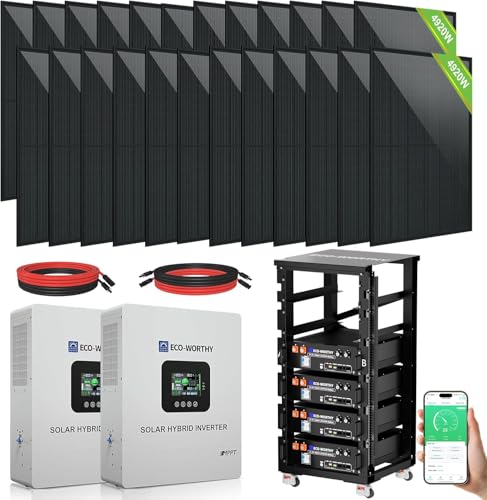
This high-capacity system targets larger off-grid applications, offering two 5kW inverters, a robust 9840W solar array, and a substantial 4x LiFePO4 battery bank. The dual-inverter setup supports 120V/240V output and expandable solar input, enabling versatile off-grid operation across larger homes, cabins, or ranches. The included energy management features allow remote monitoring via a mobile app, aiding in performance tuning and fault detection. The 10kW potential output makes it suitable for more demanding loads, such as climate control or heavy appliances, while maintaining grid-independence.
Considerations include ensuring adequate space for multiple inverters, proper heat dissipation, battery thermal management, and the potential need for professional electrical integration to meet local codes and safety standards.
ECO-WORTHY 200 Watt 12V Starter Kit
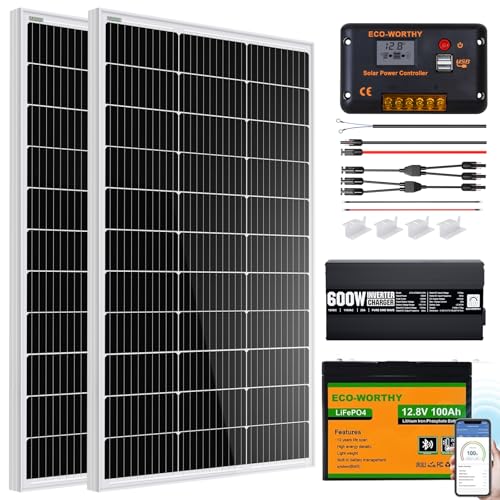
This starter kit is tailored for RVs, boats, or smaller off-grid setups, featuring two 100W panels, a 100Ah lithium battery, a 30A charge controller, and a compact inverter. It provides a low-cost entry point into solar off-grid living and serves as a practical scouting option for evaluating solar performance in a mobile or limited-space scenario. While not designed for full-home independence, it demonstrates core concepts of energy storage, solar charging, and inverter-based power delivery in a portable package.
Potential buyers should assess intended load profiles, seasonal sun exposure, and the feasibility of gradually scaling to larger systems as power needs evolve. This kit’s portability makes it a logical first step before committing to a larger, fixed installation.
Buying Guide: Key Purchase Considerations for Off-Grid Solar Systems
- Energy demand and daily load profile: List essential appliances and their wattage to estimate daily kilowatt-hours (kWh). Higher-demand homes may require larger inverters and bigger battery banks.
- Inverter capacity and configuration: Decide between single-unit or multi-inverter setups. Split-phase or 240V output can power larger appliances, but may require more complex wiring and protection.
- Battery technology and storage: Lithium iron phosphate (LiFePO4) batteries offer longer lifespans and better safety than lead-acid. Consider battery depth of discharge, cycle life, and BMS compatibility with your inverter.
- Solar panel array and spacing: Assess roof orientation, available space, and sun hours. A higher wattage array increases energy capture but may require additional mounting hardware and weather considerations.
- Monitoring and control: Look for systems with Bluetooth/WiFi monitoring and compatible mobile apps. Real-time data helps optimize charging, load shifting, and fault detection.
- Expandability and future-proofing: Choose modular components that can scale up as energy needs grow, ensuring compatibility across brands and inverters.
- Installation environment and safety: Ensure proper ventilation for inverters, weather protection for panels and racks, and adherence to local electrical codes.
- Costs and maintenance: Consider up-front costs, install difficulty, and expected lifespan of components. Some kits reduce complexity but may restrict future upgrades.
- Resilience factors: For remote settings, evaluate battery resilience against temperature swings, and ensure systems include appropriate fusing, breakers, and surge protections.
- Local regulations and incentives: Check any permitting requirements and available rebates or tax incentives for solar and energy storage installations in your area.