Best Solar Inverter With Battery Storage for Home Backup and Off-Grid Power
If you want reliable energy when the grid goes down or you’re powering a cabin off-grid, a solar inverter with battery storage is essential. This guide highlights five top options, explains who each is best for, and outlines key buying considerations. The focus is on systems that combine inverters, battery storage, and smart features to simplify monitoring and control for American homes.
Buyer snapshot: the top five picks below are aimed at homeowners, RVers, and small off-grid setups who want scalable storage, clear monitoring, and robust protection. The table summarizes core capabilities to aid quick comparison.
| Product | Key Benefit | Best For | Notable Limitation |
|---|---|---|---|
| ECO-WORTHY Powermega 48V 314Ah | 10kW hybrid inverter with 16.1 kWh usable storage; built-in BMS | Home backup and off-grid cabins | Complex setup for multi-unit parallel use |
| Aninerel 12000W Solar Hybrid Inverter | 12kW continuous, 24kW peak; 2 MPPTs; high parallel capacity | Large power loads; scalable solar with multiple units | Requires careful configuration for battery compatibility |
| ECO-WORTHY 200W Solar Panel Starter Kit | All-in-one starter kit for RVs and off-grid setups | Beginner-friendly, portable systems | Lower total storage and power than full-house kits |
| ECO-WORTHY Home Power Backup Station | 10kW inverter with 48V LiFePO4, Bluetooth & WiFi | Home backup with potential to scale | Paralleling up to 6 inverters for higher output |
| SUNGOLDPOWER 10000W 48V Inverter | 2 MPPTs, 10kW output, smart monitoring | Balanced system with monitoring | Installation may be more technical for beginners |
ECO-WORTHY Powermega 48V 314Ah Energy Storage System
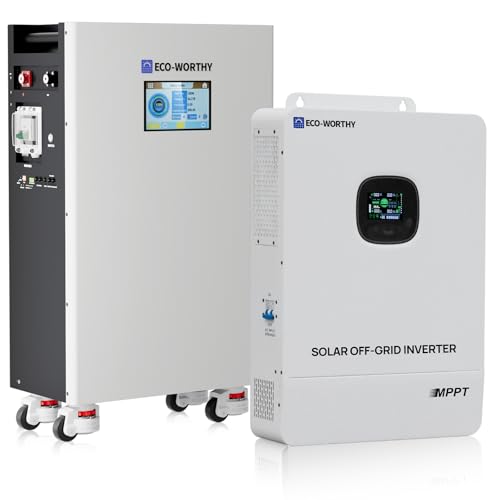
The ECO-WORTHY Powermega pairs a 10kW hybrid inverter with a 48V, 314Ah LiFePO4 battery, delivering 16.1 kWh of usable energy. This makes it a strong choice for home backup and off-grid cabins where nighttime outages or extended outages are a concern. It supports RS485, CAN, and RS232 for broad inverter compatibility, and includes a built-in LCD display for real-time data. Built-in WiFi and Bluetooth enable app monitoring for convenient remote oversight. The system features a robust BMS with a built-in circuit breaker and safety modules to guard against over-charge, over-discharge, short circuits, and extreme temperatures.
Best for: homeowners seeking a high-capacity, all-in-one storage solution with strong safety protections and easy monitoring. Better for those planning to power essential appliances during outages and in off-grid settings.
Caution: While the system supports extensive safety features, optimal performance relies on proper parallel configuration and monitoring of temperatures in tight spaces.
Aninerel 12000W Solar Hybrid Inverter 48V

The Aninerel unit provides a strong 12,000W continuous output with up to 24,000W peak. It uses 2 MPPT controllers and supports battery charging up to 220A, maximizing solar harvesting and charging efficiency. The inverter can work with a variety of battery chemistries and supports no-battery operation for direct solar-to-load use. It is designed to pair with 48V battery banks and supports parallel expansion (up to six units).
Best for: users needing high continuous power and scalable capacity for larger loads, such as workshops or multi-room off-grid homes. Choose this if you plan to grow a solar array and want strong parallel expansion capability.
Caution: Ensure compatibility with your preferred battery chemistry and verify wiring for parallel configurations to avoid misconfigurations in multi-unit stacks.
ECO-WORTHY 200 Watt Solar Panel Starter Kit

This starter kit offers a practical entry into solar for RVs, campers, boats, cabins, and small off-grid setups. It includes a 200W solar panel, a 50Ah LiFePO4 battery, a basic 12V inverter, and all necessary connections. It’s best suited for learning the basics, charging portable devices, and powering low-demand loads in remote locations. The kit’s 800Wh daily output is a rough estimate that depends on sun exposure and weather.
Best for: beginners seeking a simple, all-in-one starter solution or those building a portable, lightweight solar setup. Better for light daily use rather than full-house backup.
Caution: The included storage capacity and inverter size may limit what you can run during outages; consider upgrading if you anticipate higher energy needs.
ECO-WORTHY Home Power Backup Station
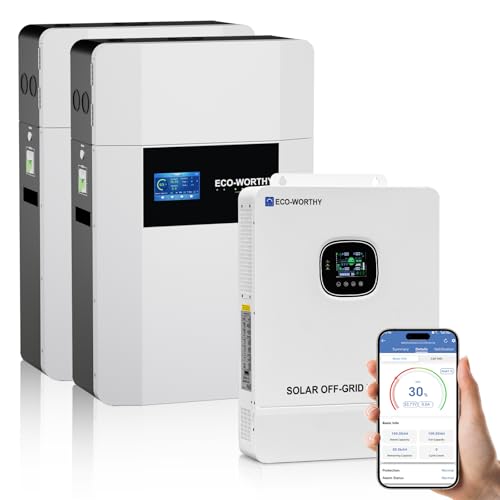
This system centers on a 10kW MPPT off-grid inverter paired with a 48V 100Ah LiFePO4 wall-mount battery. It supports 120V/240V output and can be paralleled with up to six inverters to reach 30kW. Batteries can be expanded by paralleling up to 32 units for a total capacity of up to 163.84 kWh. A 7-inch full-color display and Bluetooth/WiFi enable real-time monitoring, while RS485 and CAN support broad inverter compatibility. The design prioritizes home backup reliability and scalability.
Best for: homeowners who want a scalable, modular backup solution with future expansion potential and strong monitoring capabilities. Better for larger homes or small business backup workloads.
Caution: Parallel configurations add complexity; ensure proper electrical planning and safety clearances when expanding beyond a single unit.
SUNGOLDPOWER 10000W 48V Solar Inverter

The SUNGOLDPOWER SPH10048P provides 10,000W continuous power with up to 20,000W peak, built-in 2 MPPTs, and a maximum PV input voltage up to 500VDC. It supports split-phase 120V/240V or single-phase 120V output. A WiFi module enables remote monitoring and BMS integration for enhanced safety. The unit supports four charging/output modes, including Solar Priority and Hybrid modes, making it adaptable for varied solar-first or grid-tlexible setups.
Best for: users who want an all-in-one solution with flexible charging modes and remote monitoring. Ideal when you want a balanced system that can switch between solar-first and grid-assisted operation. Avoid this if you need a compact, ultra-simple setup.
Buying Guide: Key Purchase Considerations
- System size and needs: Calculate your peak load and daily energy consumption. Higher-watt inverters and larger battery banks are better for whole-house backup, workshops, or cabins with heavy appliances.
- Battery chemistry and safety: LiFePO4 is common for durability and safety. Look for active balancing, robust BMS protection, and circuit breakers.
- Inverter features: Check MPPT controllers, parallel-capable designs, and output configurations (single-phase vs split-phase) to match your home wiring.
- Monitoring and connectivity: Built-in WiFi/Bluetooth and mobile apps improve energy management, fault detection, and remote control.
- Expandability: If you plan to grow your system, prioritize products that support parallel units or larger battery arrays.
- Installation considerations: Ensure compatibility with your existing electrical panel, and consider professional installation for high-power systems.
- Safety and compliance: Verify certifications and adherence to local electrical codes, especially for high-output off-grid systems.
Frequently Asked Questions
- What is a solar inverter with battery storage?
Answer: It is a device that converts solar energy to usable AC power and stores excess energy in a battery for later use, enabling outages resilience and daytime-to-night energy management. - Can I run my entire home with a solar inverter and battery?
Answer: Yes, with appropriately sized inverter(s) and battery bank, but it requires careful calculation of loads and a scalable setup, often with parallel units for higher capacity. - Do all inverters support no-battery operation?
Answer: Some units offer solar-to-load operation without a connected battery, but performance varies with input voltage and system design. - Is LiFePO4 the best battery chemistry for home storage?
Answer: LiFePO4 offers safety, long cycle life, and stable performance, making it a common choice for home storage. - How do MPPT controllers affect charging efficiency?
Answer: MPPT controllers optimize the match between solar array voltage and battery charging, improving efficiency, especially under varying light conditions. - What should I consider when expanding a system?
Answer: Ensure parallel compatibility, wiring adequacy, thermal management, and safety clearances for additional units and batteries.