Best Solar Batteries for Homes to Maximize Home Power Reliability
Choosing the right solar battery system is essential for reliable home energy, especially during outages or high-demand periods. The following selection highlights five notable products that align with common residential solar goals, including capacity, safety certifications, ease of monitoring, and compatibility with solar inverters. Each option brings a different balance of portability, scale, and monitoring features to help homeowners compare effectively.
| Product | Brand | Key Benefit |
|---|---|---|
| Brightown 12-Pack Rechargeable AA Batteries | Brightown | High-capacity AA cells for solar lights and small devices |
| ECO-WORTHY Cubix 100 48V 600Ah Battery Kit | ECO-WORTHY | Large-scale LiFePO4 battery with networked monitoring |
| Jackery Solar Generator 1000 v2 | Jackery | Integrated power station with solar charging and long lifespan |
| EBL Solar AA Batteries 1300mAh | EBL | High-capacity, low self-discharge for outdoor solar lights |
| Anker SOLIX C1000 Gen 2 | Anker | Compact high-output power station with fast recharge |
Notes: This article focuses on consumer-friendly options suitable for home backup, off-grid camping-inspired use, and solar-powered devices around the house. Each product includes its own charging, output capacity, and monitoring features, helping homeowners plan for different energy scenarios—from everyday appliance use to emergency power readiness.
Brightown Rechargeable AA Batteries For Solar Lights
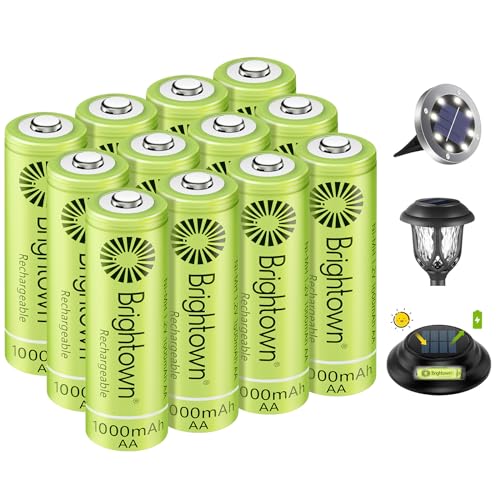
Brightown offers a 12-pack of rechargeable AA batteries with 1000mAh NiMH capacity. These cells are precharged to about 30% for transport safety and require charging before first use. The high capacity supports longer run times in solar-powered lights and other home devices, reducing the frequency of replacements. The battery’s design aims to withstand repeated recharge cycles, with a stated lifetime that can approach 1000 recharge events in typical usage. Homeowners may pair these with outdoor solar lighting to extend illumination while minimizing waste and ongoing costs.
Features highlight a balance between immediate readiness and long-term reuse, backed by a practical precharge approach and clear guidance on maintenance. The product emphasizes environmental considerations by offering a reusable alternative to disposable cells, which is a common preference in solar-powered home setups.
ECO-WORTHY Cubix 100 48V Battery Kit

The Cubix 100 kit from ECO-WORTHY represents a substantial home backup solution, featuring a 48V system and a 600Ah capacity per unit. This pack is designed for integration with solar inverters and supports advanced monitoring through CAN/RS485 interfaces and connectivity options like Bluetooth and WiFi. The kit carries UL1973 and UL9540A safety certifications, signaling careful attention to electrical safety and thermal management—critical considerations for residential installations. The system’s closed-loop communication and external rapid shutdown compatibility enhance safety and reliability for home energy storage and backup operations.
For homeowners seeking a scalable solution, the Cubix 100’s modular design makes it possible to expand storage according to energy needs, especially when paired with solar panels and home energy management systems. The product also notes a “Rack” offering to optimize space in a home or small-business setting, reinforcing its suitability for dedicated energy storage installations.
Jackery Solar Generator 1000 v2

The Jackery 1000 v2 is a portable power station designed for off-grid living, outdoor activities, and home backup. With a 1,070Wh LiFePO4 battery and a robust 1,500W continuous AC output (3,000W surge), this unit can run multiple appliances such as refrigerators, fans, and essential devices during outages or outdoor adventures. Notable features include one-hour fast charging for rapid top-ups via the Jackery app, plus long-term durability with an emphasis on battery health. The 10-year lifespan claim stems from the durability of LiFePO4 chemistry, with continued performance across many charge cycles, making it a versatile option for homeowners seeking reliable, ready-to-deploy power.
Practical considerations include the need for adequate solar input for ongoing recharges, the portability of the unit, and its compatibility with home inverters or mini-grid configurations. This product is well-suited for households that value a balance between portability and sustained energy during emergencies or outdoor use.
EBL Solar AA Batteries 1300mAh

EBL’s Solar AA batteries are designed to fit a wide range of outdoor solar lighting and everyday devices. With a 1300mAh NiMH capacity and 1.2V nominal voltage, these cells are marketed as pre-charged and ready for longer service life in solar-powered applications. The claimed low self-discharge and extended lifespan help ensure consistent performance between charges for garden lights, remote sensors, and other devices used in solar-powered setups. A focus on long-term capacity retention makes these batteries a practical choice for homeowners seeking dependable, rechargeable power for outdoor lighting and small electronics.
Considerations include how often the devices are used, the environmental conditions where the batteries operate, and whether the devices can benefit from higher-capacity cells to reduce the frequency of replacement or recharging cycles during peak solar production periods.
ZeroKor Portable Solar Generator With Panel

The ZeroKor solar generator kit combines a 300W portable power station with a 60W foldable solar panel. It includes multiple charging outlets, a DC port, USB ports, and an emergency flashlight, turning a compact unit into a convenient off-grid power source for camping and home backup. The system supports a range of devices yet cautions against exceeding its 300W continuous load, which is important for homeowners to plan around when sizing appliances and charging needs. The kit’s solar panel and power bank pairing makes it a flexible option for quick recharges using solar input, car power, or wall outlets.
From a safety and performance perspective, users should assess energy consumption patterns and whether a larger, more capable system would be necessary for full home backup or more demanding devices. The compact form factor makes it accessible for first-time buyers seeking a manageable entry into solar-powered backup solutions.
DaranEner Portable Power Station With 40W Solar Panel

The DaranEner 28,000 mAh LiFePO4 battery system positions itself as a compact yet capable portable power solution with a claimed 7-outlet configuration, including dual USB-C and USB-A ports, two AC outlets, and multiple charging options. The unit advertises a substantial all-day capacity of 89.6Wh and emphasizes two-way USB-C charging for flexible input and output. A built-in LED display assists with monitoring, and the design allows recharging via wall, DC, solar, or vehicle power sources. This model targets users who need a portable and versatile energy source for work sites, travel, or emergency readiness while keeping a relatively small footprint.
Considerations include the practicality of the total watts available for typical home devices, the reliability of LiFePO4 chemistry in daily use, and how well the unit integrates with existing solar setups or home backup strategies.
Buying Guide: Key Purchase Considerations For Home Solar Storage
- Chemistry and safety certifications: LiFePO4 chemistry tends to offer long life and stable performance, while safety certifications (such as UL standards) indicate appropriate safeguards for home installations.
- Capacity and power needs: For home backup, evaluate both energy capacity (Wh or Ah) and peak power (W). A higher continuous power rating supports running refrigerators, laptops, and essential devices during outages, while higher energy capacity extends runtime between charges or solar replenishment.
- Battery monitoring and integration: Look for systems with CAN/RS485, Bluetooth, or WiFi monitoring, especially if you plan to connect to a home energy management system or solar inverter for real-time status and alerts.
- SOLAR panel compatibility: Ensure that the capacity of solar panels and the charge controller are aligned with the battery system to maximize solar recharging, particularly during winter or low-insolation periods.
- Portability vs. stationary use: Portable power stations are ideal for camping and off-grid needs; larger rack-mounted kits are better for fixed home backup while providing scalable storage.
- Temperature and maintenance: High-temperature environments can affect battery life. Consider storage placement, ventilation, and maintenance requirements to preserve performance over years of use.
- Expansion and scalability: If you anticipate increased energy use or added solar capacity, choose a modular system that allows future expansion without complete replacement.
- Cost of ownership: Compare initial costs with expected lifetime, maintenance, and the number of recharge cycles. Reusable batteries reduce ongoing purchase costs for disposables and align with eco-friendly goals.
- Safety and installation: For larger residential setups, professional installation may be advisable to ensure proper wiring, grounding, and safety clearance, especially with high-voltage DC systems.