Best Sensor Switches for Lights to Save Energy and Improve Convenience
Sensor switches for lights bring hands-free control, energy efficiency, and improved safety to living spaces. Whether you’re upgrading a bathroom, garage, closet, or hallway, these occupancy or vacancy sensors automatically adjust lighting based on presence and ambient light. This guide highlights five top options from trusted brands, explains how to choose the right model for your wiring setup, and compares key features like neutral requirements, motion detection range, and installation ease. Use the summaries below to quickly identify models that fit your home’s wiring and lighting needs.
Summary of selected products
| Product | Brand | Key Feature |
|---|---|---|
| Lutron MS-OPS2-WH | Lutron | Single-Pole, Vacancy/Occupancy Sensor, No Neutral Required |
| Lutron MS-OPS2H-2-WH | Lutron | 2-Pack, Quiet Operation, Supports Any Bulbs |
| ECOELER Motion Sensor Switch | ECOELER | No Neutral Wire, Adjustable Occupancy/Vacancy Modes |
| ELEGRP PIR Sensor Switch | ELEGRP | No Neutral Wire, Grounding Required, Wide Compatibility |
| TOPGREENER TDOS5-HL-W-2PCS | TOPGREENER | No Neutral Wire, Occupancy/Vacancy Modes, Wall Plate Included |
Lutron Maestro MS-OPS2 White Single-Pole Sensor Switch

The Lutron MS-OPS2-WH is a compact motion-activated switch designed for indoor spaces like bathrooms, garages, and laundry rooms. It turns lights on automatically when motion is detected and off when the room is empty, helping to prevent lights from staying on unnecessarily. The device supports various bulb types and is suited for single-pole installations. Its occupancy and vacancy features enable straightforward energy savings, making it a practical upgrade for frequent use areas where hands-free control is beneficial.
Lutron Maestro 2-Pack MS-OPS2H-2-WH White Sensor Switch

This two-pack from Lutron pairs convenience with energy efficiency for multiple rooms. The MS-OPS2H-2-WH model provides automatic on/off control based on occupancy, making it ideal for adjacent spaces like bathrooms and closets. Users can rely on the sensor to manage lighting without constant manual toggling, while preserving compatibility with a broad range of lighting scenarios thanks to its adaptable design and straightforward installation.
ECOELER Motion Sensor Light Switch, No Neutral

The ECOELER model offers no-neutral operation, suitable for many existing wiring setups. It features adjustable occupancy and vacancy modes, letting you choose automatic-on or manual-on preferences. This switch detects presence to activate lights and is a solid option for bathrooms, closets, or garages focused on energy efficiency. It is UL and FCC listed, providing assurance of safety and compliance in typical residential installations.
ELEGRP Single Pole Occupancy Motion Sensor Switch
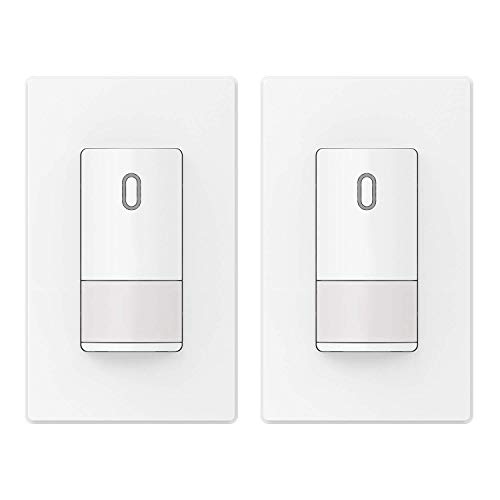
ELEGRP’s PIR sensor switch emphasizes grounding for reliable operation. The 120-degree motion field of view and adjustable sensitivity help tailor performance to room size and occupant patterns. Compatible with common bulb types, this switch suits CFL, LED, and incandescent fixtures. Grounding is a critical requirement for proper functionality, so installation should consider the electrical box’s grounding provisions to ensure optimal performance and safety.
TOPGREENER TDOS5-HL-W-2PCS Motion Sensor Switch

TOPGREENER’s TDOS5-HL-W-2PCS provides two switches with no neutral wire requirement and includes a wall plate. It supports occupancy and vacancy modes with adjustable time delays, enabling flexible control for rooms like hallways or utility areas. The installation is designed to be straightforward for single-pole circuits, and the product’s design emphasizes compatibility with a broad range of fixtures while enabling override options for manual control when needed.
Buying Guide
Key purchase considerations help determine the best sensor switch for your space and wiring setup:
- Neutral wire requirements: Some models operate without a neutral, which is important for older homes or simpler installations. If your box has a neutral, you can choose more options; if not, focus on no-neutral models.
- Motion detection and field of view: Larger rooms may benefit from wider coverage and higher sensitivity. Look for products describing 120 degrees or more and adjustable sensitivity when needed.
- Occupancy vs. Vacancy modes: Occupancy mode turns lights on automatically and off after a delay, while Vacancy mode requires manual turning on with automatic off. Your preference and local energy codes may influence the choice.
- Delay time and calibration: Time-delay settings ranging from seconds to several minutes determine how long lights stay on after motion stops. Choose based on room usage to avoid unnecessary cycling.
- Wiring compatibility and load rating: Check bulb compatibility (LED, CFL, incandescent) and the total wattage the switch supports. Ensure your electrical box can accommodate the switch’s wiring and grounding requirements.
- Mounting and aesthetics: Some models include wall plates and offer sleek, low-profile designs that blend with existing décor. Consider the finish and whether a neutral reference or dimming capability is needed.
- Installation ease and safety: For complex wiring or grounding needs, professional installation may be prudent. Read product manuals for wiring diagrams and safety notes before starting.
- Durability and regulation: Look for UL or FCC listings and well-known brands to ensure reliability in daily use and long-term performance.
In summary, selecting a sensor switch depends on your wiring availability (neutral vs no-neutral), room size, desired automation mode, and how much manual override you want. The reviewed options cover common installations—from single-pole rooms to multi-pack solutions—while prioritizing energy savings and straightforward setup.