Best Small Commercial Reverse Osmosis Systems for Businesses
For small businesses, restaurants, or light industrial needs, compact reverse osmosis (RO) systems can deliver high-purity water without bulky equipment. This guide highlights five reliable options designed for higher flow, efficient filtration, and easy monitoring. Each entry includes specifications, best-use scenarios, and key features to help you compare options for a busy operation.
Summary of selected products:
| Product | Brand | Approx. Output | Key Benefit |
|---|---|---|---|
| iSpring CRO1000 4-Stage Tankless Commercial RO | iSpring | 1000 GPD | Tankless, high flow, gauges, optional booster |
| iSpring RCS5T Commercial Tankless RO | iSpring | 500 GPD | 5-stage filtration, low waste ratio, booster |
| iSpring RCS5T+T20M | iSpring | 500 GPD | 5-stage + pre-pressurized tank option |
| Frizzlife PD1000-TAM4 | FRIZZLIFE | 1000 GPD | 9-stage filtration, alkaline remineralization |
| Waterdrop G3P600 | Waterdrop | 600 GPD | 8-stage filtration, tankless, smart faucet |
iSpring CRO1000 1000 GPD Tankless Commercial RO

The iSpring CRO1000 is designed for commercial use with a high output of 1,000 GPD and a tankless design that provides on-demand purified water at about 0.7 GPM. Built-in inlet and outlet gauges simplify pressure monitoring, and it supports an optional PMP1000 booster pump for operations with lower incoming pressure (below 80 psi). Its filtration includes a 20″ x 4.5″ PP sediment filter, two 20″ carbon block filters, and a 1,000 GPD RO membrane housed in stainless steel for durability. This unit is suitable for small restaurants, cafés, and light industrial settings that require steady, reliable performance.
Key considerations: Tankless design saves space but may depend on adequate water pressure. The booster pump option can help maintain production in lower-pressure scenarios. The system reduces a broad range of contaminants and aims to deliver consistent filtered water for drinking or process use.
iSpring RCS5T Commercial Tankless RO with 1.5:1 Pure to Drain
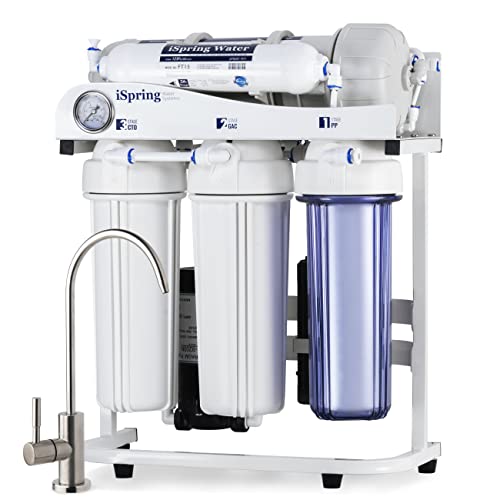
The iSpring RCS5T delivers 500 GPD from a 5-stage filtration lineup that targets PFAS (including PFOA and PFOS), rust, sediment, chlorine, disinfection byproducts, and odors. The RO membrane handles heavy metals and pesticide residues, while the fifth stage improves taste by removing residual chlorine. The system emphasizes high capacity with a favorable 1.5:1 pure-to-drain ratio and includes a built-in booster pump to compensate for low water pressure, making it a strong fit for light commercial environments like restaurants, salons, offices, and labs seeking reliable, high-quality RO water.
Considerations include ensuring adequate incoming pressure for optimal performance and monitoring waste ratios to manage water use effectively in a busy setting.
iSpring RCS5T+T20M 500 GPD with 20-Gallon Tank

This variant combines a 500 GPD RO system with a 20-gallon pre-pressurized tank, enhancing storage and delivering consistent water flow during higher demand periods. The setup includes the same 5-stage filtration as the RCS5T, with the added benefit of a pressurized tank for steadier supply. It is well-suited for small commercial environments like salons, offices, labs, and light food-service operations that need reliable filtration and a predictable water supply.
Key notes: Tanked configuration can ease peak-demand pressure drops. The 60% water savings claims reflect improved efficiency, but actual performance will depend on feed water quality and pressure. Booster compatibility helps with low-pressure conditions.
FRIZZLIFE PD1000-TAM4 1000 GPD Tankless RO System

The Frizzlife PD1000-TAM4 is a high-capacity 9-stage tankless RO water filtration system designed to remove more than 1000 contaminants with a 0.0001-micron membrane. It includes alkaline remineralization (TAM4) to raise pH and restore essential minerals, producing water with balanced taste and mineral content. The system is certified for lead-free materials and meets multiple NSF/ANSI standards. A tankless design enables space efficiency, while a robust filtration stack targets heavy metals, PFAS, chlorine, fluoride, arsenic, TDS, VOCs, and more. Suitable for small to mid-sized commercial spaces needing premium filtered water on demand.
Considerations include ensuring proper wiring and plumbing for a tankless configuration and monitoring the post-filter remineralization for desired mineral balance in finished water.
Waterdrop G3P600 8-Stage Tankless RO System

The Waterdrop G3P600 is an 8-stage, tankless RO system designed for under-sink installation with a compact footprint. It features certified reductions against multiple contaminants including chlorine, lead, PFAS, and heavy metals, with a 2:1 pure-to-drain ratio and a smart LED faucet showing real-time filtration data. Tankless operation keeps the unit slim for spaces where counter or cabinet space is at a premium. The system is suitable for small offices, cafes, and labs that prioritize compact design without sacrificing filtration quality.
Important considerations include confirming that the faucet and display interface meet your preferences and that the 600 GPD rate aligns with your daily demand and peak usage patterns.
Buying Guide for Small Commercial RO Systems
- Output and demand: Match GPD capacity to your peak daily needs. Tankless designs save space but may require stable incoming water pressure; consider booster pumps for low-pressure feeds.
- Filtration stages: More stages generally yield better contaminant removal and mineral balance. For commercial uses, 5–9 stages are common, depending on water quality and target contaminants.
- Tank vs. tankless: Tank systems store reserve water, helpful during rush periods; tankless units deliver on-demand water but may be sensitive to pressure fluctuations.
- Filtration quality and certifications: Look for NSF/ANSI certifications and third-party testing for reliability, especially if serving drinking water.
- Maintenance and parts availability: Check filter replacement frequency, availability of replacement membranes, and ease of service.
- Space and installation: Tankless systems save space but require proper mounting, electrical supply, and plumbing clearances. Tank systems may need dedicated space for tanks and filters.
- Water quality goals: Consider remineralization or pH adjustment if your application needs balanced mineral content or taste improvements.
- Cost of ownership: Factor in filter/membrane replacement costs, energy use, and potential water wastage. Some models advertise favorable pure-to-drain ratios to reduce waste.
All listed options provide robust filtration for small commercial environments. When selecting, prioritize peak demand handling, space constraints, and your local water quality to ensure consistent, high-purity output for your business needs.