Best 110 Amp Hour Marine Battery Solutions for Boats
For boaters who demand dependable, long-lasting power on the water, 110 amp hour (AH) marine batteries offer extended runtime for trolling motors, lighting, and onboard electronics. This guide highlights five top options, including legacy sealed lead-acid and modern LiFePO4 designs, to help you compare capacity, weight, cycle life, and charging behavior. Each product below is tailored for marine use and supports sustained performance in demanding conditions. Use the summary table to quickly scan core specs, then dive into detailed sections to understand suitability for your vessel.
| Product | Type | Approx. Capacity | Key Benefit |
|---|---|---|---|
| WattCycle 12V 100Ah LiFePO4 (B0DJXRFBRB) | LiFePO4 | 100 Ah | High cycle life; built-in Bluetooth monitor; 110A BMS |
| WattCycle 12V 100Ah Lithium Battery (B0DRFSVDWX) | LiFePO4 | 100 Ah | Direct-fit Group 31; 110A BMS; remote monitoring |
| MOSEWORTH 12V 100Ah LiFePO4 | LiFePO4 | 100 Ah | Triple protection; fast charging; expandable in parallel |
| Interstate Batteries Marine Deep Cycle 12V 100Ah (31-AGM5) | AGM Lead-Acid | 100 Ah | Extreme deep-cycle power; 3x longer life than conventional |
| Redodo 12V 100Ah Bluetooth Dual-Purpose 900CCA | LiFePO4 | 100 Ah | Bluetooth monitor; 900 CCA; OTA updates |
WattCycle 12V 100Ah LiFePO4 Battery, 110A BMS

The WattCycle 12V 100Ah LiFePO4 battery is designed as a drop-in replacement with Group 31 dimensions, offering a lighter weight with more usable capacity than traditional lead-acid designs. Its 1280Wh rating supports longer runtimes for marine systems, including trolling motors and auxiliary electronics. A built-in 110A Smart BMS provides protections against overcharge, over-discharge, overcurrent, short circuits, and temperature fluctuations. This model emphasizes long cycle life and reliable performance under high-demand conditions on water.
WattCycle 12V 100Ah Lithium Battery (B0DRFSVDWX)

This WattCycle model also offers a 100Ah LiFePO4 configuration with a Group 31 fit and a robust 110A BMS. The battery is engineered for high-efficiency energy delivery with stable voltage across cycles, making it well-suited for marine RVs, trolling motors, and off-grid boat setups. Users benefit from healthy charging curves and the ability to monitor health through compatible apps, ensuring power remains available when needed on the water.
MOSEWORTH 12V 100Ah LiFePO4 Marine Battery
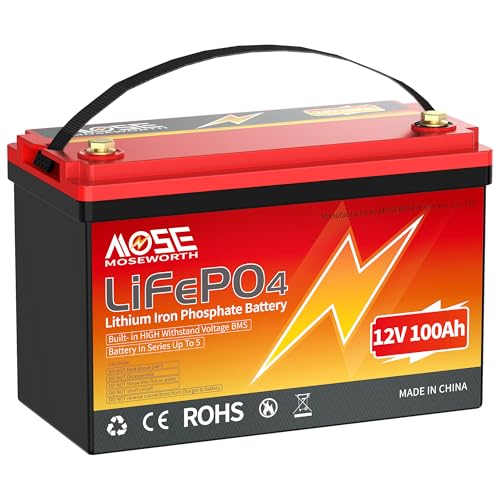
The MOSEWORTH 100Ah LiFePO4 unit emphasizes safety with an advanced triple-protection BMS, including low-temperature cutoff, high-temperature protection, and overcharge/over-discharge safeguards. It supports fast charging, with a compact footprint suitable for tight spaces on small boats. The product is expandable by connecting additional cells in parallel for higher capacity, and it is designed to deliver consistent voltage in demanding marine environments.
Interstate Batteries Marine Deep Cycle 12V 100Ah AGM

This Interstate deep-cycle AGM battery is engineered for rugged marine use, combining high-cranking power with deep-cycle capabilities. It features thick plates to support long discharge cycles and reliable recharges, delivering a practical balance of starting power and sustained operation for trolling motors, lighting, and accessories. The design aims to endure the harsh marine environment while maintaining performance across trips.
Redodo 12V 100Ah Bluetooth Dual-Purpose 900CCA

Redodo combines dual-purpose capability with Bluetooth connectivity for real-time status monitoring and energy management. With 900 CCA and 1000 MCA ratings, this LiFePO4 option combines strong starting power with deep-cycle capacity, suitable for boats equipped with outboard engines and electronic accessories. The included OTA update capability enables remote feature enhancements as technology evolves on the water.
Buying Guide: Key Purchase Considerations
When selecting a 110 AH marine battery, consider the following perspectives to align with your boat, usage, and maintenance preferences:
- Battery Chemistry: LiFePO4 batteries offer long cycle life, lighter weight, and deeper discharge capabilities, but at a higher upfront cost. AGM lead-acid options are generally heavier but may be more familiar and compatible with older systems.
- Weight and Space: Lithium options can significantly reduce weight, improving efficiency and handling. Measure available space to confirm a proper fit, especially for compact hull layouts.
- Cycle Life and Durability: Deep-cycle designs prioritize durability for repeated charge/discharge cycles. BMS quality impacts protection against overcharge, over-discharge, and temperature fluctuations on the water.
- Charging Compatibility: Check charging profiles and solar compatibility if you use solar or shore power. Some batteries support fast charging, while others prioritize longevity.
- Monitoring and Connectivity: Built-in Bluetooth or app-based monitoring helps you track state of charge, health, and temperature. OTA update capabilities can extend functionality over time.
- Maintenance Requirements: Lead-acid AGM batteries generally require less frequent maintenance but may need water top-offs in some designs. LiFePO4 packs are low-maintenance but require compatible charging gear.
- Cost vs. Runtime: Higher upfront costs for LiFePO4 are often offset by longer life and lighter weight. Evaluate total cost of ownership across typical boating seasons.
- Warranty and Support: Manufacturer warranties and availability of replacement cells or service influence long-term reliability on the water.
In summary, the five highlighted options provide a mix of LiFePO4 and AGM designs, each with strengths in capacity, monitoring, and practicality for marine use. Your choice should balance weight, space, runtime needs, and compatibility with your boat’s existing electrical system and charging setup.