Best Ship-to-Shore Power Transfer Switches for RVs and Boats
The buyer intent is clear: you need reliable transfer switches that safely switch between shore power and an auxiliary power source (inverter, generator, or battery system) for RVs, boats, or campers. This guide highlights five solid options, explains who each is best for, and notes practical limitations. Use this to compare compatibility, ease of installation, and safety features before purchasing.
| Product | Best For | Key Benefit |
|---|---|---|
| Renogy 30Amp Transfer Switch | RVs, campers, off-grid setups | Broad compatibility with inverters and shore power |
| Sekelo AC Rotary Transfer Switch | Boats and yachts needing reverse polarity safety | Break-before-make for safe switching |
| Lizixny 30 Amp Manual Transfer Switch | Mobile and off-grid vehicles | 3-position shore/off/gen with 120/240V support |
| Nirakoka 30 Amp Automatic Transfer Switch | RV and marine use with automatic switching | Automatic source switching and two-input management |
| KUTTOLE 50 Amp Automatic Transfer Switch | High-demand RVs or boats | Dual protection and 240V capability for heavy loads |
Renogy 30Amp Transfer Switch For Shore Power

Best for RVs and off-grid campers that use shore power alongside a solar inverter. This switch automatically transitions between main and backup sources to maintain uninterrupted power. It is designed to work with 1000W–3000W pure sine wave inverters and other battery systems. The unit’s ABS body supports outdoor use in challenging environments.
Who it’s best for: RV owners and campers needing seamless power shifts without manual intervention. Why chosen: robust construction, broad inverter compatibility, and automatic switching reduce risk of backfeed and power gaps. Caution: ensure wire gauge and enclosure fit your space, as real-world installation can require precise mounting.
Sekelo AC Rotary Selector Switch Panel
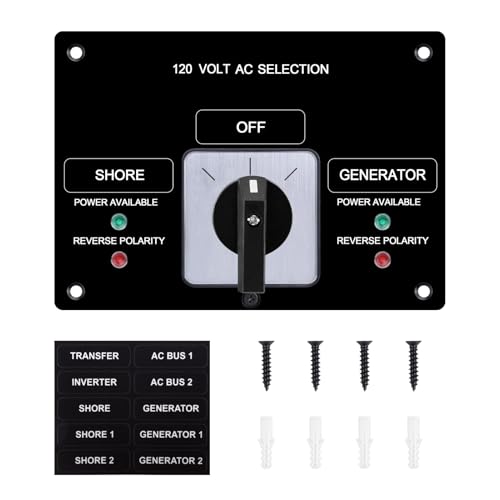
Best for boats and yachts requiring a heavy-duty, break-before-make transfer with clear polarity indicators. This 2-position shore generator switch helps prevent cross-connection between sources and uses a robust copper-based rotary mechanism with a silver alloy contact for durability.
Who it’s best for: boat owners prioritizing safety and reliable source separation. Why chosen: the break-before-make design minimizes backfeed risks, and the reverse polarity indicator aids dock-side safety. Caution: installation relies on accurate wiring diagrams; miswiring can compromise safety.
Lizixny 30 Amp Manual Transfer Switch

Best for mobile and off-grid power setups that demand a practical 3-position design (Shore/Off/Gen). The unit supports both 120V and 240V AC and uses industrial-grade materials with multiple terminals for versatile wiring.
Who it’s best for: RVs, motorhomes, boats, or campers seeking a simple manual transfer. Why chosen: clear three-position control reduces accidental backfeed; 12-terminal layout supports reliable, durable wiring. Caution: heavier-duty wiring may be required for higher loads, and manual operation means user oversight is needed during transitions.
KUTTOLE 50 Amp Automatic Transfer Switch

Best for high-demand RVs or boats with dual 120/240V power sources. The automatic switch prioritizes generator power and provides dual protection against simultaneous inputs. It is designed for 50A service and supports 240VAC operation with a neutral current of up to 70A.
Who it’s best for: larger installations with higher power needs or where generator backup is frequent. Why chosen: automatic prioritization and protective interlocks help prevent dangerous simultaneous-source conditions. Caution: higher amperage means larger enclosure and potentially more complex installation.
Buying Guide: Key Considerations for Ship-To-Shore Power Transfer Switches
- Power rating and voltage: Verify the system’s voltage (120V vs. 240V) and current needs. Choose a switch that comfortably handles the maximum load with room to spare.
- Automatic vs. manual: Auto-switching provides seamless transitions but may be unnecessary for simple setups; manual units are cheaper and straightforward.
- Safety features: Look for break-before-make designs, reverse polarity indicators, and interlocks to prevent backfeed and cross-connection.
- Compatibility: Check compatibility with inverters, generators, and shore power sources. Ensure the switch supports your inverter’s waveform type (pure sine wave is common for critical devices).
- Durability: Outdoor or marine installations benefit from weather-resistant enclosures and corrosion-resistant materials.
- Installation considerations: Some units require professional wiring, proper enclosure sizing, and adherence to electrical codes. Factor in space, mounting, and cable gauges.
Frequently Asked Questions
- What is a ship-to-shore transfer switch?
A device that automatically or manually switches electrical load between shore power and an onboard power source (inverter, generator, or other) to prevent backfeed and maintain continuous power.
- Do I need an automatic or manual transfer switch for an RV?
Automatic switches offer seamless power transitions, which are beneficial for uninterrupted appliances. Manual switches are simpler and cheaper when automatic functionality is not required.
- Can I install these switches myself?
Some models are designed for DIY installation with clear wiring diagrams. Others may require professional electrical installation to meet safety standards and local codes.
- What amperage should I choose for a high-demand RV or boat?
Choose a switch that matches or exceeds your maximum draw. For heavy loads, a 50A or higher unit provides more headroom than a 30A model.
- Are break-before-make switches safer?
Yes. Break-before-make prevents simultaneous connection of two sources, reducing the risk of backfeed and potential faults.
- Will these switches work with 120V and 240V systems?
Many are rated for both, but always verify the voltage rating and compatibility with your particular shore power and inverter configuration.