Best Reverse Osmosis Commercial Systems for Businesses
Answering your search for reliable, high-capacity filtration, these commercial RO systems deliver consistent output for restaurants, laboratories, hotels, and light industrial use. This guide highlights five strong options, with best uses, benefits, and practical cautions to help buyers choose wisely. Each entry notes who it’s best for and why it stands out, along with a clear caveat when applicable. A quick comparison table is included below to help you scan core specs at a glance.
| Product | Best For | Output (GPD) | Notes |
|---|---|---|---|
| iSpring CRO1000 | High-volume commercial venues (restaurants, small businesses) | 1000 | Tankless, on-demand water; booster pump recommended for low pressure. |
| iSpring RCS5T | Restaurants, salons, labs needing stable supply | 500 | Low-waste 1.5:1 ratio; includes booster pump. |
| ecoviva RO1000G | High-volume offices or facilities with quiet operation needs | 1000 | German sealed design; true commercial-grade with no bulky tank. |
| Oceanic RO/DI 300-800 | Aquarium facilities, labs requiring very clean water | 300-800 | RO+DI path; booster pump included. |
| iSpring RCC7 | Under-sink retrofit for larger homes or light commercial use | 75 | Top-mounted faucet; NSF/ANSI 58 certified. |
iSpring CRO1000 4-Stage Tankless Commercial RO System

The CRO1000 offers true commercial-grade performance with a 1,000 GPD output. Its tankless design provides on-demand clean water with a flow rate around 0.7 GPM. Built-in inlet and outlet gauges simplify pressure monitoring, and an optional PMP1000 booster pump is advised for pressures below 80 psi (recommended range: 80-130 psi). Best for busy restaurants, light industrial sites, or medical offices needing steady supply without a storage tank.
Why chosen: It combines high flow, robust filtration, and easy monitoring in a compact, tankless frame ideal for spaces with limited storage. A potential limitation is the need for a booster pump in some water conditions, which adds installation considerations.
Best for: High-demand venues where continuous purified water matters and space is a premium.
Caution: If your water pressure is consistently above 130 psi, verify compatibility with existing plumbing to avoid excessive system strain.
iSpring RCB3P Tankless RO Filtration System

This under-sink system provides up to 300 GPD with a 1.5:1 pure-to-drain ratio and includes a booster pump and pressure gauge. It removes more than 99% of contaminants, including PFAS, lead, chlorine, fluoride, arsenic, and more. With a freestanding stainless frame and mounting options, it’s suited for residential kitchens as well as light commercial use where installation flexibility is important.
Why chosen: Strong contaminant removal and compact footprint make it a versatile option for business owners who need reliable RO water without a large footprint. Best for facilities that require a robust under-sink setup rather than a full countertop unit.
Best for: Small offices, beauty salons, and cafés needing dependable RO water at point-of-use.
Caution: Installation may require professional plumbing for optimal line routing and space planning.
iSpring RCS5T Commercial Tankless RO System
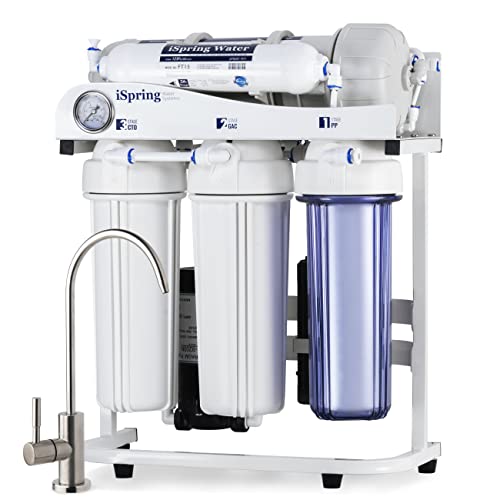
The RCS5T delivers 500 GPD with a 1.5:1 pure-to-drain ratio and a built-in booster pump. Its 5-stage filtration includes PFAS removal in the early stages, followed by a high-quality RO membrane that targets heavy metals and pesticides, and a final stage for chlorine reduction and taste improvement. This makes it well-suited for restaurants, salons, labs, and offices that require reliable, high-quality RO water with relatively low waste.
Why chosen: The 5-stage configuration provides broader contaminant reduction, including PFAS and heavy metals, while preserving water efficiency. Best for environments where water quality is critical and space is a consideration.
Best for: Light commercial settings like small clinics, labs, or offices that need consistent, high-quality water.
Caution: The 60% reduction in water waste is contingent on installation conditions; ensure adequate waste line routing.
ecoviva RO1000G Tankless 9-Stage Commercial RO

The ecoviva RO1000G is a true commercial-grade, tankless RO system delivering 1,000 GPD at 0.7 GPM. It features a 3:1 pure-to-drain ratio and a working pressure range of 80-130 psi. The German-sealed design minimizes vibration and noise, and the unit carries NSF/ANSI 58/53/42/61/372 certifications for broad contaminant reduction. This system is built for high-volume use with durable, long-lasting components.
Why chosen: It combines high output with quiet operation and a robust seal design, making it suitable for busy facilities needing reliable water with minimal noise. Best for offices, factories, or kitchens where space, noise, and reliability matter.
Best for: High-volume environments that require discreet, continuous RO water without a bulky tank.
Caution: The sealed design, while quiet, requires careful installation to ensure all seals remain effective over time.
Oceanic Commercial RO/DI Water Filtration System
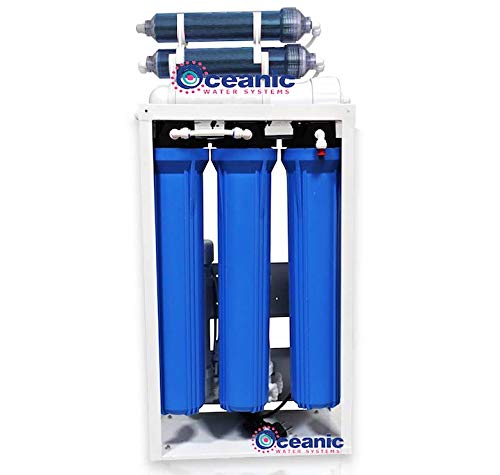
This commercial-grade RO/DI setup provides hundreds of gallons per day with a booster pump to enhance production. It removes 99% of contaminants and delivers 0 TDS water after DI treatment—ideal for aquariums, laboratories, and facilities requiring ultra-pure water. The booster pump helps maintain consistent output even with fluctuating water pressure.
Why chosen: The combination of RO and DI stages makes it particularly suited for environments that demand ultra-pure output, such as labs or aquariums. Best for facilities needing precise TDS control and dependable production.
Best for: Aquariums, research labs, and facilities requiring consistently ultra-pure water.
Caution: DI stages require periodic resin replacement to maintain total deionization performance.
iSpring RCC7: 5-Stage Under-Sink RO System

The RCC7 is NSF-certified and provides 75 GPD with a 5-stage filtration process. It reduces more than 1,000 contaminants by up to 99% and reduces TDS by 80-90%. A top-mounted faucet and transparent first-stage housing simplify installation and monitoring. It is designed for under-sink use and is suitable for households and small-scale commercial installations where space is limited.
Why chosen: While not a high-capacity unit, it offers reliable purification for smaller spaces with straightforward maintenance. Best for small offices or homes expanding into better water quality without significant capital expenditure.
Best for: Small businesses or households needing reliable, compact RO water at the point-of-use.
Caution: Output is significantly lower than larger commercial units; plan for higher-demand periods accordingly.
Buying Guide: Key Considerations for Commercial RO Systems
- Water demand: Estimate peak daily gallons and choose a system with ample capacity to avoid shortages during busy periods.
- Pressure and flow: Check working pressure requirements and whether a booster pump is included or recommended for your water supply.
- Contaminant targets: Compare approved contaminants removed (PFAS, heavy metals, chlorine, nitrates, etc.) to your water concerns.
- Tank vs. tankless: Tankless designs save space and reduce storage but may require more complex installation and monitoring.
- Wastewater and efficiency: Consider the RO-to-wastewater ratio and any built-in return or low-waste features for sustainability.
- Certifications and safety: NSF/ANSI certifications and sealed designs can indicate reliability and safety in handling drinking water.
- Installation and maintenance: Assess ease of filter changes, monitoring tools, and whether professional installation is advisable.
Frequently Asked Questions
- What is the difference between tankless and tank-based commercial RO systems?
Answer: Tankless units provide on-demand purified water with no storage tank, saving space, while tank-based systems store filtered water and may be simpler to install in some layouts. - Which contaminant removals are common in commercial RO systems?
Answer: Common removals include lead, chlorine, fluoride, PFAS, arsenic, asbestos, nitrates, and various heavy metals. - Do all commercial RO systems require a booster pump?
Answer: Not always, but many systems recommend a booster pump to maintain optimal pressure and production, especially in older or low-pressure water supplies. - How do I know which system fits my business needs?
Answer: Compare daily output, pressure requirements, contaminant targets, space constraints, and total cost of ownership, including maintenance and potential upgrades. - Are these systems certified for drinking water?
Answer: Several listed options come with NSF/ANSI certifications, indicating compliance with safety and quality standards for drinking water. - What maintenance is typical for RO systems?
Answer: Regular filter changes, membrane checks, and occasional pump or seal inspections are common; consult product manuals for exact intervals.