Best 7000 Watt Portable Generator Guide: Top Open-Frame and Inverter Choices
Answer: For reliable 7000-watt portable power, choose open-frame inverter generators or high-output inverter models that deliver clean power for sensitive electronics and heavy appliances. This guide highlights five top options, clarifying who each is best for, plus practical caveats. Ideal buyers include homeowners needing backup power, RVers requiring high surge capacity, and contractors needing portable high-wattage power.
The following table summarizes the five selected models, focusing on wattage, key features, and ideal use cases.
| Product | Best For | Key Benefit | Approx. Runtime |
|---|---|---|---|
| PowerSmart 7000-Watt Open Frame Inverter Generator (PS5055C) | Home backup and RVs requiring dual voltage | Clean power for sensitive electronics; electric start | About 6 hours at 50% load |
| PowerSmart 7000-Watt Open Frame Inverter Generator (PS5055C variant) | Heavy-duty use with dual-voltage | Strong surge performance; easy start | About 6 hours at 50% load |
| PowerSmart 7000W Open Frame Inverter Generator (322cc OHV) | Power users needing 120/240V flexibility | Large surge and clean sine wave | About 6 hours at 50% load |
| Honda EU7000iS 7000 Watt Inverter Generator | Quiet camping, RV, and home backup | Very quiet operation; Bluetooth app support | Up to 16 hours on certain loads |
| WEN 6800-Watt Dual Fuel RV-Ready (DF680iX) | RV or light home backup with dual fuel | Dual fuel flexibility; CO watchdog | Depends on fuel type and load |
PowerSmart 7000-Watt Open Frame Inverter Generator (PS5055C)

Best for: Home backup and off-grid camping where 120/240V dual voltage is needed. This model delivers a 7000W surge and 6000W running power with a clean sine wave (<3% THD), suitable for laptops, phones, and other sensitive electronics, while also running heavy appliances during outages. It features an electric push-button start (battery included) and a 322cc OHV engine for steady runtime. The 120/240V selector supports transfer switch compatibility and RV 50-Amp service. A short warm-up is advised before connecting high-wattage loads to stabilize the inverter and engine. Common caveat: startup stability matters for simultaneous high-load devices on some loads; plan to stagger initial connections if needed.
Who this is best for: Homeowners needing reliable backup with whole-house transfer compatibility, and RV users who require a robust dual-voltage generator for high-wattage appliances. Why selected: It combines high surge with clean power, plus practical electric start for quick deployment.
PowerSmart 7000-Watt Open Frame Inverter Generator (Second Model)
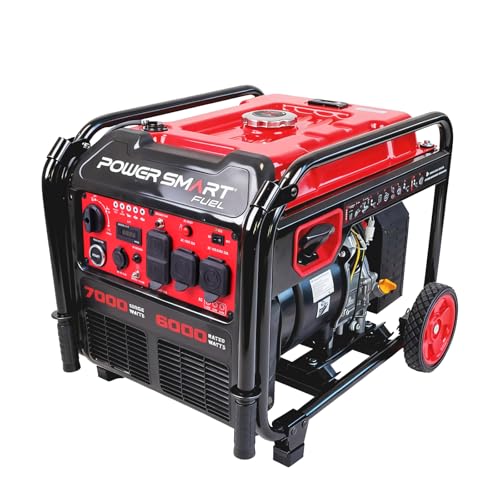
Best for: Camping and temporary job sites needing 120/240V power with clean sine wave. This unit mirrors the first model’s specs—clean power for sensitive electronics and reliable engine performance. It’s well-suited for overnight use due to a similar 6-hour runtime at moderate loads. Better for: Users who want a rugged open-frame design combined with inverter reliability for mobile power needs. Limitation: Open-frame design can be noisier than enclosed units in some environments.
PowerSmart 7000W Open Frame Inverter Generator (322cc OHV, Third Model)
Best for: Scenarios requiring higher surge capacity and 120/240V versatility for well pumps, central AC, or heavy-duty tools. This model emphasizes a robust 322cc engine and a clean sine wave output. It’s a strong pick for those needing dependable backup with quick electric start. Choose this if you need reliable power for short, intense outages. Caution: ensure your startup sequence matches the recommendation to avoid overload when connecting multiple high-watt devices simultaneously.
Honda EU7000iS 7000 Watt Inverter Generator

Best for: Quiet camping, RV trips, and home backup where low noise is essential. The EU7000iS uses advanced inverter technology for clean power and is unusually quiet (52–58 dB). It supports remote operation via Honda’s My Generator app with Bluetooth. The runtime can reach up to 16 hours under certain loads, making it a practical choice for longer outages or extended outdoor events. Limitation: higher upfront cost relative to some competitors, but cost is often offset by reliability and quiet operation.
Oxseryn Power Equipment 4400 Watts Inverter Generator

Best for: Smaller-scale RV trips or emergency home backup when budget or space is a constraint. This unit offers 4400 peak watts and 3400 running watts with ECO mode and RV-ready outputs. It’s a compact, lighter option compared to 7000W-class models. Consider: It does not meet the 7000W target but provides compact high-efficiency power for lighter setups and portability. Caution: not ideal for high-wattage appliances or whole-house backup.
WEN 6800-Watt Dual Fuel RV-Ready DF680iX

Best for: RV enthusiasts and homeowners needing dual-fuel flexibility with a CO watchdog for safety. The DF680iX delivers 6800 surge and 5100 running watts on gasoline, with propane operation for longer run times and cleaner emissions. It features a bonded-neutral 240V configuration for Level 2 charging and automatic CO shutdown. Limitation: slightly under the 7000W target, but still a high-output option with practical dual-fuel versatility.
Buying Guide
What matters most in a 7000-watt portable generator
- Power needs: Evaluate your startup surge and running watts. A model with 7000W surge and around 6000W running is ideal for mixed loads, including HVAC, refrigerators, and electronics.
- Power type: Open-frame vs. enclosed inverter. Open-frame units are typically more rugged and easier to repair, while enclosed units tend to be quieter and portable for camping.
- Voltage and outlets: Look for 120/240V capability and a mix of outlets (AC, 12V DC, RV). This affects transfer-switch compatibility and RV service readiness.
- Starting method: Electric start simplifies ignition, and recoil backup is useful if the battery fails. Consider fuel capacity and runtime at 50% load.
- Fuel type and efficiency: Gasoline engines are common; dual-fuel variants offer flexibility and longer runtimes in emergencies.
- Safety features: CO detectors, shutoff sensors, and overload protection help prevent accidental damage or hazards.
- Noise and footprint: Quieter models are preferable for camping or neighborhoods; balance with power needs and price.
How to Choose Between Models
- Best for quiet camping: Honda EU7000iS for low noise and app monitoring.
- Best for full-home backup: PowerSmart PS5055C variants with 120/240V dual voltage and transfer-switch readiness.
- Best for budget dual-fuel flexibility: WEN DF680iX for Level 2 EV charging support and dual fuel.
- Best for rugged RV use: Open-frame PowerSmart models offering high surge and straightforward maintenance.
Maintenance and Safety Tips
- Run new units for a short period to ensure oil and fuel lines are properly seated before heavy use.
- Store fuel in approved containers and follow local regulations for storage. Use stabilizers for longer storage.
- Regularly inspect spark plugs, air filters, and battery health for electric-start models.
- Follow manufacturer guidance for load sequencing to avoid tripping breakers during startup.
FAQ
- What is a “7000W surge” vs “6000W running”?
Surge watts indicate the maximum power the generator can provide for a short time to start heavy loads. Running watts show continuous power output. Choose a model with surge well above the largest initial load in your setup.
- Do I need dual voltage (120/240V) for home backup?
Dual voltage supports whole-house transfer and compatibility with larger appliances. It is recommended if you plan to power a transfer switch for a full-home or larger RV setup.
- Is inverter power safer for electronics?
Yes. Inverter generators produce a cleaner sine wave with low Total Harmonic Distortion, reducing risk to sensitive devices.
- What maintenance is essential for gas-powered generators?
Regular oil changes, air-filter checks, spark plug replacement, and battery maintenance for electric-start units are essential to ensure reliability.
- How long can these generators run continuously?
Runtime depends on load and fuel capacity. Typical 50% load runtimes range from about 5 to 8 hours for many 7000W-class units; some models offer longer runtimes at lighter loads.
- Are there safety considerations with CO detectors?
Yes. CO detectors or integrated shutdown features protect occupants by automatically turning off the unit if dangerous gas levels are detected.